
Free Grade 6 mathematics teaching kit
Compare Unit Rates on the Same Basis
Current teacher guidance: 2 November 2026. Student tasks retain their stated core editions. Use the current stage choices and matching guide below.
Changes in the current files · 2 November 2026
- The teacher guide includes annotated fictional sound, partial and error responses, with concrete teaching actions and evidence to seek next.
Prepare the materials
Prepare this lesson or activity
Recommended selection edition 1.0.0. Original source files retain their displayed editions.
Use the matching guide to choose a response to the work you observe. Clarify access and task wording first; one response is not a diagnosis. Keep independent work, later tasks and answers aside until their intended use.
Current teacher guidance: 2 November 2026. Student tasks retain their stated core edition; use the matching current guide linked here. Earlier files are kept separately in the archive.
- Audience / fit
- Grade 6 math
- Teaching or planning target
- Choose a defensible comparison by finding rates with the same units and direction, then interpret the result for the stated goal.
- Essential prerequisites
- For Grade 6 mathematics. Begin here when students can interpret a requested unit rate and its units. Otherwise, start with Find and Interpret “Per One”.
- Preparation
- Read the Start Here selections; preparation time depends on the selected route.
- Use time
- Use the teacher guide to plan the selected route
- Materials
- Paper and pencil. Optional counters for equal groups. No device, purchase, account or email is needed.
- What to print
- Print the chosen activity. Follow the source or reveal instructions beside it.
Evidence to notice: Look for rates expressed on a common basis, with the compared quantities and units kept clear.
Preview the actual student page
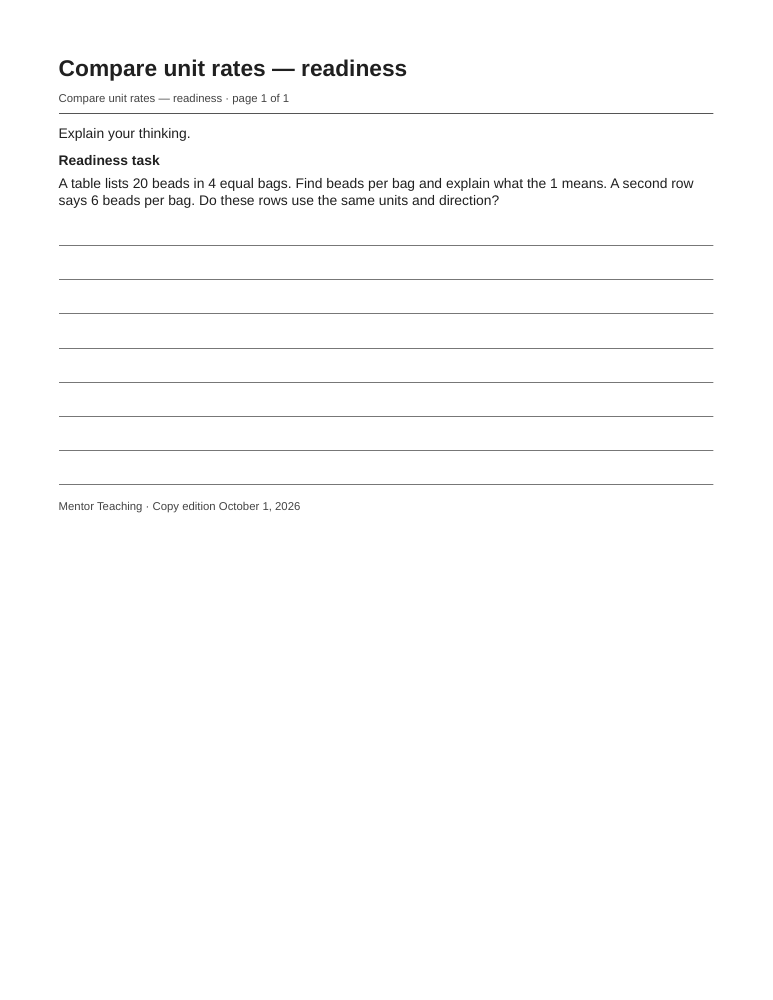
Start with the selected task
Matching teacher guide and answers — keep separate: Matching teacher guide and answers · 19 pages.
Compare the observed response with the guide’s criteria. Clarify access and wording, then use its conditional directions to choose an activity below. Follow-up and later tasks are not interchangeable test forms.
Teaching stages, response practice and later checks
Starting tasks
- Readiness check only · 1 page
PDF · Editable Word · Read in browser
Teaching and guided practice
- Model and guided practice · 2 pages
PDF · Editable Word · Read in browser
Independent responses
- Independent check · 2 pages
PDF · Editable Word · Read in browser
Focused teaching responses
- Continue · 1 page
PDF · Editable Word · Read in browser - Clarify · 1 page
PDF · Editable Word · Read in browser - Rebuild the idea · 1 page
PDF · Editable Word · Read in browser - Extension · 1 page
PDF · Editable Word · Read in browser - Apply in a new setting · 1 page
PDF · Editable Word · Read in browser
Follow-up checks
- Follow up check · 2 pages
PDF · Editable Word · Read in browser
Later tasks — reserve for another occasion
- Later revisit · 2 pages
PDF · Editable Word · Read in browser
Teacher files — separately
- Matching teacher guide and answers · 19 pages · Teacher PDF · Editable teacher Word · Read in browser · teacher copy
Archived page guidance and source files · Write a local teaching plan
Current print and editable package
Library package prepared 2 November 2026. Revised guides are marked with that date; other files retain their stated editions. Keep this package with the teacher. Read START-HERE, choose one stage, and retain teacher keys and checks for later use in their separate folders. Online browser versions are linked from the preparation pages.
Choose from the response
Choose the next teaching move
Describe what the learner said, wrote or showed. Check access, wording, prerequisites and calculation before interpreting it. A single response is not a diagnosis. Record support and prior exposure; a helped or rehearsed task is practice.
Give readiness before models. The short-check pages contain two independent tasks; show page 1 before page 2 when the guide calls for that order. Keep both follow-up pages for after selected teaching. Apply in a New Setting remains an additional activity.
Start with the supplied materials
Observe, clarify and select one response
Shared basis, goal-matched comparison, ties and missing information are explained.
Teaching move: Ask for a labeled rate and why it applies to the new quantity.
Read the matching teacher directions; keep answers with the teacher.
The response is ambiguous, or a choice lacks comparable labeled rates.
Teaching move: Read neutrally or invite an oral/labeled drawing response. Ask what the 1 names without supplying a calculation or choice.
Read the matching teacher directions; keep answers with the teacher.
After clarification, totals or mixed rate directions still determine the comparison.
Teaching move: Use the equal-group/table task. If per-one meaning is unclear, return to that prerequisite lesson.
Read the matching teacher directions; keep answers with the teacher.
Whole-number comparisons and boundaries are handled.
Teaching move: Try the exact fraction comparison or a common-quantity argument, including what reversing direction changes.
Read the matching teacher directions; keep answers with the teacher.
Look again after teaching
After the supplied teaching and guided practice, give the selected independent task without its answers. Use its explanation to choose a response above.
After selected response teaching and another learning opportunity, use the unused follow-up task.
Return on a later occasion
Reserve these tasks until their intended use. They have different demands; do not treat them as equivalent tests or proof of broad mastery.
Return to preparation and all formats · Complete teacher guide and answers
Archive: Additional formats, earlier editions and teaching guidance
Earlier guidance and source files are retained as historical records. For classroom teaching and printing, use the current stage files and matching guides above. Older guidance, timing and layouts are superseded; some retained browser/Word files have limited writing space or sparse extra pages. Keep historical student files with their historical keys and do not mix editions.
Is this the right resource?
- Audience / fit
- Grade 6 math
- Teaching or planning target
- Choose a defensible comparison by finding rates with the same units and direction, then interpret the result for the stated goal.
- Essential prerequisites
- For Grade 6 mathematics. Begin here when students can interpret a requested unit rate and its units. Otherwise, start with Find and Interpret “Per One”.
- Preparation
- Read the Start Here selections; preparation time depends on the selected route.
- Use time
- Use the teacher guide to plan the selected route
- Materials
- Paper and pencil. Optional counters for equal groups. No device, purchase, account or email is needed.
- What to print
- Use the stage-specific student choices below and the matching teacher guide. Give independent, new-evidence and later-assessment pages only at their intended stage.
Start teaching
Readiness check only · PDF (1 page)
Model and guided practice · PDF (2 pages)
Use readiness to check per-one meaning, then teach with the separate lesson and practice. Compare the same units in the same direction. Give the independent check only after practice; totals alone and a missing time cannot establish a fair rate comparison.
Choose a stage and format
Give only the stage being used. Keep later tasks and all teacher keys with the teacher until needed.
Archive: Formats and all files
Earlier guidance and source files are retained as historical records. For classroom teaching and printing, use the current stage files and matching guides above. Older guidance, timing and layouts are superseded; some retained browser/Word files have limited writing space or sparse extra pages. Keep historical student files with their historical keys and do not mix editions.
Complete reference files may include teaching, independent tasks, later evidence or teacher answers. Keep them with the teacher; use the separate stage selections above for handouts.
Browse free resources · Unit-rate collection and starting route
Compare rates with the same units and direction, explain ties and missing information, and check whether totals could mislead.
All files are free, with no account, email address, payment or subscription.
- Teaching target
- Choose a defensible comparison by finding rates with the same units and direction, then interpret the result for the stated goal.
- Fit and prerequisites
- For Grade 6 mathematics. Begin here when students can interpret a requested unit rate and its units. Otherwise, start with Find and Interpret “Per One”.
- Materials
- Paper and pencil. Optional counters for equal groups. No device, purchase, account or email is needed.
- What’s included
- Printable student materials and editable files are supplied with separate teacher guidance.
Choose what to give learners
- Give Readiness alone before showing the model, glossary or lesson.
- Teach the Model and guided lesson, then give only the separate Independent check. The lesson and check use different problems.
- Use the teacher guide to choose one supplied continue, clarify, reteach or extend task. Give only that route file.
- Reserve the follow-up check, Later revisit and Transfer files until their intended occasion. Previously shown tasks are practice, even when completed independently.
Keep answer keys with the teacher. Note which tasks students have already seen, the tools and support they used, and how they responded. Keep student notes locally. The Start Here guide explains the prerequisites and pages to select across the three kits.
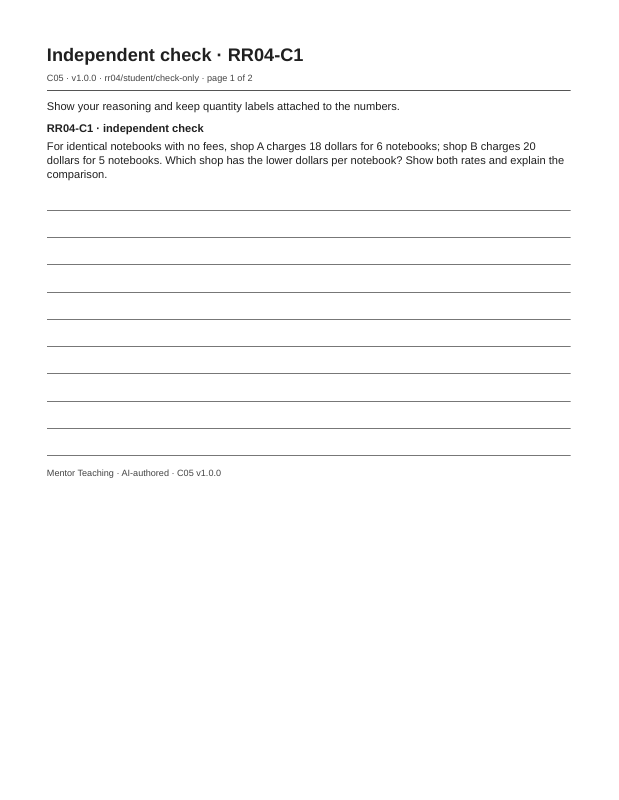
Read the independent check as HTML. Answers and next teaching moves are in the separate teacher guide.
Student files
- Readiness — give before the lesson: Printable PDF · Editable Word file · HTML text
- Model and guided lesson: Printable PDF · Editable Word file · HTML text
- Independent check — separate from the lesson: Printable PDF · Editable Word file · HTML text
- Compare pump rates on a common basis: Printable PDF · Editable Word file · HTML text
- Find and explain tickets per minute: Printable PDF · Editable Word file · HTML text
- Compare the cost per eraser: Printable PDF · Editable Word file · HTML text
- Compare fractional rates without rounding: Printable PDF · Editable Word file · HTML text
- Follow-up check — use after practice: Printable PDF · Editable Word file · HTML text
- Later practice — use at another learning opportunity: Printable PDF · Editable Word file · HTML text
- Transfer task: Printable PDF · Editable Word file · HTML text
Teacher guide and shared tools
- Teacher guide, complete keys and response routes: Printable PDF · Editable Word file · HTML text
- Collection Start Here and print selections: Printable PDF · Editable Word file · HTML text
- Representation glossary: Printable PDF · Editable Word file · HTML text
- Local teacher decision record: Printable PDF · Editable Word file · HTML text
Use the response to choose a next move
Look separately at calculations, unit labels, direction and explanation. Clarify an unclear response before choosing a practice task. After practice, collect students’ responses to a follow-up task, noting any support used.
Scope, sources and reuse
Interpret per one, preserve direction and units, compare on the same basis, explain ties and missing information, and apply a stated constant rate. No percent, measurement conversion, coordinate graphing, complex fractions or complete proportionality course. These kits address 6.RP.A.2 and selected unit-rate applications from 6.RP.A.3b; they do not assess the whole standard or a complete mathematics course.
Teachers may print, use and adapt these original materials for their teaching. Retain Mentor Teaching attribution and identify local changes. Numerical data and examples are constructed, not classroom observations.
Use the editable files to adapt the materials to your learners and local curriculum.
When the lower unit price does not buy the cheapest whole packs
A learner may calculate dollars per item correctly and still choose an infeasible or more expensive purchase. This companion teaches the missing step: find the least number of whole packs that supplies enough, compare total cash paid and qualify the decision for the stated need.
Use it after common-basis unit-price teaching when student work overlooks a pack restriction. The fictional starting response helps distinguish that reasoning from unclear units, an arithmetic slip or an access difficulty. The lesson supplies a teacher model and targeted practice; different follow-up orders test the explanation before a later whole-roll transfer.
- Read Start Here and the teacher guide. If entry reasoning is unknown, give Starting task alone.
- Choose Lesson and practice after interpreting the response. Use the worked purchase and guided complete-pack counts, then change the quantity needed to challenge an automatic supplier choice.
- Keep Follow-up check and Later transfer unused until their intended occasion. Previously shown or helped work is practice. Keep answers with the teacher.
Teacher preparation and answers
- Whole packs and purchase cost: Printable PDF · Editable Word · HTML text
- Whole packs teacher guide and answers: Printable PDF · Editable Word · HTML text
- Whole pack teaching decision record: Printable PDF · Editable Word · HTML text
Student pages to select
- Whole pack starting task: Printable PDF · Editable Word · HTML text
- Whole packs lesson and practice: Printable PDF · Editable Word · HTML text
- Whole pack follow up check: Printable PDF · Editable Word · HTML text
- Whole rolls transfer task: Printable PDF · Editable Word · HTML text
Download the whole-pack companion and selected comparison first teaching. The ZIP includes all companion PDF, native Word and HTML files plus the unchanged comparison lesson and teacher guide. The original unit-rate collection above remains available with its existing checks. Share selected student pages, not the whole ZIP.
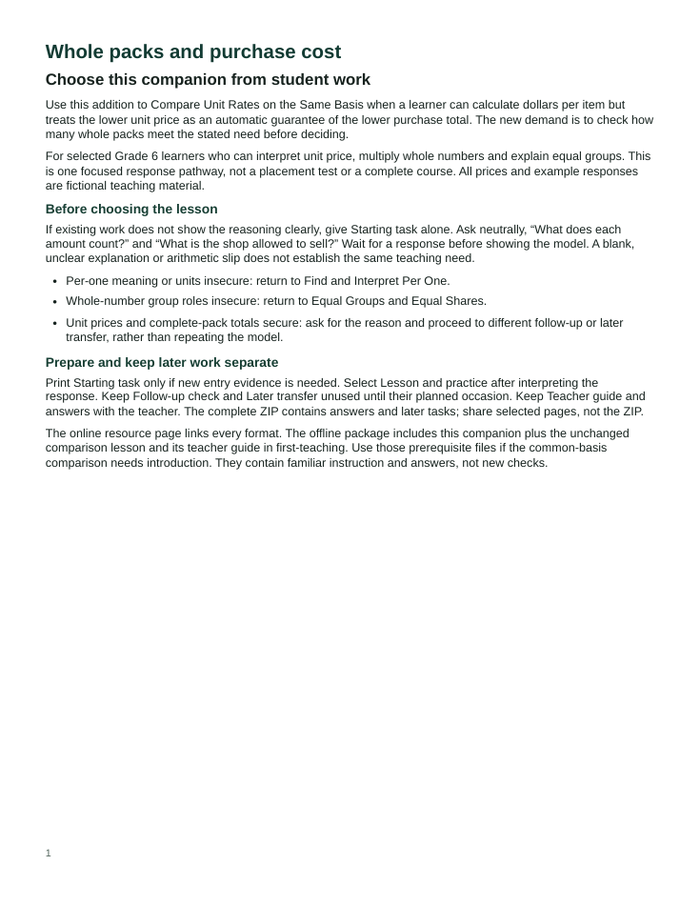
For selected Grade 6 learners who can interpret unit price and multiply whole groups. Read-aloud, enlarged text or an agreed oral or drawn response can preserve the target; supplying pack counts or a supplier choice changes what is checked. Record the support used. The transfer adds measured length; no comprehensive grade coverage or equal-difficulty claim is made.
Prices and learner examples are fictional teaching material. Teachers may print and adapt the original companion under the Terms of Use; retain attribution and identify local changes. Word copies may reflow after editing, so check print preview. Classroom effectiveness has not been established. Report a resource issue.
Use familiar practice beyond the lesson
Keep this lesson’s target when preparing familiar practice beyond the lesson. Prepare a substitute handoff with the exact student pages and return instructions. Plan neutral directions and representation supports that preserve the mathematics. Offer a brief family conversation about practice already taught.
Keep teacher keys and later checks with the teacher. Previously shown or helped work is practice; record the support before interpreting a response.
Choose a next move
- Equivalent Ratios — First teaching for labeled ratio order and equivalent groups.
- Find and Interpret “Per One” — Return to per-one meaning when direction or units remain unclear.
- Collection starting route — Choose the entry point and obtain the complete offline classroom package.
- Substitute Handoff and Independent-Work Pack — Prepare familiar ratio or rate practice with complete student pages, established routines and a return route.
- Clear Directions and Language-Support Pack — Plan neutral directions and representations while keeping quantity labels, rate direction and explanation visible.
- Practical Family-Communication Templates — Invite a short conversation about familiar mathematics; keep later classroom checks and teacher keys at school.
Editable Word files
Additional files · teacher preparation
Use the separate stage choices above for student handouts. Complete selections may include later tasks or answers.
Whole packs and purchase cost Word files (ZIP). Choose the editable files that match the task you will use. Use the full classroom collection for PDFs, HTML and other materials. The complete classroom collection includes these Word editions. Keep the bundles with the teacher and share only selected student tasks.
Share this resource
Report a resource issue · Open an issue email
Do not include student names or identifiable work in an issue report. Page revision: 2 November 2026; classroom files retain their own editions.