
Free teaching resource
Practical Family-Communication Templates
Is this the right resource?
- Audience / fit
- Teacher planning
- Teaching or planning target
- Adapt clear family messages and invite brief reading, writing or argument practice with a goal-specific family guide.
- Essential prerequisites
- Identify one routine communication purpose and the current facts that support it. Check the current authorized local source for the intended recipient, communication channel, and any procedure that applies.
- Preparation
- About 6 minutes.
- Use time
- About 2 minutes. Optional estimate for orienting a teacher team to the template bank; not measured and not student instructional time.
- Materials
- This blank template bank in print or editable form. Current, verified class details and the locally approved contact route for the intended message.
- What to print
- Print the adult planning forms and matching worked example/notes below. Adapt verified local details before use; these are adult tools.
Prepare a family message
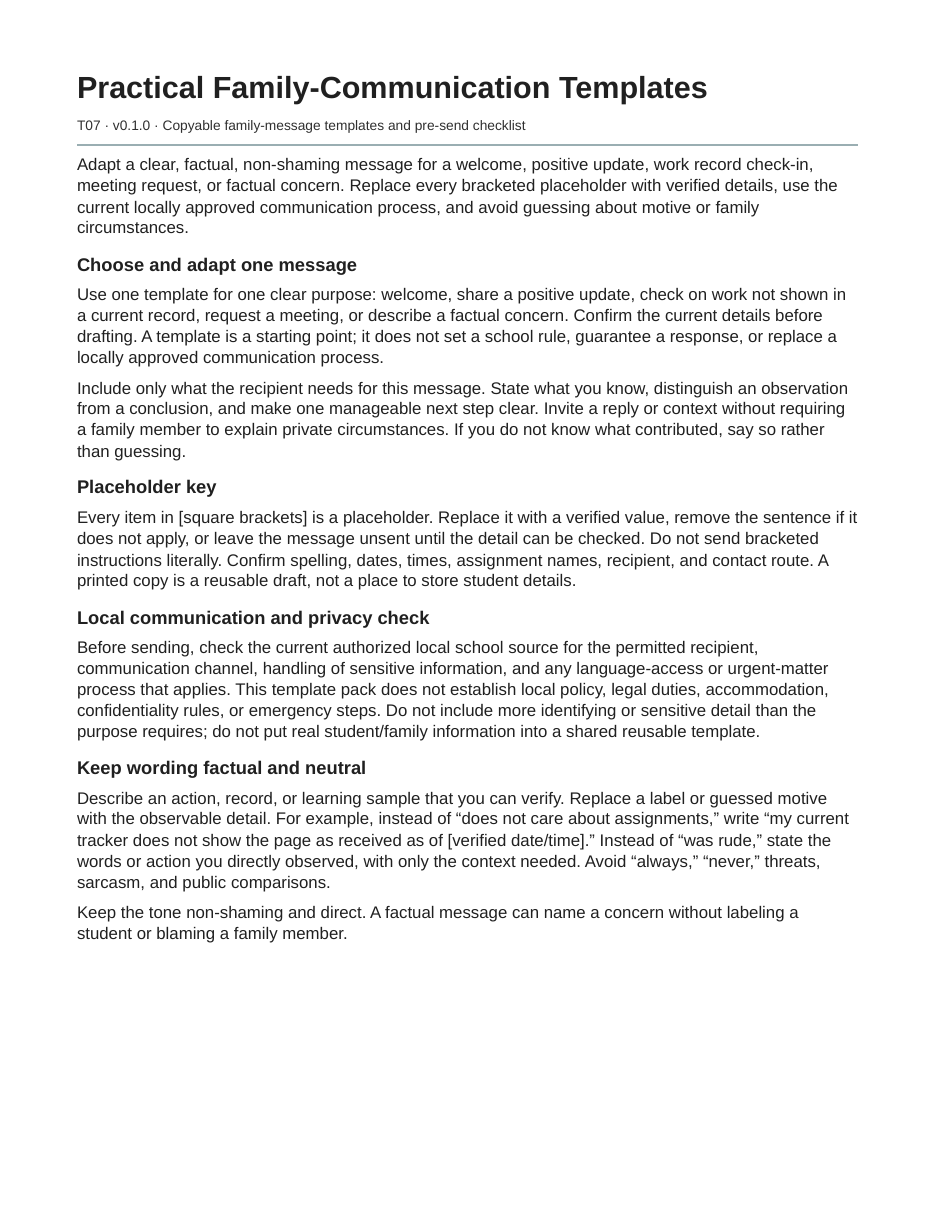
Open the adaptable message templates · PDF (7 pages)
Read the worked example and adaptation notes · PDF (9 pages)
Choose a template for the actual purpose and audience, replace its blanks with verified information, and check tone, access and the school’s communication process before sending. Keep learner information within authorized channels.
Adapt a clear, factual, non-shaming message for a welcome, positive update, work record check-in, meeting request, or factual concern. Replace every bracketed placeholder with verified details, use the current locally approved communication process, and avoid guessing about motive or family circumstances.
All files are free. No email address, account, payment, trial or subscription is required.
- Who it is for
- Teacher planning and professional use
- Preparation
- About 6 minutes.
- Use / example time
- About 2 minutes. Optional estimate for orienting a teacher team to the template bank; not measured and not student instructional time.
- Teacher guidance
- Separate notes include worked planning examples and adaptation guidance.
Materials
- This blank template bank in print or editable form.
- Current, verified class details and the locally approved contact route for the intended message.
Formats and all files
Read or download the complete resource
- Copyable family-message templates and pre-send checklist — Editable Word file (39 KB)
- Copyable family-message templates and pre-send checklist — Read in browser (HTML)
- Copyable family-message templates and pre-send checklist — Printable PDF (58 KB)
- Teacher guide: five fictional family-message examples and adaptation notes — Editable Word file (40 KB)
- Teacher guide: five fictional family-message examples and adaptation notes — Read in browser (HTML)
- Teacher guide: five fictional family-message examples and adaptation notes — Printable PDF (73 KB)
Use these forms with the adults involved. Agree roles, a preparation task and one follow-up action. Examples are fictional; adapt them to verified local details. Word files are editable; PDFs are ready to print.
Connect a family message to the learning
These examples connect Grade 6 reading, writing and argumentation practice to a small activity at home. Choose one goal students have already practiced in class. Use the existing message templates to adapt the greeting, verified learning focus and usual reply route.
For families: one short practice at a time
Help your child explain a character’s choices, strengthen a paragraph or answer a concern fairly. Choose one familiar activity, listen and leave the thinking with your child. No special books or subject knowledge are needed.
- Read the family practice guide
- Print the family practice guide — three pages; choose the page for the current goal.
- Adapt the family practice guide in Word
The guide offers a conversation, not a test. Practice is optional; teaching and checking progress remain part of the school’s work. A family can ask for a school-based option when home practice does not fit.
Teacher preparation
Share only a familiar practice text or draft and the relevant guide page. Keep answers, later classroom checks and full teacher collections with you. Provide the selected text or work on paper when needed; do not assume a printer, device, internet connection or adult availability. Use your usual language-access process, and invite talk in a language the family uses comfortably.
Replace or remove every bracketed item before sending. Verify the recipient, learning focus and contact route using the existing pre-send checklist. Do not put real student details in a reusable copy. These are practice invitations, not evidence of independent performance; if a family shares work, note any help given before interpreting it.
Reading invitation
Hello [family greeting],
We are practicing explaining how a character changes, using details from early and later in a story. If it fits your day, look at [familiar practice story supplied by the teacher] together. Ask, “What did the character choose early on, and what did they choose later? Which words or actions help you explain the change?” Let your child look back and choose the details.
A short conversation is enough; you do not need to score it or send a report. The reading page of the family guide has help if this feels difficult. You can contact me through [usual school reply route] with a question or to ask for a school-based practice option.
Writing invitation
Hello [family greeting],
We are practicing supporting an idea with a text detail and making writing clearer. If it fits your day, ask your child to show you [their familiar practice paragraph and its text]. Ask, “What idea are you explaining? Which detail supports it, and how?” Then invite them to make one sentence clearer while keeping its facts and meaning. Let your child choose and write the change.
A few minutes is enough; you do not need to correct every spelling or rewrite the paragraph. The writing page of the family guide offers another way to help. You can contact me through [usual school reply route] with a question or to ask for a school-based practice option.
Argument invitation
Hello [family greeting],
We are practicing giving reasons and answering another person’s concern fairly. If it fits your day, talk about [familiar class practice topic]. Ask your child what they support, why, and which known detail helps. Offer one reasonable concern, listen as they restate it, then ask how they might answer. You do not need to agree with their position.
Keep the conversation low stakes; nobody needs to share a personal belief or private circumstances. The argument page of the family guide includes help. You can contact me through [usual school reply route] with a question or to ask for a school-based practice option.
Support and adaptation
- If a draft feels difficult, first write one verified observation, one respectful invitation or question, and one next step. Then check whether the message needs that detail and verify the recipient and local channel. This shorter structure is a planning aid, not a substitute for the full fact and placeholder check.
Extension
- Adapt one verified concern as both a concise check-in and a meeting request. Keep the observations the same, change only the purpose and next step, and confirm each version follows the current local process. Do not add a new claim or assume the family member is available.
Talk about ratios and rates at home
These optional conversations connect to Grade 6 mathematics already practiced in class. Use the familiar problem or table supplied by the teacher; no shopping, measurements, printer, device or new materials are needed. A few minutes is enough if it fits your day. Your role is to listen, not to teach the method, check every answer or complete the work.
Equivalent ratios: keep the groups matched
Ask, “What does each quantity count? How did both quantities change? Can you show the same relationship with groups or a table?” Let your child point to the familiar example and explain. Do not supply the factor or tell them to add the same amount to both quantities.
Unit rates: explain the one
Ask, “What does your answer measure for one of? What do the words or units beside the number tell us?” Listen as your child connects the answer to the problem. A number by itself may leave the meaning unclear; invite them to name both quantities rather than giving them the division order.
Fair comparisons: match the basis and the goal
Ask, “Are these rates written with the same units? What is the question asking you to compare? What would a tie mean? Is any information missing?” Let your child explain using the supplied problem. A lower cost per item answers a unit-cost question; it does not prove which product is best overall. Do not guess missing information or require a winner when the rates are equal.
If the explanation is difficult
Invite your child to show one part using a drawing or a language you both use comfortably. Look back at familiar practice, or stop and bring a question to the teacher through the usual school route. No score, photo or report is required by this guidance. If home practice does not fit, ask for a school-based option.
For teachers: adapt one invitation
Hello [family greeting],
We are practicing [naming both quantities and explaining equivalent groups / interpreting a unit rate / comparing rates on the same basis — choose one]. If it fits your day, ask your child to explain [familiar practice problem or table supplied by the teacher]. Use the matching conversation above, listen and leave the thinking with your child. A short conversation is enough; you do not need to score it or send a report.
You can contact me through [usual school reply route] with a question or to ask for a school-based practice option.
Replace or remove all bracketed items before sending; use the existing pre-send checklist to verify the learning focus, recipient and reply route. Supply only the chosen familiar practice on paper when needed. Use the usual language-access process. Keep teacher keys, full classroom packages and later checks at school. Any helped work is practice, not evidence of independent performance.
About the materials
Use the editable files to adapt the materials to your learners and local curriculum.
You may print, copy and adapt the resource for your planning and classroom use under our Terms of Use. Report a resource issue.
Share this resource
Report a resource issue · Open an issue email
Do not include student names or identifiable work in an issue report. Page revision: 15 October 2026; classroom files retain their own editions.