
Free teaching resource
First 30 Days of New-Teacher Mentoring
Is this the right resource?
- Audience / fit
- Teacher planning
- Teaching or planning target
- Plan a teacher-owned mentoring cycle with meeting forms, fictional examples and a complete unit-rate rehearsal: interpret student reasoning, choose teaching and return to a fresh check.
- Essential prerequisites
- Identify the new teacher and mentor roles that actually apply in the local setting. Before collecting observation notes, confirm locally whether this is developmental mentoring or formal evaluation and how any notes may be used or retained.
- Preparation
- About 10 minutes.
- Use time
- About 15 minutes. Untested estimate for a mentor/new-teacher orientation; actual meeting lengths and cadence are set locally.
- Materials
- This toolkit in print or editable form. A locally agreed meeting/observation time and current authorized guidance about role boundaries and note handling, if applicable.
- What to print
- Print the adult planning forms and matching worked example/notes below. Adapt verified local details before use; these are adult tools.
Prepare the mentoring conversation
Open the mentoring meeting forms · PDF (6 pages)
Read the worked example and adaptation notes · PDF (7 pages)
Agree on one teaching focus and a meeting time. Use the adult meeting forms for evidence, a feasible next action and follow-up. Check local role boundaries and note handling; the unit-rate rehearsal and learner prompts are separate optional materials.
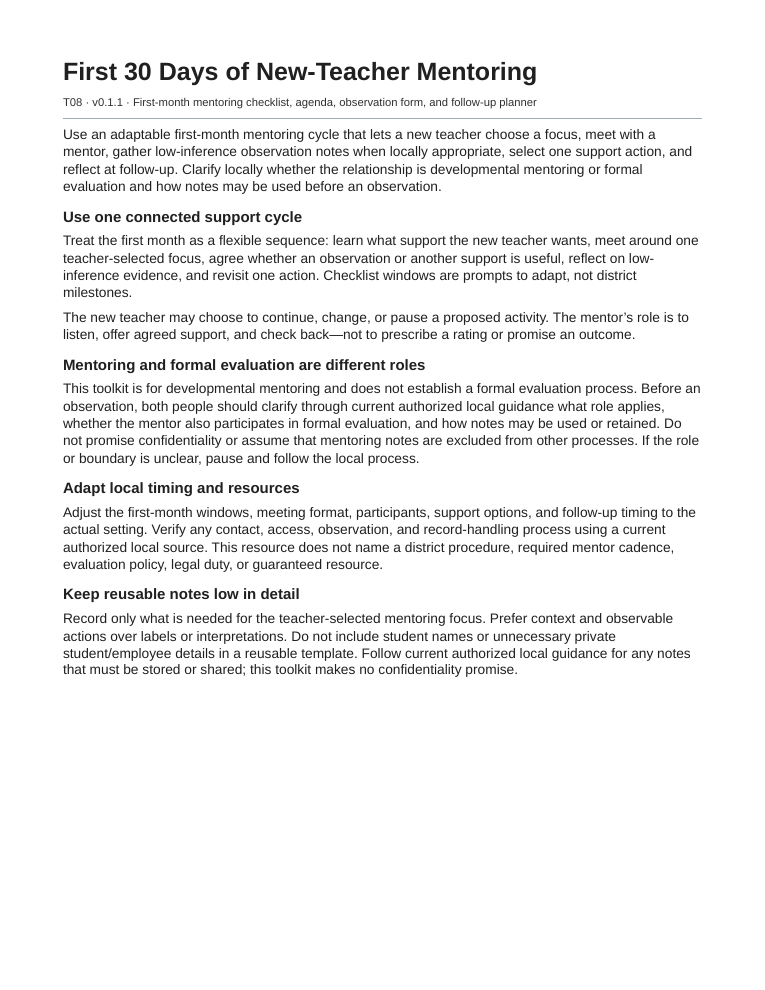
Use an adaptable first-month mentoring cycle that lets a new teacher choose a focus, meet with a mentor, gather low-inference observation notes when locally appropriate, select one support action, and reflect at follow-up. Clarify locally whether the relationship is developmental mentoring or formal evaluation and how notes may be used before an observation.
All files are free. No email address, account, payment, trial or subscription is required.
- Who it is for
- Teacher planning and professional use
- Preparation
- About 10 minutes.
- Use / example time
- About 15 minutes. Untested estimate for a mentor/new-teacher orientation; actual meeting lengths and cadence are set locally.
- Teacher guidance
- Separate notes include worked planning examples and adaptation guidance.
Materials
- This toolkit in print or editable form.
- A locally agreed meeting/observation time and current authorized guidance about role boundaries and note handling, if applicable.
Formats and all files
Read or download the complete resource
- First-month mentoring checklist, agenda, observation form, and follow-up planner — Editable Word file (39 KB)
- First-month mentoring checklist, agenda, observation form, and follow-up planner — Read in browser (HTML)
- First-month mentoring checklist, agenda, observation form, and follow-up planner — Printable PDF (59 KB)
- Teacher guide: fictional first-month mentoring cycle and adaptation notes — Editable Word file (40 KB)
- Teacher guide: fictional first-month mentoring cycle and adaptation notes — Read in browser (HTML)
- Teacher guide: fictional first-month mentoring cycle and adaptation notes — Printable PDF (68 KB)
Use these forms with the adults involved. Agree roles, a preparation task and one follow-up action. Examples are fictional; adapt them to verified local details. Word files are editable; PDFs are ready to print.
Support and adaptation
- If a first meeting feels too broad, invite the new teacher to name one current question and one support they want. Agree only one next action. If the role or note boundary is unclear, do not start observation or record notes until current authorized local guidance clarifies the process.
Extension
- Compare two possible support actions for the same teacher-selected focus. Choose one that preserves the new teacher’s agency, is available locally, and can be revisited with observable evidence; explain why the alternative was not selected for this cycle.
About the materials
Use the editable files to adapt the materials to your learners and local curriculum.
You may print, copy and adapt the resource for your planning and classroom use under our Terms of Use. Report a resource issue.
Rehearse a mathematics mentoring cycle
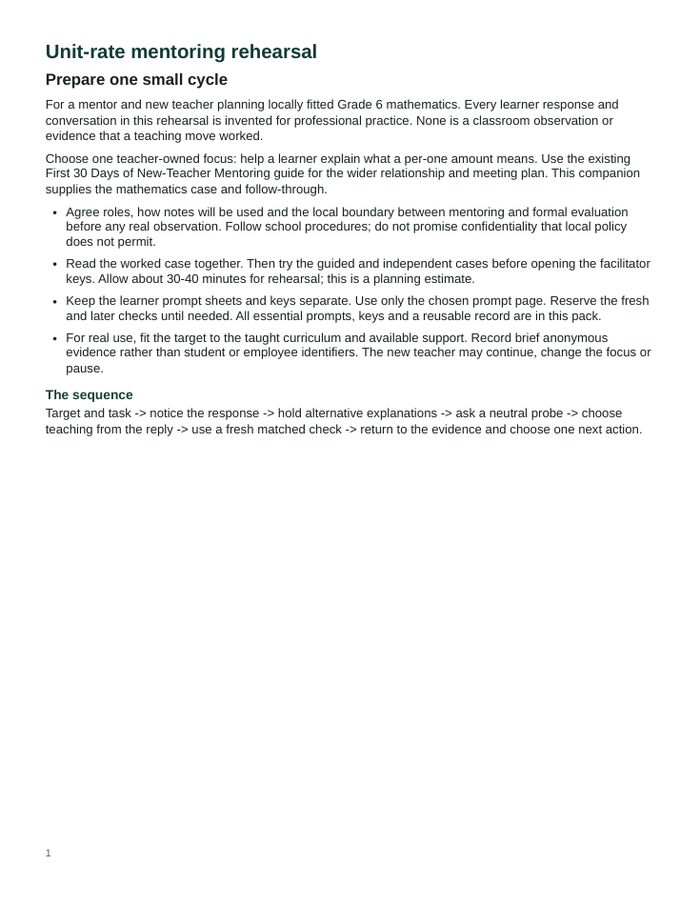
Use a complete fictional Grade 6 unit-rate case to move from student reasoning to a teaching response and a fresh check. A reversed rate, a correct unlabelled number and a correct response after help call for different investigation. The worked conversation models alternatives, a neutral probe and conditional teaching; guided and independent cases let the mentor and new teacher try the decisions.
All student work and conversations are invented for professional practice. They do not report classroom results. Fit the mathematics and prerequisites locally; keep the teacher’s choice of focus and locally agreed mentoring boundaries.
- Read the rehearsal together, then try the guided and independent cases before opening the facilitator answers.
- Use the four separate learner prompt pages as needed: initial task, practice, fresh check and later check. Keep check pages and answers unseen until use.
- Record support and prior exposure, qualify what the new response shows, and agree one teacher-chosen next action.
ZIP files · teacher preparation only
This archive may combine teaching, later tasks and answers. Choose the individual resource and its stage-specific pages before making student handouts.
Download the complete unit-rate mentoring rehearsal — four document sets, 21 print pages, with PDF and adaptable HTML copies. Essential prompts, answers and the cycle record work offline; teacher materials and learner pages are in separate folders. The original mentoring forms above remain available in PDF and Word.
- Unit-rate mentoring rehearsal: Printable PDF · Adaptable HTML
- Unit-rate rehearsal facilitator guide: Printable PDF · Adaptable HTML
- Equal shares: learner prompts: Printable PDF · Adaptable HTML
- Mentoring cycle record: Printable PDF · Adaptable HTML
For further mathematics teaching, use Find and Interpret Per One. For prerequisite equal sharing, use Equal Groups and Shares. For general response planning, use Check for Understanding and Choose the Next Step. These are optional routes; the rehearsal supplies its own complete tasks and keys.
Original teaching text may be copied or adapted under the Terms of Use. Classroom effectiveness has not been established. Report a resource issue.
Share this resource
Report a resource issue · Open an issue email
Do not include student names or identifiable work in an issue report. Page revision: 15 October 2026; classroom files retain their own editions.