
Free teaching resource
Objective-to-Assessment Alignment Pack
Is this the right resource?
- Audience / fit
- Teacher planning
- Teaching or planning target
- Connect one learning objective to the student task, observable evidence, and assessment criteria.
- Essential prerequisites
- A locally selected learning objective or curriculum expectation. An actual or draft student task, including the text, problem, data or materials learners will receive.
- Preparation
- About 5 minutes.
- Use time
- About 20 minutes. Estimate for a short colleague practice: 3 minutes directions, 7 minutes one worked case, 7 minutes to draft/check one alignment and 3 minutes debrief. Untested professional-use estimate; not student lesson time.
- Materials
- This pack in print or editable form. The selected objective/task and its required stimulus, problem or data. Pencil or keyboard. No student records are needed.
- What to print
- Print the adult planning forms and matching worked example/notes below. Adapt verified local details before use; these are adult tools.
Align the task and evidence
Open the alignment planner · PDF (5 pages)
Read the worked example and adaptation notes · PDF (9 pages)
Name the learning objective, choose a task that would show it, and check the evidence and response demands against the same objective. Use the adult worked example to review the match before teaching.
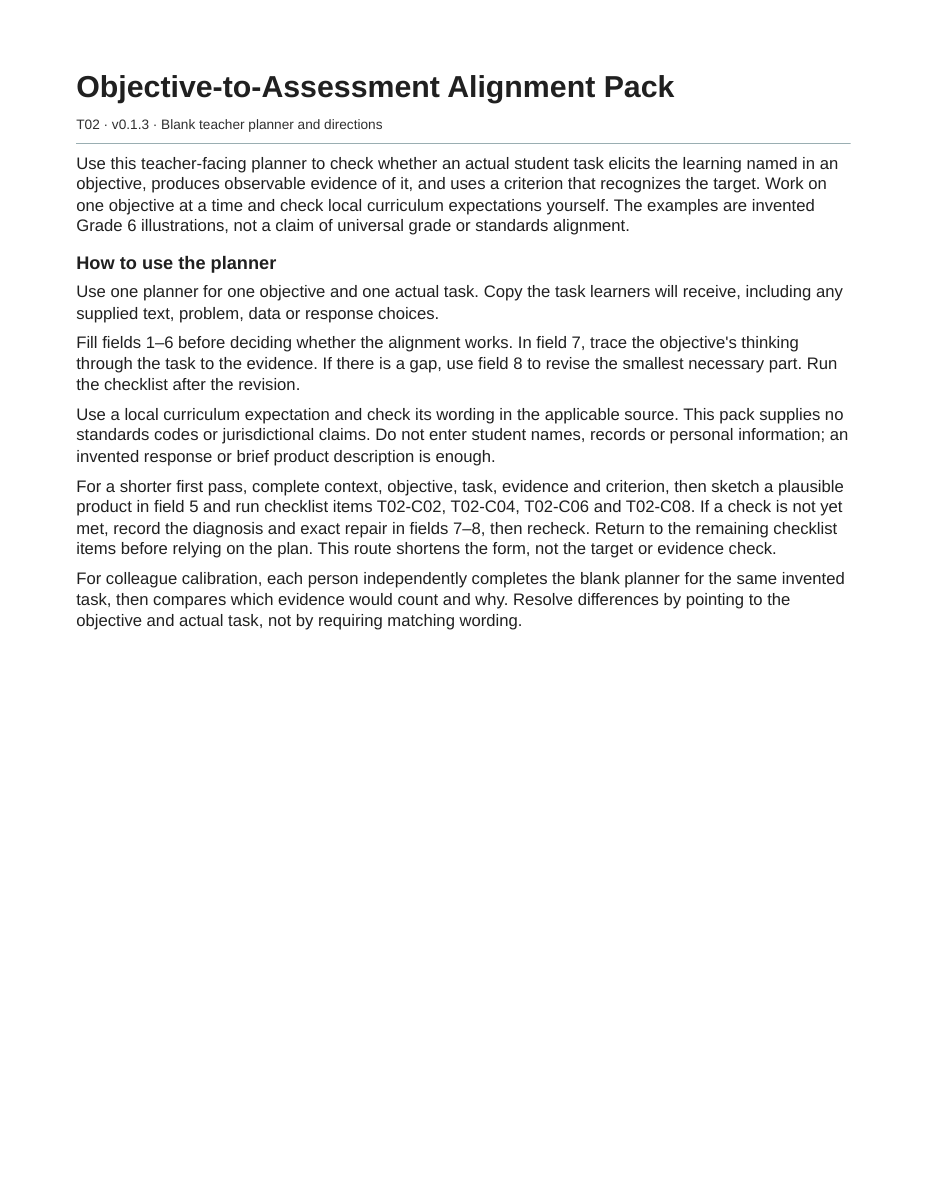
Use this teacher-facing planner to check whether an actual student task elicits the learning named in an objective, produces observable evidence of it, and uses a criterion that recognizes the target. Work on one objective at a time and check local curriculum expectations yourself. The examples are invented Grade 6 illustrations, not a claim of universal grade or standards alignment.
All files are free. No email address, account, payment, trial or subscription is required.
- Who it is for
- Teacher planning and professional use
- Preparation
- About 5 minutes.
- Use / example time
- About 20 minutes. Estimate for a short colleague practice: 3 minutes directions, 7 minutes one worked case, 7 minutes to draft/check one alignment and 3 minutes debrief. Untested professional-use estimate; not student lesson time.
- Teacher guidance
- Separate notes include worked planning examples and adaptation guidance.
Materials
- This pack in print or editable form.
- The selected objective/task and its required stimulus, problem or data.
- Pencil or keyboard. No student records are needed.
Formats and all files
Read or download the complete resource
- Blank teacher planner and directions — Editable Word file (39 KB)
- Blank teacher planner and directions — Read in browser (HTML)
- Blank teacher planner and directions — Printable PDF (57 KB)
- Teacher guide: worked alignments and repairs — Editable Word file (43 KB)
- Teacher guide: worked alignments and repairs — Read in browser (HTML)
- Teacher guide: worked alignments and repairs — Printable PDF (86 KB)
Use these forms with the adults involved. Agree roles, a preparation task and one follow-up action. Examples are fictional; adapt them to verified local details. Word files are editable; PDFs are ready to print.
Support and adaptation
- Support for the barrier of a crowded form or limited typing time: draft brief phrases in fields 1–6, use arrows to connect objective → task → evidence, then finish diagnosis, revision and checklist. A teacher may dictate their own planning notes or use the editable DOCX. This changes the mode of tool completion, not the student's target or evidence; a student response-mode change must be checked against the local objective.
Extension
- Transfer extension: keep one objective fixed but change the task format or stimulus (for example, paragraph to labeled organizer, or one supplied data set to a second invented data set). Complete fields 3–8 again. Explain which evidence still demonstrates the objective, what the criterion must change, and what the new task can no longer show. The reasoning, not extra items, is the extension.
About the materials
Use the editable files to adapt the materials to your learners and local curriculum.
You may print, copy and adapt the resource for your planning and classroom use under our Terms of Use. Report a resource issue.
Share this resource
Report a resource issue · Open an issue email
Do not include student names or identifiable work in an issue report. Page revision: 15 October 2026; classroom files retain their own editions.