
Free teaching resource
Check for Understanding and Choose the Next Step
Is this the right resource?
- Audience / fit
- Teacher planning
- Teaching or planning target
- Separate what a response shows from your interpretation, then plan a focused next move and recheck.
- Essential prerequisites
- A locally selected learning target and an actual short check that asks learners to show it. A response or work sample gathered under known directions and access conditions. Do not enter student names or identifying records in this tool.
- Preparation
- About 3 minutes.
- Use time
- About 10 minutes. Estimate to review one response, choose a brief next move, and plan a recheck.
- Materials
- This tool in print or editable form. The short check and the learner response, with identifying details removed. A pencil or keyboard.
- What to print
- Use the stage-specific student choices below and the matching teacher guide. Give independent, new-evidence and later-assessment pages only at their intended stage.
Prepare a response decision
Adult decision record and checklist · PDF (4 pages)
Fresh student recheck only · PDF (1 page)
Read the worked example and adaptation notes · PDF (9 pages)
Use the blank adult record to plan one target, record a response and choose the next teaching move. The guide contains the worked example. Keep the fresh student recheck unseen until after that teaching; it is separate from the adult form.
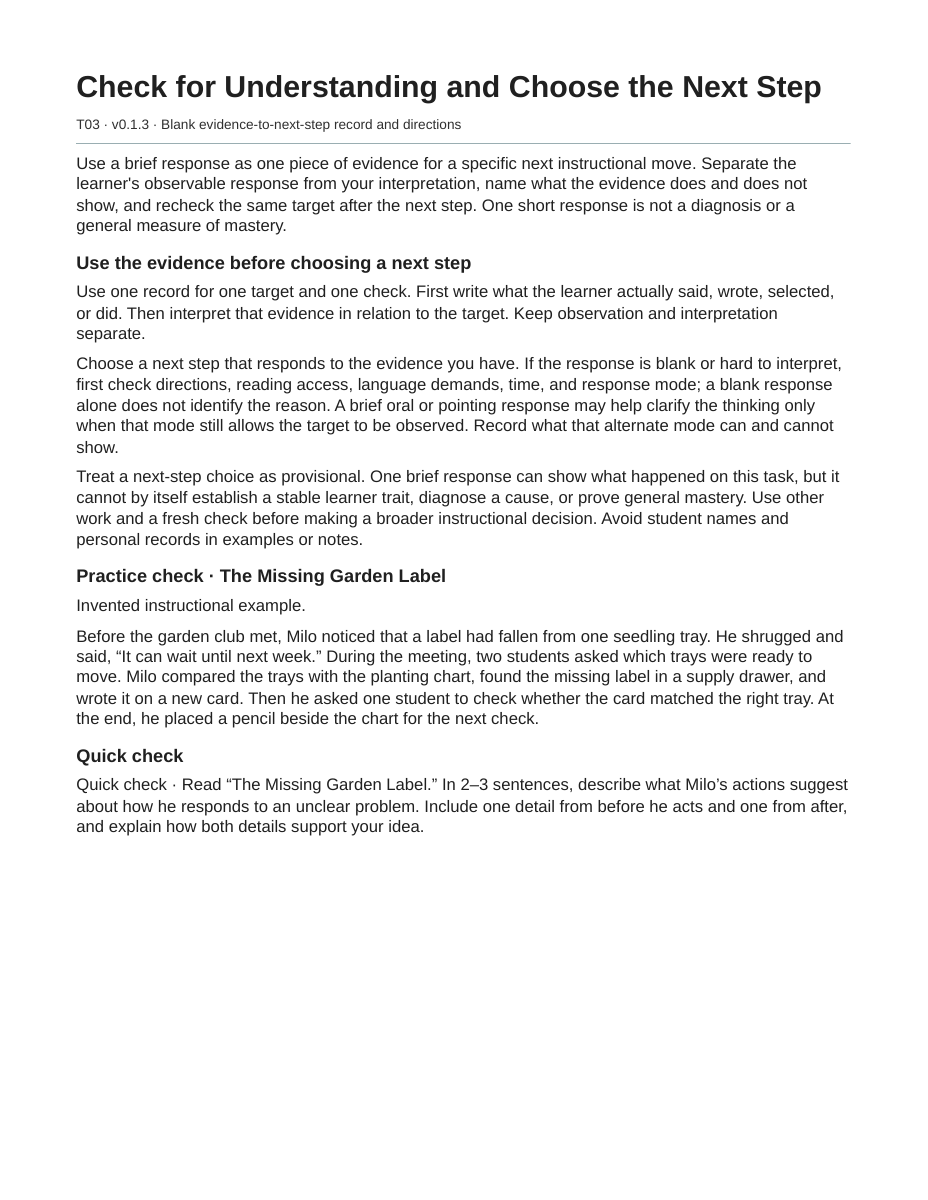
Use a brief response as one piece of evidence for a specific next instructional move. Separate the learner's observable response from your interpretation, name what the evidence does and does not show, and recheck the same target after the next step. One short response is not a diagnosis or a general measure of mastery.
All files are free. No email address, account, payment, trial or subscription is required.
- Who it is for
- Teacher planning and professional use
- Preparation
- About 3 minutes.
- Use / example time
- About 10 minutes. Estimate to review one response, choose a brief next move, and plan a recheck.
- Teacher guidance
- Separate notes include worked planning examples and adaptation guidance.
Materials
- This tool in print or editable form.
- The short check and the learner response, with identifying details removed.
- A pencil or keyboard.
Choose a stage and format
Give only the stage being used. Keep later tasks and all teacher keys with the teacher until needed.
Formats and all files
Complete reference files may include teaching, independent tasks, later evidence or teacher answers. Keep them with the teacher; use the separate stage selections above for handouts.
Read or download the complete resource
- Blank evidence-to-next-step record and directions — Editable Word file (39 KB)
- Blank evidence-to-next-step record and directions — Read in browser (HTML)
- Blank evidence-to-next-step record and directions — Printable PDF (58 KB)
- Teacher guide: sample responses and evidence-based next steps — Editable Word file (42 KB)
- Teacher guide: sample responses and evidence-based next steps — Read in browser (HTML)
- Teacher guide: sample responses and evidence-based next steps — Printable PDF (89 KB)
Use these forms with the adults involved. Agree roles, a preparation task and one follow-up action. Examples are fictional; adapt them to verified local details. Word files are editable; PDFs are ready to print.
Support and adaptation
- If a written response does not provide interpretable evidence and writing is not part of the target, check the learner's existing supports and local procedures. A neutral oral explanation or pointing to a detail while explaining it may help clarify the same thinking demand. Record the mode and what it can show; it does not establish written-composition skill.
Extension
- When a response already includes an inference, relevant earlier and later details, and reasoning, invite a second defensible interpretation of the same passage. Ask which details support each reading and what remains uncertain. Do not assign the extension solely because a learner finished quickly.
About the materials
Use the editable files to adapt the materials to your learners and local curriculum.
You may print, copy and adapt the resource for your planning and classroom use under our Terms of Use. Report a resource issue.
Use response evidence in a mentoring conversation
The unit-rate mentoring rehearsal supplies a complete fictional mathematics case: hold alternative explanations, ask a neutral probe, choose a learner-facing teaching move and use a new matched check. It extends the general response-planning forms with a subject-specific mentor/new-teacher conversation.
Share this resource
Report a resource issue · Open an issue email
Do not include student names or identifiable work in an issue report. Page revision: 15 October 2026; classroom files retain their own editions.