
Grade 6 argumentation practice and checks
Arguments: Check, Respond and Reconsider
Is this the right resource?
- Audience / fit
- Grade 6 ELA
- Teaching or planning target
- Identify a statement’s job in its argument and explain the claim–reason–evidence connection and limits. Represent a counterargument fairly, acknowledge why a selected concern matters, connect a reasoned reply to it, and name a remaining limit. Score reasoning rather than agreement with a position.
- Essential prerequisites
- For Grade 6; check the prerequisites for your class. Learners can read or listen to a short argument and write, type or dictate a brief explanation. Use Distinguish Claims, Reasons, and Relevant Evidence for argument roles and Respond to a Counterargument for fair counterargument responses before these checks as needed.
- Preparation
- Read Start Here; print only selected files; preparation time depends on the selected route.
- Use time
- Plan the selected route from the teacher guide
- Materials
- Use the selected student pages, pencil or typing/dictation option and the separate teacher guide. Read-aloud or text-to-speech can support access when decoding is not the target. Keep students’ own classifications and reasoning, and note the support they used and any text they had already seen.
- What to print
- Use the primary PDF choice below and its matching adult guide. Print only the phase/task being used; keep complete keys and later checks with the teacher.
Start teaching
Print only the student pages you plan to use. Keep teacher answers and later checks with the teacher until their intended use.
Formats and all files
Browse free resources · Argumentation collection and starting route
Help Grade 6 students identify claims, choose relevant evidence and respond fairly to counterarguments. After teaching, use a short check, choose focused practice and try a follow-up task. Includes printable and editable student materials with separate teacher guidance.
All files are free, with no account, email address, payment or learning platform required.
- Teaching targets
- Identify a statement’s job in its argument and explain the claim–reason–evidence connection and limits. Represent a counterargument fairly, acknowledge why a selected concern matters, connect a reasoned reply to it, and name a remaining limit. Score reasoning rather than agreement with a position.
- Fit and prerequisites
- For Grade 6; check the prerequisites for your class. Learners can read or listen to a short argument and write, type or dictate a brief explanation. Use Distinguish Claims, Reasons, and Relevant Evidence for argument roles and Respond to a Counterargument for fair counterargument responses before these checks as needed.
- Materials and access
- Use the selected student pages, pencil or typing/dictation option and the separate teacher guide. Read-aloud or text-to-speech can support access when decoding is not the target. Keep students’ own classifications and reasoning, and note the support they used and any text they had already seen.
- What’s included
- Printable student materials and editable files are supplied with separate teacher guidance.
Teach, respond and reconsider
- Teach or revisit Distinguish Claims, Reasons, and Relevant Evidence and Respond to a Counterargument as needed. Once their texts have been shown or discussed, they are practice.
- After teaching, give students just the short check, making sure they have not already read its texts. Keep answer keys with the teacher and save later tasks for another opportunity.
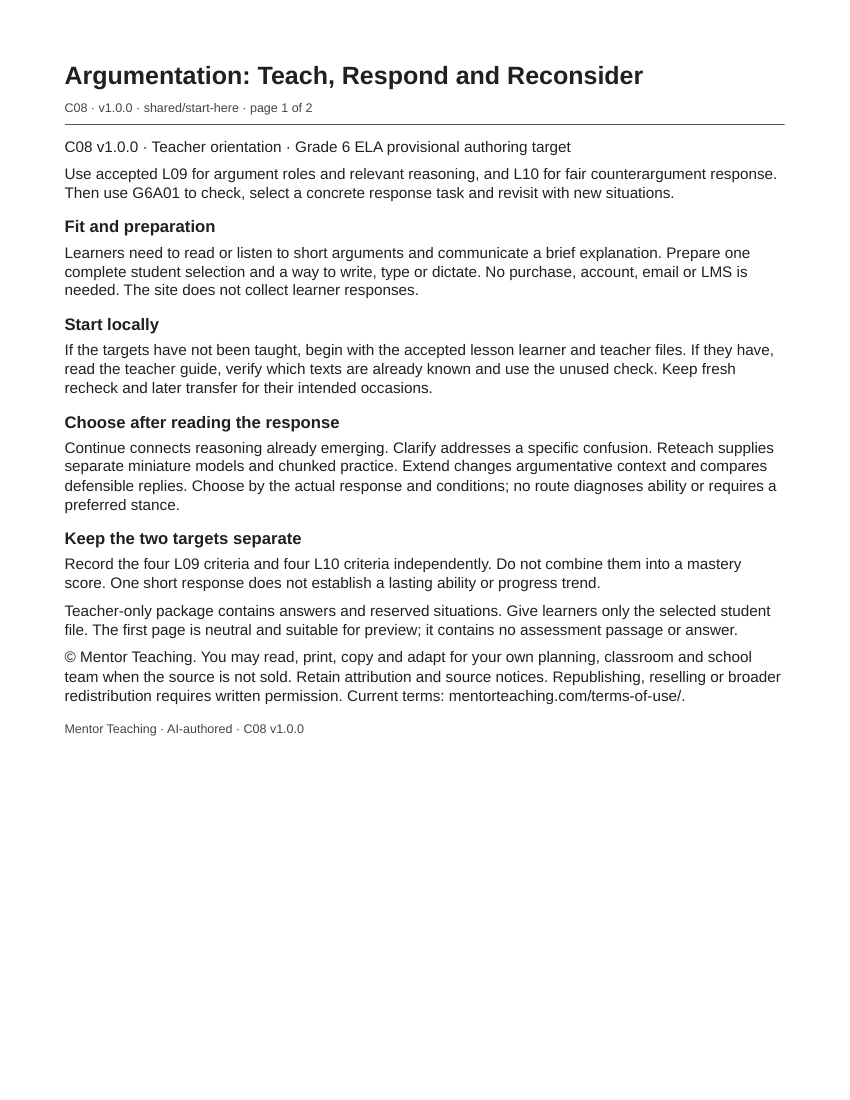
- Look separately at argument classification and counterargument response. An accurate detail may still be irrelevant, and a fair reply may accept, qualify or disagree with a proposal. Clarify an unclear response and check which texts students have already seen before choosing a continue, clarify, reteach or extend task.
- Use the selected task for practice. Save the follow-up check until after that practice, and the later task for another learning opportunity. Before using either as a check, make sure students have not seen its text. Record the support students used and compare their reasoning.
Student files — share only the selected task
- Short check — keep back until after teaching: Printable PDF · Editable Word · HTML text
- Connect claims, reasons and evidence; explain a fair reply: Printable PDF · Editable Word · HTML text
- Distinguish argument roles and repair an unfair paraphrase: Printable PDF · Editable Word · HTML text
- Models for argument roles and counterargument replies: Printable PDF · Editable Word · HTML text
- Compare statement roles and two defensible replies: Printable PDF · Editable Word · HTML text
- Follow-up check — use after practice: Printable PDF · Editable Word · HTML text
- Later task — try another context: Printable PDF · Editable Word · HTML text
Teacher guidance and complete keys
- Teacher guide, keys and next teaching steps: Printable PDF · Editable Word · HTML text
- Teacher Start Here and printing guide: Printable PDF · Editable Word · HTML text
The teacher guide keeps the argument lesson’s four argument criteria and the counterargument lesson’s four response criteria distinct. It supplies answers and alternatives, concrete route tasks and a local decision record. Keep it separate from student copies. A fair representation can address one main concern and the speaker’s stated alternative; it need not list every concern.
Choose a next move
- Distinguish Claims, Reasons, and Relevant Evidence lesson — Teach statement roles, relevance, reasoning links and the limits of evidence.
- Respond to a Counterargument lesson — Model a fair representation and a reply connected to the actual concern; no preferred stance earns credit.
- Check for Understanding and Choose the Next Step — Record local observations and conditions using this cycle’s separate criteria; keep student-identifying data off the site.
- Participate in an Evidence-Based Discussion — Apply reasoning in discussion when ready; check its different participation demands.
- Collection starting route and classroom package — Obtain first-teaching materials and the new response cycle together.
- Substitute Handoff and Independent-Work Pack — Choose practice after teaching and keep teacher models, answers and later checks separate.
- Clear Directions and Language-Support Pack — Clarify directions while students classify roles and develop their own fair response.
- Practical Family-Communication Templates — Offer low-stakes argument practice while keeping later classroom checks separate.
Sources and classroom use
New arguments and exchanges are original fictional instructional examples. Any counts are invented examples, not research or reported classroom results. Teachers may print and adapt the materials for classroom use under the site’s Terms of Use; retain attribution and identify local changes. The site does not collect student responses. Terms of Use.
Share this resource
Report a resource issue · Open an issue email
Do not include student names or identifiable work in an issue report. Page revision: 15 October 2026; classroom files retain their own editions.