
Free teaching resource
Participate in an Evidence-Based Discussion
Is this the right resource?
- Audience / fit
- Grade 6 ELA
- Teaching or planning target
- Use paired texts to contribute an evidence-based point and engage fairly with a different idea.
- Essential prerequisites
- Learners can read a short informational text or use a supported reading route. Learners have practiced identifying a claim and a supporting detail, or the teacher will model the distinction during this lesson.
- Preparation
- About 8 minutes.
- Use time
- About 45 minutes. Planned 45-minute sequence in the teacher directions; estimate only, not classroom-tested.
- Materials
- One learner packet per student, including the paired texts and preparation sheet. A way to display the teaching slides. Pencils or another way to annotate; optional device/AAC or agreed response materials. A way for each learner to exchange or submit one evidence-based point and one response/question.
- What to print
- Use the primary PDF choice below and its matching adult guide. Print only the phase/task being used; keep complete keys and later checks with the teacher.
Start teaching
Print only the student pages you plan to use. Keep teacher answers and later checks with the teacher until their intended use.
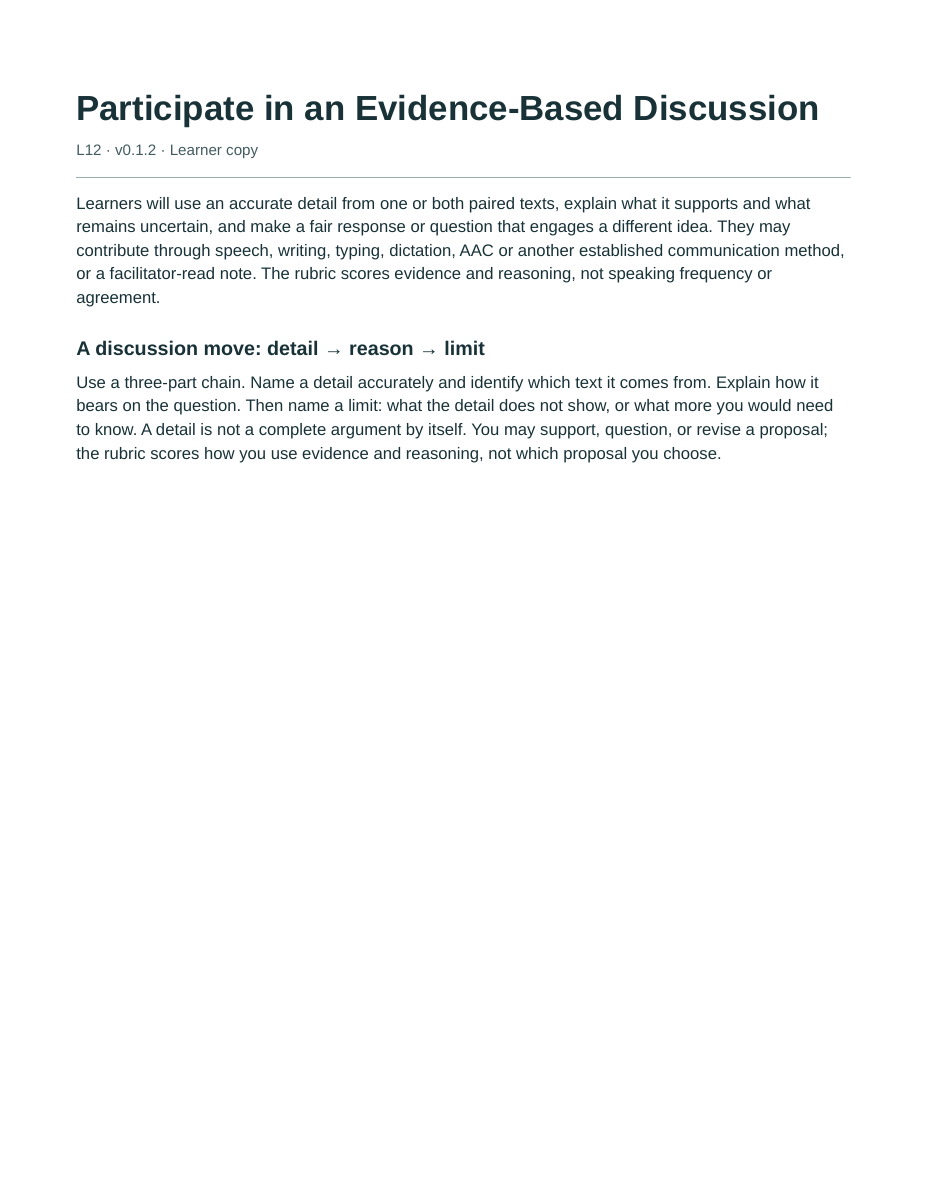
Learners will use an accurate detail from one or both paired texts, explain what it supports and what remains uncertain, and make a fair response or question that engages a different idea. They may contribute through speech, writing, typing, dictation, AAC or another established communication method, or a facilitator-read note. The rubric scores evidence and reasoning, not speaking frequency or agreement.
All files are free. No email address, account, payment, trial or subscription is required.
- Who it is for
- Grade 6 ELA
- Preparation
- About 8 minutes.
- Teaching time
- About 45 minutes. Planned 45-minute sequence in the teacher directions; estimate only, not classroom-tested.
- Teacher guidance
- Separate teacher files include completed examples or answer and scoring guidance.
Materials
- One learner packet per student, including the paired texts and preparation sheet.
- A way to display the teaching slides.
- Pencils or another way to annotate; optional device/AAC or agreed response materials.
- A way for each learner to exchange or submit one evidence-based point and one response/question.
Formats and all files
Read or download the complete resource
- Learner copy — Editable Word file (40 KB)
- Learner copy — Read in browser (HTML)
- Learner copy — Printable PDF (63 KB)
- Learner copy — Editable teaching slides (50 KB)
- Teacher guide and answer key — Editable Word file (44 KB)
- Teacher guide and answer key — Read in browser (HTML)
- Teacher guide and answer key — Printable PDF (107 KB)
Keep teacher guidance and answers separate from student copies. Word files contain editable text; the PDF files are ready to print.
Support and adaptation
- For learners who face reading-load, processing-time, transcription, or speech-access barriers, chunk each note into claim/detail/why/limit; preview the two texts, read them aloud or allow available text-to-speech, offer wait time and paired rehearsal, provide the sentence stems ‘The text says…,’ ‘This matters because…,’ and ‘One limit is…,’ and accept writing, typing, dictation, AAC/established communication, or a facilitator-read note with permission. Keep the evidence, reasoning, limit, and response-to-another-idea criteria constant; the route changes access, not what is measured.
Extension
- Design a four-week comparison that would help the fictional advisory decide between a choice window and a guided book talk. State what each week would hold constant, how every learner could contribute through an equivalent route, which evidence would be collected, what the evidence could and could not establish, and what result would change the plan. Avoid treating a small preference count as a measure of learning or a short observation as proof of cause.
About the materials
Use the editable files to adapt the materials to your learners and local curriculum.
You may print, copy and adapt the resource for your planning and classroom use under our Terms of Use. Report a resource issue.
Share this resource
Report a resource issue · Open an issue email
Do not include student names or identifiable work in an issue report. Page revision: 15 October 2026; classroom files retain their own editions.