
Free teaching resource
Clear Directions and Language-Support Pack
Is this the right resource?
- Audience / fit
- Teacher planning
- Teaching or planning target
- Make task steps clear and choose language support without supplying the answer. Includes reading, writing and argumentation examples.
- Essential prerequisites
- Choose one actual task and name the thinking or skill it is intended to show. Check the task text, materials, response expectations, and any locally authorized learner-specific supports.
- Preparation
- About 12 minutes.
- Use time
- About 3 minutes. Planning estimate for introducing or reviewing directions before a task; adjust to the actual task and class.
- Materials
- This blank direction planner and checklist in print or editable form. The actual task text, prompt, and materials learners will use.
- What to print
- Print the adult planning forms and matching worked example/notes below. Adapt verified local details before use; these are adult tools.
Prepare clear directions
Open the direction-planning forms · PDF (5 pages)
Read the worked example and adaptation notes · PDF (5 pages)
Name the actual learning target, break the task into clear actions, and choose vocabulary or a response frame for the observed language barrier. Check the directions against the real student task before use.
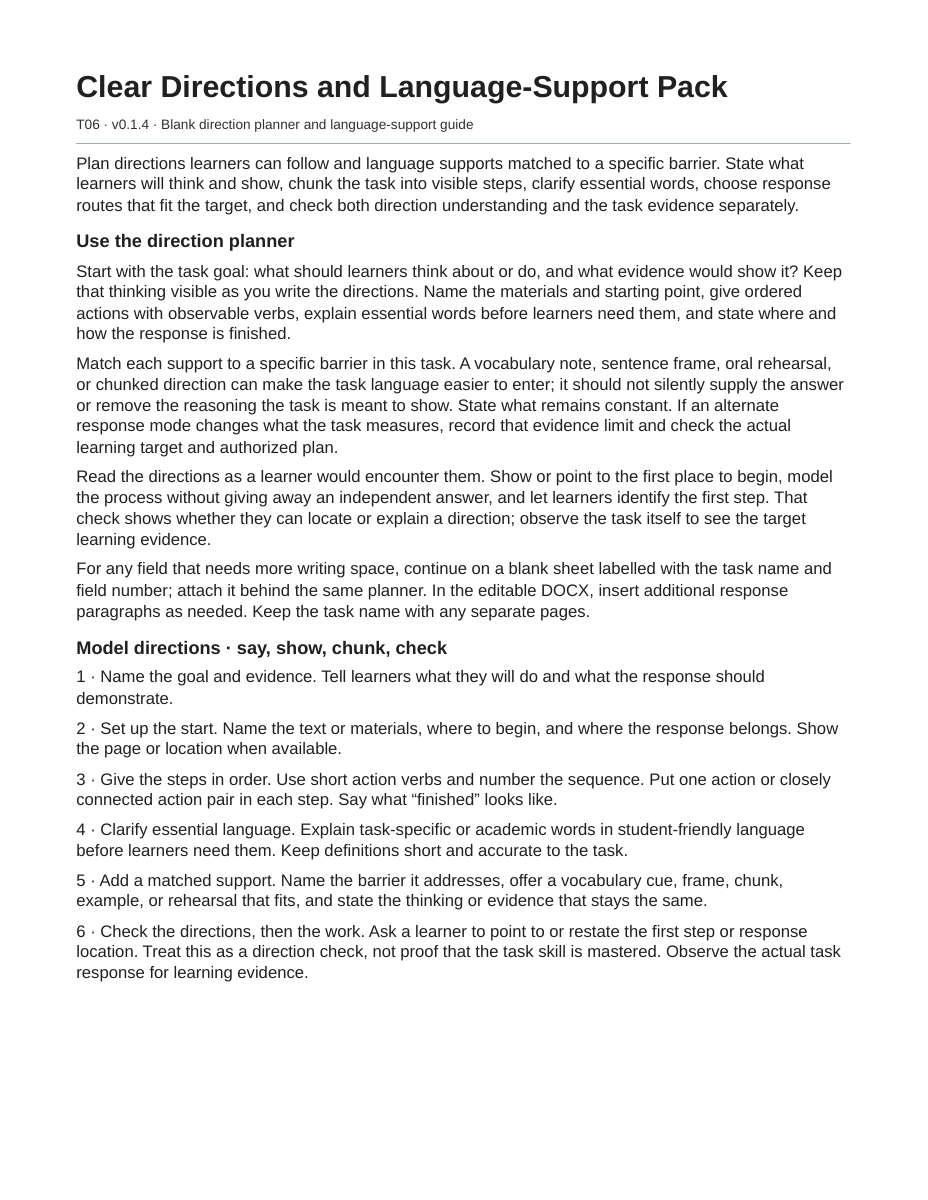
Plan directions learners can follow and language supports matched to a specific barrier. State what learners will think and show, chunk the task into visible steps, clarify essential words, choose response routes that fit the target, and check both direction understanding and the task evidence separately.
All files are free. No email address, account, payment, trial or subscription is required.
- Who it is for
- Teacher planning and professional use
- Preparation
- About 12 minutes.
- Use / example time
- About 3 minutes. Planning estimate for introducing or reviewing directions before a task; adjust to the actual task and class.
- Teacher guidance
- Separate notes include worked planning examples and adaptation guidance.
Materials
- This blank direction planner and checklist in print or editable form.
- The actual task text, prompt, and materials learners will use.
Formats and all files
Read or download the complete resource
- Blank direction planner and language-support guide — Editable Word file (39 KB)
- Blank direction planner and language-support guide — Read in browser (HTML)
- Blank direction planner and language-support guide — Printable PDF (62 KB)
- Teacher guide: completed direction examples and local-use notes — Editable Word file (41 KB)
- Teacher guide: completed direction examples and local-use notes — Read in browser (HTML)
- Teacher guide: completed direction examples and local-use notes — Printable PDF (71 KB)
Use these forms with the adults involved. Agree roles, a preparation task and one follow-up action. Examples are fictional; adapt them to verified local details. Word files are editable; PDFs are ready to print.
Plan supports for reading, writing and argumentation
Use the blank planner with the exact student task you intend to give. Make the starting point and steps easier to follow while keeping students responsible for the thinking. The examples below help you choose what to clarify and what to leave for students to decide.
Example: directions for character-change cover work
This example uses the four-page character-change packet. Keep its teacher notes and answers separate. Enter these details in the eight fields of the direction planner, adapting the help and submission steps to your class:
- Goal and evidence: students explain a change in Anika’s choices using an early and a later word or action, distinguish this from a change in the bridge or setting, and name one limit of the story.
- Task and starting point: provide the complete packet and a pencil. Point to the directions on page 1, story on page 2, optional tracker on page 3 and response space on page 4.
- Steps: read the story; find an early word or action; find a later word or action; explain the change using both; distinguish it from the bridge or setting; state what the story does not establish. Students choose the evidence and write their own response.
- Essential language: clarify “early” and “later” as points in the story, “circumstances” as the situation around a person, and “evidence” as words or actions that support an explanation. Do not point out which story details to select.
- Optional frame: if organizing the explanation is a language barrier, offer “At first ___. Later ___. This suggests ___ because ___. The story does not show ___.” Students supply every idea and detail. Note that the frame supplies part of the response structure.
- Matched support: repeat or display the numbered steps and help students locate the pages. Use the existing tracker when helpful. Record any reading support, frame or additional prompt given; do not supply the interpretation.
- Response choices: follow the task goal and authorized support plan. If an oral response is appropriate for the reasoning goal, record that the evidence is oral, together with any help given. It does not show independently written sentence organization.
- Finish and return: the response includes early and later evidence, an explanation, a distinction from the bridge or setting, and a reasonable limit. Name where students turn in all pages. Ask them to locate the first step before starting; judge the learning from their actual response.
Keep the goal visible in each collection
- Character change: clarify the directions and locations of story and response. Students still choose early and later evidence, explain a change in the character and limit their claim.
- Evidence writing and revision: distinguish writing a supported paragraph from revising a draft while preserving its facts and meaning. Clarify instruction words and response locations. Rehearsal or a frame may help, but record the help and judge only the writing students actually produce; an oral answer does not show independently written organization.
- Arguments and fair replies: explain instruction words such as “claim,” “reason” and “evidence” using a separate example. Students still decide each statement’s role, select relevant evidence and respond fairly to the concern. Do not label the task’s statements or explain its concern for them. Judge the reasoning, rather than agreement with a particular position.
Before a check, prepare permitted supports using the collection’s teacher guide. Keep later texts and answers out of practice. Note previous use of the text and the support actually given so you can interpret the response fairly. For cover work, put the selected support and a clear return route in the substitute handoff, using your school’s approved system for private student information.
Support and adaptation
- When a task has several steps or unfamiliar terms, show a numbered sequence and explain essential words in context before the task. Identify the barrier this addresses. Keep the learner responsible for the same target reasoning, choice of evidence, and response quality; record if any response option changes the evidence. Do not infer diagnosis or replace an authorized plan.
Extension
- Apply the same target to a second task or text. Compare the language demands, identify which words and steps change, and decide which supports transfer without supplying new answers. Keep the target visible and do not add questions merely to make the task longer.
Plan supports that keep the mathematics visible
Use the existing direction planner with one selected task from the equivalent-ratio and unit-rate collection. Name the mathematical goal before choosing a support, and follow the learner’s established supports and local procedures.
Match a support to the barrier
- Dense directions or unfamiliar words: divide the instructions into short steps and read them neutrally. Explain general words without choosing the operation, rate direction or comparison for the learner.
- Difficulty organizing quantities: provide space to draw matched groups or make a table. For a check of quantity meaning, leave the labels and rate direction for the learner to supply; prefilled labels change what the response can show.
- Writing or handwriting obscures the explanation: when written composition is not the target, invite an oral explanation or a labeled drawing with an explanation. Record the response mode and any help; it does not establish independent written explanation.
Use a neutral prompt
For equivalent ratios, ask, “What does each quantity name, and what changed?” For a unit rate, ask, “What does the one refer to?” For a comparison, ask, “What are you comparing, and what is the goal?” Do not supply the shared factor, division order or preferred choice when you are checking the learner’s reasoning.
Keep calculation, labels, direction and explanation separate in your notes. A calculator, a prefilled table or an adult’s suggested operation may support practice while leaving independent calculation or representation uncertain. If you model a solution, call the response practice and use a different, previously unseen task later when checking that goal. The supplied teacher guides explain the task-specific criteria and next moves.
About the materials
Use the editable files to adapt the materials to your learners and local curriculum.
You may print, copy and adapt the resource for your planning and classroom use under our Terms of Use. Report a resource issue.
Share this resource
Report a resource issue · Open an issue email
Do not include student names or identifiable work in an issue report. Page revision: 15 October 2026; classroom files retain their own editions.