
Inclusion and Accessibility
UDL in Action: Incorporating Universal Design for Learning into Your Lesson Plans
Also in: Lesson Planning Fundamentals
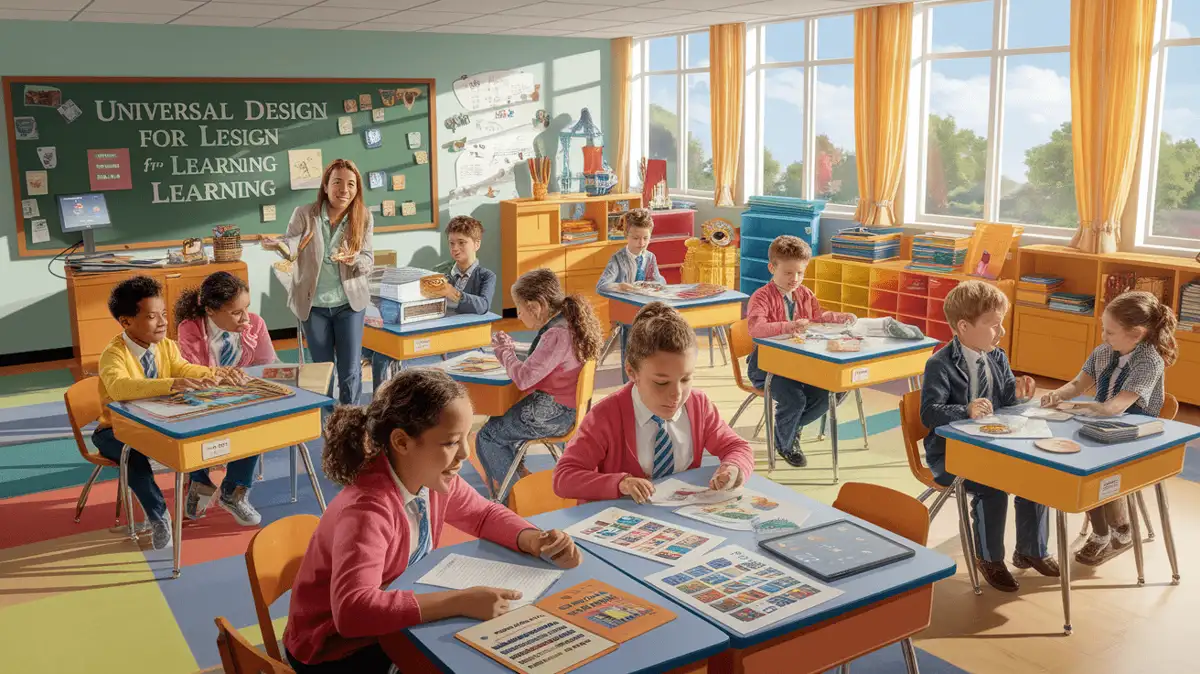
UDL planning action sequence
- Clarify the learning objective, required evidence, and demands that are not part of the objective.
- Identify one likely barrier in engagement, representation, or action and expression using current task evidence.
- Add a purposeful option that removes that barrier while preserving the objective and criteria.
- Teach students how and when to use the option; continue all required accommodations and individualized supports.
- Review use, evidence quality, access, and workload, then retain, revise, or remove the option without labeling learners.
Worked example: separate directions from the science target
Hypothetical example: In a science classification task, the target is to group organisms by observable features, but several students lose their place in multi-step oral directions. The teacher provides the same directions as a numbered text-and-symbol card, reads them aloud, and models the first classification. Students may point, sort cards, or use an approved communication system to show the same reasoning.
The teacher reviews classification accuracy, skipped steps, requests for clarification, and whether the card creates a new visual or language barrier. If evidence improves only because the model reveals the answers, the support is revised. The option is retained when it improves access to directions without changing the classification evidence; it is not proof that one format suits a learner generally.
Copyable UDL option review
Learning objective:
Required evidence:
Demand outside the objective:
Observed or anticipated barrier:
Purposeful option:
Required accommodations retained:
How the option is taught:
Evidence and access review:
Retain, revise, remove, or add support:
Universal Design for Learning supports proactive planning for variability through options for access, participation, and expression. UDL does not guarantee that every option is accessible or replace individualized accommodations and services.
What UDL changes in lesson planning
CAST developed Universal Design for Learning as a framework for planning around learner variability. Use its guidance to identify barriers and select options for access, participation, and expression that fit the objective, then verify those options in practice.
UDL encourages planning more than one appropriate route to the same objective when a single format creates an avoidable barrier. It cannot remove every barrier in advance, so review student work and adjust.
UDL focuses on reducing avoidable barriers in the learning environment rather than treating learner variation as a defect.
Plan options for identified barriers affecting disabled students, multilingual learners, students experiencing temporary difficulties, and others. Check whether an option improves access to the stated objective rather than assuming it benefits every learner or creates equity by itself.
The Three Pillars of UDL in Practice
The framework groups guidance around engagement, representation, and action and expression. Select options for the objective and barrier rather than offering choice without a purpose.
Multiple Means of Engagement
This part of UDL addresses the reasons and conditions that shape participation. Offer relevant choices, clarify the purpose, and gather feedback, but do not infer a student's motivation or assume that choice will create engagement.
When the response format is not itself the objective, a teacher might offer a paper, a podcast with a transcript, or an infographic if each option elicits comparable evidence and meets access and technology requirements. Compare the resulting work instead of assuming that a preferred format will increase engagement.
Collaborative projects or structured debates can be considered when they fit the objective, student age, local policy, and access needs. Treat student interests as one planning input, and check the evidence produced rather than assuming that interest will achieve the curriculum goal.
Multiple Means of Representation
Representation guidance addresses how information is presented. Select representations for the concept, known barriers, and required supports, then check how students interpret them.
Instead of relying solely on textbooks, present important information in more than one accessible format—for example, climate data in a chart, an audio explanation with a transcript, or a hands-on model. Choose options according to the learning goal, known barriers, required accommodations, and student feedback, not presumed visual, auditory, or kinesthetic types.
Provide representations that fit the objective and applicable student plans. Use qualified sign-language interpreting when required, accessible descriptions for diagrams, and content adjustments that do not erase the intended knowledge or reasoning. Check whether each route actually provides access.
Multiple Means of Action and Expression
Action-and-expression guidance addresses how students use information and show what they know. Use alternative response formats only when the format is not part of the learning objective and each route supplies defensible evidence.
When research writing is not the target, a teacher might permit a written essay, captioned documentary, model with explanation, or presentation. Define common criteria first, provide required supports, and do not assume the formats demonstrate mastery equally without reviewing the evidence.
Scaffolds such as writing templates, graphic organizers, or speech outlines may reduce specific barriers. Check whether each scaffold preserves the objective and follow required accommodations; no generic scaffold ensures that every student has what they need to succeed.
Plan a UDL-informed lesson
Applying UDL to the lesson planning process means adding intentional flexibility to an existing objective, sequence, and assessment. Start with a specific barrier rather than adding options for their own sake.
Start with Clear, Flexible Goals
Before selecting activities, establish clear learning goals and objectives that define the intended learning rather than a single response method. State what students should know, understand, or be able to do, then evaluate which response options can provide valid evidence of that objective.
A learning objective should be specific enough to guide instruction and define valid evidence. Alternative routes are appropriate only when they preserve that objective; flexibility does not ensure mastery.
Design with Diversity in Mind
When planning instructional strategies, identify known barriers, required supports, and feasible alternatives from the start. UDL offers planning guidance, not evidence that it is categorically superior to every other planning approach.
Ask which formats provide access to the information, which bounded choices support participation, and which response routes produce valid evidence. These questions can support an adaptable plan, but choice does not by itself establish access or learner autonomy.
Embed Choice Throughout
Offer bounded choices only when each route provides valid evidence of the same objective and meets accessibility, workload, and technology constraints.
Possible options include appropriately scaffolded texts, a captioned video paired with text, or learning stations with equivalent tasks. Use an option only when it preserves the learning goal, meets required supports, and does not create an access, workload, or technology barrier.
Classroom strategies to test
The examples below are possible starting points. Review each one against the objective, student plans, available time, and evidence of access before using it.
Engagement strategies to test
- Choice Boards: Create menus of activities where students can select tasks that align with their interests and strengths
- Relevant Contexts: Connect a lesson to an age-appropriate current event, community issue, or fictional scenario; invite personal experience only as an optional private contribution.
- Collaborative Learning: Design group projects that allow students to contribute their unique strengths to a collective goal
- Student Voice: Regularly ask students what works for them and adjust accordingly
Representation Strategies for Access
- Multimedia Resources: Combine text, audio, video, or interactive elements only when each format serves a defined purpose; do not require multiple formats in every lesson.
- Graphic Organizers: Provide visual frameworks to help students organize information
- Adjusted Text Support: Use appropriately scaffolded or accessible texts while preserving the objective and following student plans; do not assume that a different reading level provides equivalent content.
- Multisensory Approaches: Incorporate visual, auditory, and kinesthetic elements into instruction
Expression Strategies for Assessment
- Portfolio Options: Let students present evidence of learning through collections of their best work
- Performance-Based Assessment: Let students demonstrate knowledge through presentations, demonstrations, or performances
- Digital Tools: Use approved, accessible tools only when they fit the objective, protect student data, and have a non-digital alternative.
- Flexible Timelines: Provide extended time or alternative pacing when required by a student plan or permitted by local policy; do not make consequential changes outside established procedures.
Supporting English Language Learners
When integrating ELD standards into a UDL plan, select supports tied to the language objective, such as visuals, permitted use of a student's other languages, and response formats that do not add irrelevant language demands. Check comprehension through the stated objective rather than assuming that UDL automatically supports every English learner.
Reviewing digital and assistive tools
Digital and assistive tools can support particular actions such as reading text aloud, dictating, organizing work, or presenting information. A tool still needs local approval and review for privacy, accessibility, cost, reliability, and fit with the objective.
Examples of digital access tools
- Text-to-Speech Software: Can render compatible text as audio; verify pronunciation, document structure, licensing, privacy, device access, and fit with the student's required tools.
- Speech-Recognition Tools: Can convert speech to text; review recognition accuracy, background-noise conditions, privacy, accessibility, editing demands, and a non-recording alternative.
- Interactive Whiteboards: Can display and manipulate content; provide an equivalent route when visibility, reach, motion, or interaction creates a barrier.
- Educational Apps: Consider only approved apps whose content, data practices, accessibility, cost, and evidence fit the objective; gamification does not establish learning value.
- Video-Creation Tools: Use only when media production fits the objective and the workflow addresses consent or notice, audience, storage, student data, captions, attribution, device access, and a non-recording option.
Low-tech options
Low-tech options include the materials below. Select one for a specific barrier or task, follow applicable safety and access requirements, and review the resulting student work.
- Seating or movement options approved for the room and consistent with physical access, safety, and individualized requirements
- Printed graphic organizers and templates
- Manipulatives and hands-on materials
- Alternative writing tools (colored pens, different paper types)
- Timer tools for managing work sessions
Making Technology Accessible
Use accurate captions, purposeful text alternatives, keyboard-operable controls, and formats compatible with required assistive technology. These features can reduce particular barriers when implemented correctly, but accessibility requires testing the actual content and following individualized plans.
Reflect, Adjust, and Grow
Treat UDL as an iterative design process: identify one barrier, test an option, inspect the resulting access and learning evidence, and adjust.
Gathering Student Feedback
Students can report barriers and useful options, but their feedback is one source of evidence alongside observed access, student work, individualized plans, and specialist guidance.
- Exit tickets asking what helped them learn best that day
- Brief access surveys asking which task features reduced or created a barrier, without assigning students a fixed learning type
- One-on-one check-ins to discuss what's working
- Peer feedback sessions where students share successful strategies
Professional Development and Growth
Professional learning, implementation guidance, and collaborative planning may help teachers evaluate UDL options. Select support that matches the local role and barrier, and judge it by changes in planning and student evidence rather than assuming it will produce student success.
Collaborative Problem-Solving
Work with colleagues, special education specialists, and other support staff to identify solutions to implementation problems. Useful options may emerge in either informal staff conversations or scheduled planning sessions.
Recording Effects and Remaining Barriers
Record which option or alternative removed a barrier, what evidence the learner produced, and what still requires adjustment. Interest or participation in one lesson does not establish a durable or general change.
Review one barrier and one option
Identify one barrier, plan one feasible option, and compare the resulting evidence with the stated objective. Record preparation demands and student feedback; keep, revise, or remove the option accordingly. UDL options supplement required individual supports, and evidence from one task does not establish broader academic, identity, or life outcomes.
Classroom resources for this teaching goal
- Clear Directions and Language-Support Pack — Use the planner and worked examples to clarify a task's words and steps while keeping the learner's thinking decisions visible. Record support that changes what a response can show.
- Objective-to-Assessment Alignment Pack — Use the blank planner and fictional worked alignments to check whether a task elicits the objective and produces evidence recognized by its criterion.
Tools in this guide: Plan from an access barrier with a UDL sequence, a focused directions example, and a copyable option review.