
Inclusion and Accessibility
Differentiated Instruction: Targets, Barriers, Supports, and Evidence
Also in: Instructional Strategies
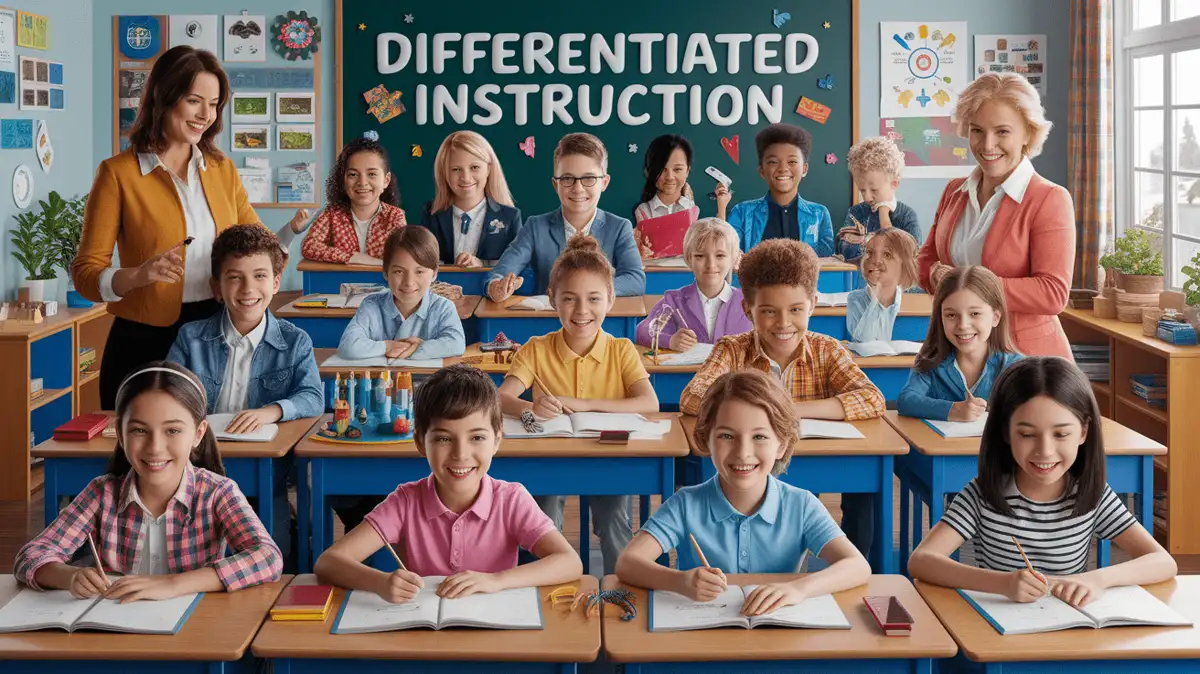
Differentiated instruction can vary access to content, support during the learning process, grouping, pacing, or product routes while preserving the intended learning goal and required supports. The IRIS module distinguishes content, process, and product. Use evidence from the actual task to decide which change, if any, is needed.
For every tiered text, podcast, skit, model, or response choice, check content, language demand, preparation, and the evidence criterion. When reading or writing is itself assessed, an alternate medium may support practice but cannot by itself demonstrate that construct. Apply required individual accommodations under the relevant assessment conditions.
Define the differentiation decision
Differentiated instruction does not replace an IEP, 504 plan, individualized accommodation, or a support-team decision. Follow required plans, consult the authorized support team when a barrier or accommodation is unclear, and use ordinary classroom options only when they do not conflict with those requirements.
Differentiated instruction does not require a separate lesson plan for every student. Plan a shared learning goal, identify likely differences in prior evidence or access needs, and vary tasks, supports, grouping, or response formats when those differences affect the target.
Use differentiation in response to a defined barrier, support need, or difference in current task evidence. State what will change, what learning target will remain constant, and how the effect will be reviewed.
Differentiation is a planned change to content access, process, support, product, grouping, pacing, or environment in response to a defined learner need while preserving the intended target. Equity requires examining access and opportunity, but a differentiated format does not guarantee engagement, challenge, support, or success for every student.
Differentiation Strategies
Differentiated instruction can vary four aspects of a lesson. Select among them according to the objective, current evidence of student understanding, and access needs.
Content: What Students Learn
Content is the information and skills named in the objective. Content differentiation changes how students access or work with that material without silently changing the intended learning target.
- Tiered Readings: For supported practice, select texts whose content and language demands suit the task. Topic similarity alone does not establish equivalent evidence. If reading a specified text is the assessed construct, retain that text and the authorized supports in the final check.
- Varied Media: Supplement a core text with videos, podcasts, or infographics that convey the same central concepts.
- Learning contracts: Define required tasks, checkpoints, and pacing options, with an optional extension tied to the same objective when current work indicates it is appropriate.
Process: How Students Learn
Process is the activity or practice through which students work with the content. Change the process only when current evidence or an access requirement identifies a reason to do so.
- Flexible grouping: Use pairs, small groups, and individual work according to the task. Group by current task evidence, a voluntarily stated interest, support needs, or at random, then review individual evidence before regrouping; do not treat a group as a fixed readiness label.
- Choice boards: Offer a bounded set of tasks that address the same objective and use the same non-negotiable evidence criteria.
- Hands-On Activities: Offer manipulatives, experiments, or role-playing scenarios as an alternative to a traditional worksheet.
Product: How Students Show What They Know
Product is the response or work used to demonstrate the intended construct. Offer compatible formats only when each format provides the evidence required by the objective and authorized assessment conditions.
- Tiered Assessments: Create versions of a test or project that are more or less scaffolded, but assess the same core standards.
- Varied Formats: Instead of only a written report, allow students to create a podcast, design a presentation, write and perform a skit, or build a physical model.
- RAFT Assignments: Ask students to write or create from a specific perspective by defining the Role, Audience, Format, and Topic.
Learning Environment: Where Students Learn
The learning environment includes physical, sensory, social, and procedural conditions. Adjust a specific condition when it creates an identified barrier, and confirm the effect through participation and work evidence rather than inferring that every learner feels safe or supported.
- Flexible Seating: Provide different seating options, such as wobble stools, floor cushions, or standing desks, to meet physical and sensory needs.
- Quiet Zones vs. Collaboration Stations: Designate areas in the room for different types of work.
- Clear Routines: Establish clear procedures so students know how to work independently, transition between groups, and access materials without constant teacher direction.
Which part of the lesson should change?
| Current evidence or barrier | Possible change | Keep constant | Review |
|---|---|---|---|
| Students lack prerequisite vocabulary but can reason about the concept. | Preteach key terms and add a glossary or labeled model. | The concept and reasoning expected. | Whether students use the terms accurately in an explanation. |
| Students understand the idea but the response mode creates an access barrier. | Offer an authorized oral, typed, drawn, or assisted response route. | The construct and scoring criteria. | Whether each route yields interpretable evidence of the same target. |
| Current work shows different misconceptions. | Use temporary groups for targeted models or practice. | The shared objective and access to core instruction. | New individual work before regrouping. |
| Students have already met the target. | Offer an extension that applies or justifies the same learning. | Required evidence and access to feedback. | Whether the extension deepens the target rather than adding unrelated work. |
Worked example: preserve the science target
Hypothetical example: The objective is to explain heat transfer using evidence from a demonstration. An entry response shows that several students can name conduction but do not connect particle motion to the observed temperature change. The teacher keeps the explanation target, models one cause-and-effect sentence with a diagram, and gives those students a short frame for their first explanation. Other students begin with the unframed prompt; students who already explain the mechanism compare two materials.
The teacher then collects one explanation from every student and checks the same criteria: a claim about heat transfer, relevant evidence, and a causal link. If the frame produces copied wording without the causal link, it is revised or removed. The grouping is temporary and changes with the next individual evidence.
Copyable differentiation decision record
Shared objective:
Current evidence or access barrier:
Required plan or accommodation:
Content, process, product, grouping, pacing, or environment change:
What remains constant:
Individual evidence to collect:
Retain, revise, remove, or regroup when:
Implementing Differentiation in Class
Begin with one lesson and one identified need. Gather evidence about learners’ current understanding, interests, strengths, and support needs through entry tickets, short surveys, and observation. Use that evidence to select a specific adjustment.
Apply one adjustment, such as a bounded choice board in a history unit or regrouping students during a mathematics task. Compare the resulting student work and access evidence with the intended objective. Then retain, revise, or remove the adjustment without assuming effects on confidence or motivation.
Monitor and adjust the approach
Review each differentiation adjustment over time. Use brief checks, observation, and student work to determine whether it supports the stated objective, then retain, revise, or remove it.
Use brief evidence sources to review the adjustment:
- Exit tickets: Ask one objective-aligned question at the end of class and use the response to identify the next model, practice step, extension, or support.
- Think-Pair-Share: Listen to student conversations to check understanding.
- Student reflection: Ask students to identify which part of the task was clear, which step was difficult, and which support affected their work; do not use a confidence rating as a substitute for task evidence.
Use the evidence to choose a reteach, additional model, different example, practice set, or extension. Review whether the adjustment preserved the objective and produced clearer evidence.
Review differentiation over time
Review differentiation decisions with colleagues by comparing the objective, adjustment, and resulting student work. Use those discussions to identify one change to test without assuming an informal exchange will produce a useful idea.
Use digital tools only when they serve a defined instructional need. Adaptive software may supply additional practice, and a platform such as Google Slides can distribute a choice board; review accessibility, privacy, content accuracy, teacher workload, and student evidence before retaining either approach.
Select a strategy based on the objective, current evidence, access barrier, and available support rather than mixing options for variety. Check its effect on individual participation and work, and revise without inferring how every student feels.
Summary
- Target one decision: Change one task demand or support in response to evidence rather than adding options without a defined purpose.
- Review four areas: Consider content access, process, product, and the learning environment, while preserving the intended target and required supports.
- Test one adjustment: Implement one bounded change, such as a choice board or flexible grouping, and compare student work and access evidence before deciding whether to retain it.
- Collect usable evidence: Use objective-aligned exit tickets, observation, and student work to choose the next instructional response.
- Use flexible grouping deliberately: Group and regroup students based on readiness, interest, or the task, and review individual evidence before regrouping.
- Offer bounded choices and request feedback: Provide options that assess the same target, state non-negotiable criteria, and ask which barrier or support affected the task. Choice and feedback do not by themselves establish ownership or motivation.
Tools in this guide: Choose an adjustment with a comparison table, a worked differentiation decision, and a copyable evidence-review record.
Classroom resources for this teaching goal
- Clear Directions and Language-Support Pack — Use the planner and worked examples to clarify a task's words and steps while keeping the learner's thinking decisions visible. Record support that changes what a response can show.
- Check for Understanding and Choose the Next Step — Use the record and fictional examples to separate an observable response from its interpretation, choose one teaching move and plan a check of the same target.