
Free Grade 6 mathematics teaching kit
Equivalent Ratios: Scale Both Quantities
Current teacher guidance: 2 November 2026. Student tasks retain their stated core editions. Use the current stage choices and matching guide below.
Changes in the current files · 2 November 2026
- The teacher guide includes annotated fictional sound, partial and error responses, with concrete teaching actions and evidence to seek next.
Prepare the current paper lesson
Generate or reject a candidate equivalent ratio by explaining how both labeled quantities change together.
Prepare this lesson — make a concise run sheet, choose teaching pages to present and keep a reusable local plan.
Intended US Grade 6 mathematics · edition 0.2.2. AI-assisted materials; classroom effectiveness has not been established.
Current teacher guidance: 2 November 2026. Student tasks retain their stated core edition; use the matching current guide linked here. Earlier files are kept separately in the archive.
- Before starting
- Count and name the two quantities in a ratio, preserve their order, and use equal groups or multiplication/division with whole numbers. The student lesson includes a short introduction to 'for every' and colon notation. Fraction and decimal work also requires interpreting one half and multiplying a decimal by one half or three halves.
- Prepare
- Ordinary paper and pencil; counters are optional. Check readiness before selecting whole-count or fractional-length work.
- Timing
- Published planning estimates: preparation 4–6 minutes; full lesson 40–55; focused follow-up 8–12; independent check 4–6. Revisit later after another learning opportunity.
- Evidence to notice
- Look for both labeled quantities changing by the same factor, a meaningful explanation, and attention to the difference between whole objects and continuous lengths.

Choose the stage to prepare
- Initial readiness · 1 page
Browser copy · Editable Word · Student PDF - Model and guided practice · 4 pages
Browser copy · Editable Word · Student PDF - Independent response — reserve until after teaching · 2 pages
Browser copy · Editable Word · Student PDF - Selected response — use after clarification · 2 pages
Browser copy · Editable Word · Student PDF - Later reassessment — save for another learning opportunity · 2 pages
Browser copy · Editable Word · Student PDF - Extension — optional · 1 page
Browser copy · Editable Word · Student PDF
For the teacher, separately: Matching guide and answers · 12 pages. Keep answers with the teacher and give each reserved task only at its intended stage.
Matching teacher-only formats: Teacher browser copy · Editable teacher Word · Teacher PDF.
Choose a next teaching move · Find another resource · Detailed fit and existing editions below
Choose from the evidence
A next teaching move, not a diagnosis
Use what the learner actually said, wrote or showed. First check access to the prompt and the named prerequisites; clarify the quantity, wording or calculation before interpreting the response. A single answer does not establish a persistent difficulty.
- Start with the supplied task
- Observe and clarify
- Try guided practice
- Use the separate independent check
- Revisit later
Start with the supplied task
Readiness pages. Use the response to choose where teaching should begin.
Observe, then clarify before choosing a response
These options come from this edition’s teacher guidance. Select an observation to inspect a possible teaching response; no option assigns a learner a diagnosis.
A response uses the same addend on both unequal quantities, after the learner has correctly named the quantities.
Teacher move: One complete group needs both parts. Sketch the first 2-triangle-and-3-circle group, then a second and third. Count each type. Which part is missing from the proposed 6-and-7 model?
Look for new evidence: Look for a matching number of complete groups and an explanation that both parts change together.
Open the response pack at response 1. The PDF contains both response lessons (2 pages); the page link does not restrict printing. Choose the matching response in the teacher guide.
Matching teacher guide and answers · for the teacher only.
The numerical quantities are correct, but the response does not reveal why they preserve the relationship.
Teacher move: Start with the quantity we know. How many groups of seven are in twenty-one? What must those same groups mean for the square tiles? Show this in a table, then explain it in your own words.
Look for new evidence: Look for the factor connected to both labeled quantities, not a memorized number pair.
Open the response pack at response 2. The PDF contains both response lessons (2 pages); the page link does not restrict printing. Choose the matching response in the teacher guide.
Matching teacher guide and answers · for the teacher only.
Try guided practice and check what changed
Use the model and guided-practice pages. Look for both labeled quantities changing by the same factor, a meaningful explanation, and attention to the difference between whole objects and continuous lengths. If the response is still unclear, return to access, prerequisites and the teacher’s clarification prompts rather than choosing a label.
Use the independent task separately
Independent student pages · 2 pages. Keep the matching teacher answers separate. Compare the explanation as well as the result; decide what teaching to try next from the supplied criteria.
Save the later task for another learning opportunity
Later student pages · 2 pages. This is a different task or context, not a calibrated equivalent test or proof of general mastery. Use the teacher guide to interpret the evidence and its limits.
Full-route fit notes
- Audience / fit
- Grade 6 math
- Teaching or planning target
- Explain equivalent ratios by scaling both labeled quantities together, including scaling down where taught.
- Essential prerequisites
- Count and name the two quantities in a ratio, preserve their order, and use equal groups or whole-number multiplication and division. The lesson introduces “for every” and colon notation.
- Preparation
- About 4–6 minutes, estimated.
- Use time
- 40–55 minutes for the full route; planning estimate.
- Materials
- Ordinary paper and pencil. Counters are optional; learners can sketch groups.
- What to print
- Use the stage-specific student choices below and the matching teacher guide. Give independent, new-evidence and later-assessment pages only at their intended stage.
Archive: More formats and existing route guidance
Earlier guidance and source files are retained as historical records. For classroom teaching and printing, use the current stage files and matching guides above. Older guidance, timing and layouts are superseded; some retained browser/Word files have limited writing space or sparse extra pages. Keep historical student files with their historical keys and do not mix editions.
Teach, check and respond
AI-assisted teaching materials.
Edition 0.2.2. United States Grade 6 mathematics. Start with readiness, teach both-quantity scaling, then use a separate check. The optional fractional-length bridge requires halves and decimal multiplication.
Preview a teaching task
A pattern uses 3 star stickers for every 5 circle stickers. It needs 6 stars. How many circles keep the same relationship?
Keep independent tasks and later checks with the teacher until the selected stage. Give a later check after another learning opportunity. The teacher file includes answers; keep it separate from student handouts.
Choose stages and editable formats
- Readiness · PDF (1 page) · Editable Word · Browser copy
- Model and guided practice · PDF (4 pages) · Editable Word · Browser copy
- Independent check · PDF (2 pages) · Editable Word · Browser copy
- Response mini-lessons · PDF (2 pages) · Editable Word · Browser copy
- Later check after teaching · PDF (2 pages) · Editable Word · Browser copy
- Whole-object extension · PDF (1 page) · Editable Word · Browser copy
- Teacher quick start and complete keys · PDF (9 pages) · Editable Word · Browser copy
Readiness, taught practice and later checks have different demands. These tasks are not calibrated assessments.
Preparation and teaching times are planning estimates. Print and adapt under the Terms of Use; report a resource issue without student names or identifiable work.
Archive: Earlier lesson files
Earlier guidance and source files are retained as historical records. For classroom teaching and printing, use the current stage files and matching guides above. Older guidance, timing and layouts are superseded; some retained browser/Word files have limited writing space or sparse extra pages. Keep historical student files with their historical keys and do not mix editions.
These earlier editions remain available. Use one edition consistently; keep its own teaching pages and key together.
Start teaching
Readiness check only · PDF (1 page)
Model and guided practice · PDF (2 pages)
Start with the one-page readiness check if needed, then teach using the separate model and guided-practice pages. Give the independent check afterward. The original six-page lesson combines teaching, independent tasks and an extension; keep that complete reference packet with the teacher. The later-revisit tasks are separate.
Choose a stage and format
Give only the stage being used. Keep later tasks and all teacher keys with the teacher until needed.
- Readiness check only · PDF (1 page) · ·
- Model and guided practice · PDF (2 pages) · Model and guided practice · editable Word · Model and guided practice · browser copy
- Independent check · PDF (3 pages) · ·
- Whole-group extension · PDF (1 page) · Whole-group extension · editable Word · Whole-group extension · browser copy
Archive: Formats and all files
Earlier guidance and source files are retained as historical records. For classroom teaching and printing, use the current stage files and matching guides above. Older guidance, timing and layouts are superseded; some retained browser/Word files have limited writing space or sparse extra pages. Keep historical student files with their historical keys and do not mix editions.
Complete reference files may include teaching, independent tasks, later evidence or teacher answers. Keep them with the teacher; use the separate stage selections above for handouts.
Use complete groups and a ratio table to explain equivalent ratios, challenge a same-addend error, and choose a focused follow-up. Begin with a separate readiness task and a short introduction to ratio language. The kit includes a model, three guided tasks, three independent tasks, two supplied reteaching routes, two later tasks, and an extension.
All files are free. No email address, account, payment, trial or subscription is required.
- Who it is for
- Grade 6 mathematics; check prerequisites and local curriculum fit.
- Preparation
- About 4–6 minutes, estimated.
- Teaching time
- Full lesson about 35–45 minutes; independent check about 4–6 minutes; selected follow-up about 8–12 minutes. These are planning estimates, not classroom-timed results.
- Materials
- Ordinary paper and pencil. Counters are optional; learners can sketch groups.
- What’s included
- Printable student materials and editable files are supplied with separate teacher guidance.
Choose what to print
- Teach the full lesson: give the separate Readiness page first, before showing the introduction. Then use Teach the Lesson pages 1–6. The first page explains “for every” and colon notation; later pages contain the model, guided work, and independent tasks.
- Use a short check: print Check-only pages 1–3. These repeat the lesson's three independent tasks, so use one copy or the other.
- Teach one follow-up: use Follow-up page 1 for complete matched groups after same-addend reasoning, or page 2 to explain a valid ratio when the known quantity is second.
- Look again later: use Later Revisit pages 1–2 after another learning opportunity. The tasks are fresh, but compare the reasoning students show in each context.
Use the Start Here guide in HTML for the complete route and page selection. The representation glossary and optional local planning record are also available as HTML. Keep any student notes local; the site does not collect student responses.
Archive: Earlier edition preview
Earlier guidance and source files are retained as historical records. For classroom teaching and printing, use the current stage files and matching guides above. Older guidance, timing and layouts are superseded; some retained browser/Word files have limited writing space or sparse extra pages. Keep historical student files with their historical keys and do not mix editions.
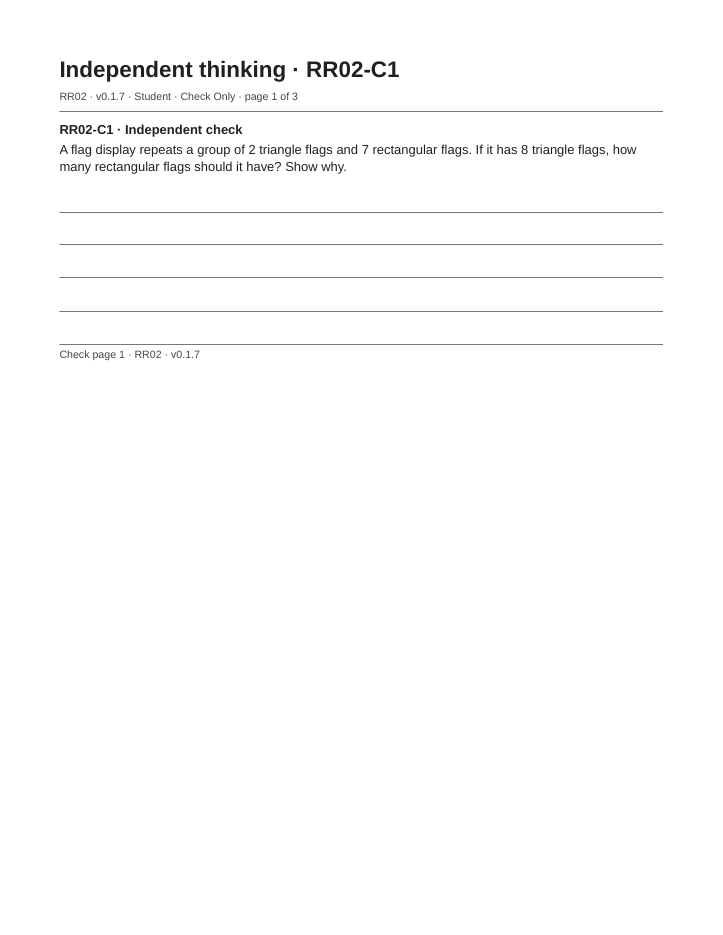
Read the three independent tasks as HTML. Answers and routing guidance are in the separate teacher guide.
Student files
- Readiness page — Printable PDF (24 KB)
- Readiness page — Editable Word file (37 KB)
- Readiness page — HTML text (3 KB)
- Full lesson — Printable PDF (51 KB)
- Full lesson — Editable Word file (38 KB)
- Full lesson — HTML text (8 KB)
- Independent check only — Printable PDF (29 KB)
- Independent check only — Editable Word file (37 KB)
- Independent check only — HTML text (4 KB)
- Two focused follow-up routes — Printable PDF (28 KB)
- Two focused follow-up routes — Editable Word file (37 KB)
- Two focused follow-up routes — HTML text (3 KB)
- Later revisit tasks — Printable PDF (26 KB)
- Later revisit tasks — Editable Word file (37 KB)
- Later revisit tasks — HTML text (3 KB)
Teacher files and shared tools
- Teacher guide and complete key — Printable PDF (86 KB)
- Teacher guide and complete key — Editable Word file (41 KB)
- Teacher guide and complete key — HTML text (17 KB)
- Start Here guide — Printable PDF (29 KB)
- Start Here guide — Editable Word file (37 KB)
- Start Here guide — HTML text (3 KB)
- Representation glossary — Printable PDF (31 KB)
- Representation glossary — Editable Word file (37 KB)
- Representation glossary — HTML text (3 KB)
- Optional local planning record — Printable PDF (26 KB)
- Optional local planning record — Editable Word file (37 KB)
- Optional local planning record — HTML text (3 KB)
Use the response cautiously
Look separately at quantity order, complete groups or a shared factor, arithmetic, units, and explanation. A blank or unclear response calls for clarification before a content reteach. A short correct response does not establish broad ratio mastery. The later tasks change context; one also asks learners to scale down.
This kit addresses part of the equivalent-ratio work in 6.RP.A.3a. It does not cover coordinate plotting or the complete Grade 6 ratios domain. Check the prerequisites for your class.
About the materials
You may print, copy and adapt the resource for your planning and classroom use under our Terms of Use. Report a resource issue.
Use familiar practice beyond the lesson
Keep this lesson’s target when preparing familiar practice beyond the lesson. Prepare a substitute handoff with the exact student pages and return instructions. Plan neutral directions and representation supports that preserve the mathematics. Offer a brief family conversation about practice already taught.
Keep teacher keys and later checks with the teacher. Previously shown or helped work is practice; record the support before interpreting a response.
When quantity meanings need first teaching
Explain Equal Groups, Comparisons and Shares — Before paired ratios, teach one-quantity group roles and distinguish copies from an additive difference when those meanings are unclear.
Move from a supplied rate to testing a relationship
When paired-ratio and per-one reasoning are secure, the selected Grade 7 Proportional Relationships collection teaches multi-row tests, tables, rules, graphs, starting amounts and model limits. It supplies actual response lessons, different independent checks, transfer and complete keys. This adds a new reasoning target; keep this resource’s own tasks and exposure records for their original purpose.
Editable Word files
Choose the editable files for this resource and keep teacher guidance separate.
Share this resource
Report a resource issue · Open an issue email
Do not include student names or identifiable work in an issue report. Page revision: 15 October 2026; classroom files retain their own editions.