
Free Grade 6 mathematics teaching kit
Find and Interpret “Per One”
Is this the right resource?
- Audience / fit
- Grade 6 math
- Teaching or planning target
- Find a requested unit rate and explain which quantity is measured per one of the other quantity.
- Essential prerequisites
- For Grade 6 mathematics. Start with the equivalent-ratio lesson if students need help naming quantities in order, making equivalent groups or dividing whole numbers.
- Preparation
- Review the teacher decision table and select readiness, lesson or check pages; preparation time depends on the route.
- Use time
- Teach, check and respond in separate selected steps; use time depends on prior learning and the response task.
- Materials
- Paper and pencil. Optional counters for equal groups. No device, purchase, account or email is needed.
- What to print
- Use the primary PDF choice below and its matching adult guide. Print only the phase/task being used; keep complete keys and later checks with the teacher.
Prepare → teach → check → respond
- Prepare: keep the readiness task separate · PDF (1 page)
- Teach: show quantity for one, then practice · PDF (2 pages)
- Check: collect an independent response · PDF (2 pages)
- Respond: choose a teaching move from the decision table · PDF (17 pages)
Use the teacher guide’s complete keys and alternatives. Save different follow-up and later tasks until their intended use.
Formats and all files
Browse free resources · Unit-rate collection and starting route
Find a requested unit rate, label both quantities and explain what “per one” means. Use separate checks and supplied response tasks.
All files are free, with no account, email address, payment or subscription.
Choose what to give learners
- Give Readiness alone before showing the model, glossary or lesson.
- Teach the Model and guided lesson, then give only the separate Independent check. The lesson and check use different problems.
- Use the teacher guide to choose one supplied continue, clarify, reteach or extend task. Give only that route file.
- Reserve the follow-up check, Later revisit and Transfer files until their intended occasion. Previously shown tasks are practice, even when completed independently.
Keep answer keys with the teacher. Note which tasks students have already seen, the tools and support they used, and how they responded. Keep student notes locally. The Start Here guide explains the prerequisites and pages to select across the three kits.
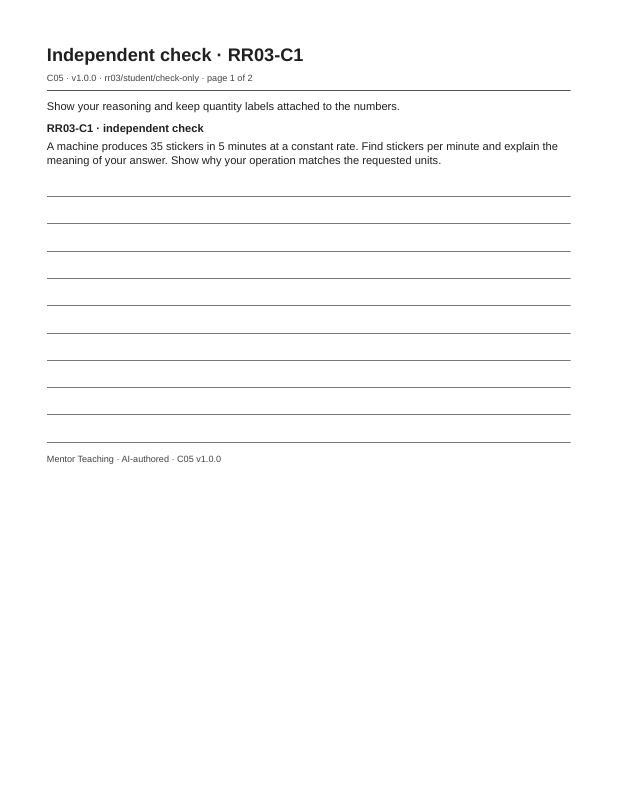
Read the independent check as HTML. Answers and next teaching moves are in the separate teacher guide.
Student files
- Readiness — give before the lesson: Printable PDF · Editable Word file · HTML text
- Model and guided lesson: Printable PDF · Editable Word file · HTML text
- Independent check — separate from the lesson: Printable PDF · Editable Word file · HTML text
- Use a unit rate to find a new total: Printable PDF · Editable Word file · HTML text
- Explain what “per one” means: Printable PDF · Editable Word file · HTML text
- Find a unit rate with equal groups: Printable PDF · Editable Word file · HTML text
- Compare rates in both directions: Printable PDF · Editable Word file · HTML text
- Follow-up check — use after practice: Printable PDF · Editable Word file · HTML text
- Later practice — use at another learning opportunity: Printable PDF · Editable Word file · HTML text
- Transfer task: Printable PDF · Editable Word file · HTML text
Teacher guide and shared tools
- Teacher guide, complete keys and response routes: Printable PDF · Editable Word file · HTML text
- Collection Start Here and print selections: Printable PDF · Editable Word file · HTML text
- Representation glossary: Printable PDF · Editable Word file · HTML text
- Local teacher decision record: Printable PDF · Editable Word file · HTML text
Use the response to choose a next move
Look separately at calculations, unit labels, direction and explanation. Clarify an unclear response before choosing a practice task. After practice, collect students’ responses to a follow-up task, noting any support used.
Scope, sources and reuse
Interpret per one, preserve direction and units, compare on the same basis, explain ties and missing information, and apply a stated constant rate. No percent, measurement conversion, coordinate graphing, complex fractions or complete proportionality course. These kits address 6.RP.A.2 and selected unit-rate applications from 6.RP.A.3b; they do not assess the whole standard or a complete mathematics course.
Teachers may print, use and adapt these original materials for their teaching. Retain Mentor Teaching attribution and identify local changes. Numerical data and examples are constructed, not classroom observations.
Use the editable files to adapt the materials to your learners and local curriculum.
Previous classroom editions
Find and Interpret Per One — teacher: Read in browser (previous edition) · Editable Word (previous edition) · PDF (previous edition)
Find and Interpret Per One — student lesson: Read in browser (previous edition) · Editable Word (previous edition) · PDF (previous edition)
Use familiar practice beyond the lesson
Keep this lesson’s target when preparing familiar practice beyond the lesson. Prepare a substitute handoff with the exact student pages and return instructions. Plan neutral directions and representation supports that preserve the mathematics. Offer a brief family conversation about practice already taught.
Keep teacher keys and later checks with the teacher. Previously shown or helped work is practice; record the support before interpreting a response.
Choose a next move
- Equivalent Ratios — First teaching for labeled ratio order and equivalent groups.
- Compare Unit Rates on the Same Basis — Move to fair comparisons when per-one meaning and units are secure.
- Collection starting route — Choose the entry point and obtain the complete offline classroom package.
- Substitute Handoff and Independent-Work Pack — Prepare familiar ratio or rate practice with complete student pages, established routines and a return route.
- Clear Directions and Language-Support Pack — Plan neutral directions and representations while keeping quantity labels, rate direction and explanation visible.
- Practical Family-Communication Templates — Invite a short conversation about familiar mathematics; keep later classroom checks and teacher keys at school.
When quantity meanings need first teaching
Explain Equal Groups, Comparisons and Shares — Before fractional per-one amounts, use the equal-shares model to explain division as a fraction of a fixed measured unit; retain the separate ratio and rate-direction teaching.
Discuss unit-rate reasoning with a mentor
Use the complete unit-rate mentoring rehearsal when the professional goal is interpreting a learner’s response and deciding what to teach next. Its fictional equal-sharing case connects the rate’s unit to a neutral probe, conditional teaching and a fresh check. The mathematics lessons and learner downloads on this page remain the route for further per-one teaching.
Move from a supplied rate to testing a relationship
When paired-ratio and per-one reasoning are secure, the selected Grade 7 Proportional Relationships collection teaches multi-row tests, tables, rules, graphs, starting amounts and model limits. It supplies actual response lessons, different independent checks, transfer and complete keys. This adds a new reasoning target; keep this resource’s own tasks and exposure records for their original purpose.
Editable Word files
Choose the editable files for this resource and keep teacher guidance separate.
Share this resource
Report a resource issue · Open an issue email
Do not include student names or identifiable work in an issue report. Page revision: 15 October 2026; classroom files retain their own editions.