
Grade 6 reading: focused practice and later checks
Central Ideas and Summaries: Check and Next Teaching
Current preparation is shown below. Student tasks and matching guidance retain their stated editions. Earlier page guidance and source files are kept in the archive.
Changes in the current files · 2 November 2026
- Editable links use the matching structured Word selections, including their table or list structure.
Prepare the materials
Prepare this lesson or activity
Recommended selection edition 1.0.0. Original source files retain their displayed editions.
Use the matching guide to choose a response to the work you observe. Clarify access and task wording first; one response is not a diagnosis. Keep independent work, later tasks and answers aside until their intended use. The teacher guide supplies the models and guided prompts; the student focused-practice file is not a separate first-teaching lesson.
- Audience / fit
- Grade 6 ELA
- Teaching or planning target
- Help Grade 6 readers move from a summary response to focused teaching: find the whole-passage point, choose and combine details, correct overstatements, then try different check and comparison texts.
- Essential prerequisites
- Students can read or listen to a short passage and attempt a summary. Use Identify a Central Idea and Write a Summary before a check when the main point and summary need first teaching.
- Preparation
- Read Start Here; print only selected files; preparation time depends on the selected route.
- Use time
- Plan the selected route from the teacher guide
- Materials
- Selected student pages, paper and pencil or an established response method, and the separate teacher guide.
- What to print
- Print the chosen activity. Follow the source or reveal instructions beside it.
Evidence to notice: Look for a central idea supported by relevant details and a concise, accurate summary in the learner’s own words.
Preview the actual student page
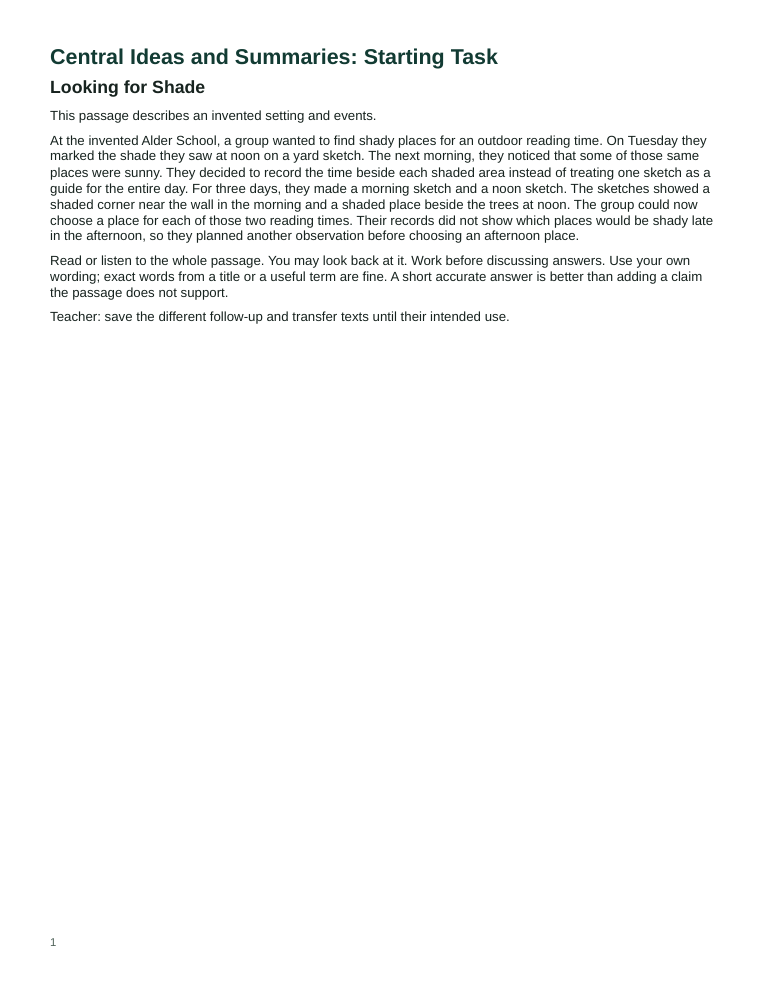
Start with the selected task
Matching teacher guide and answers — keep separate: Matching teacher guide and answers · 7 pages.
Compare the observed response with the guide’s criteria. Clarify access and wording, then use its conditional directions to choose an activity below. Follow-up and later tasks are not interchangeable test forms.
Teaching stages, response practice and later checks
Starting tasks
- Starting check · 2 pages
PDF · Editable Word · Read in browser
Focused teaching responses
- Focused practice · 4 pages
PDF · Editable Word · Read in browser
Follow-up checks
- Follow up check · 2 pages
PDF · Editable Word · Read in browser
Later tasks — reserve for another occasion
- Later transfer · 2 pages
PDF · Editable Word · Read in browser
Teacher files — separately
- Start here · 3 pages · Teacher PDF · Editable teacher Word · Read in browser · teacher copy
- Matching teacher guide and answers · 7 pages · Teacher PDF · Editable teacher Word · Read in browser · teacher copy
- Planning record · 2 pages · Teacher PDF · Editable teacher Word · Read in browser · teacher copy
- Print and exposure guide · 2 pages · Teacher PDF · Editable teacher Word · Read in browser · teacher copy
Archived page guidance and source files · Write a local teaching plan
Current print and editable package
Library package prepared 2 November 2026. Revised guides are marked with that date; other files retain their stated editions. Keep this package with the teacher. Read START-HERE, choose one stage, and retain teacher keys and checks for later use in their separate folders. Online browser versions are linked from the preparation pages.
Central Ideas and Summaries: Check and Next Teaching · current ZIP · 0.5 MB
Choose from the response
Choose the next teaching move
Describe what the learner said, wrote or showed. Check access, wording, prerequisites and calculation before interpreting it. A single response is not a diagnosis. Record support and prior exposure; a helped or rehearsed task is practice.
For first teaching, use the linked original summary lesson. Teacher-guide pages 2–3 supply models and guided prompts; Focused Practice is not a separate first-teaching lesson. Give the new entry task only if unused, then the unused follow-up after another opportunity. Later transfer adds a comparison demand.
Start with the supplied materials
Teacher model and guided prompts, pages 2–3 are teacher guidance, not a student handout.
Observe, clarify and select one response
There is no usable response yet.
Teaching move: Check text access, directions and a way to respond. Invite the learner to explain the task without diagnosing a reading difficulty.
Read the matching teacher directions; keep answers with the teacher.
Only a topic or isolated detail is supplied.
Teaching move: Find the whole-passage point; ask how it fits the beginning and ending.
Read the matching teacher directions; keep answers with the teacher.
A supported point has small or unrelated details.
Teaching move: Choose and Combine Details: check whether each detail explains the point.
Read the matching teacher directions; keep answers with the teacher.
Relevant details are copied as a list.
Teaching move: Model combining and paraphrasing with the passage available; copying alone does not settle understanding.
Read the matching teacher directions; keep answers with the teacher.
The summary adds opinion, an invented result or an overstatement.
Teaching move: Keep the Meaning Accurate: check each claim and retain the passage’s limitation.
Read the matching teacher directions; keep answers with the teacher.
Point, details, concise wording and accuracy are secure here.
Teaching move: Compare defensible summaries and justify an omission, then use a different text later.
Read the matching teacher directions; keep answers with the teacher.
Look again after teaching
After selected response teaching and another learning opportunity, use the unused follow-up task.
Return on a later occasion
Reserve these tasks until their intended use. They have different demands; do not treat them as equivalent tests or proof of broad mastery.
Return to preparation and all formats · Complete teacher guide and answers
Archive: Additional formats, earlier editions and teaching guidance
Earlier guidance and source files are retained as historical records. For classroom teaching and printing, use the current stage files and matching guides above. Older guidance, timing and layouts are superseded; some retained browser/Word files have limited writing space or sparse extra pages. Keep historical student files with their historical keys and do not mix editions.
Is this the right resource?
- Audience / fit
- Grade 6 ELA
- Teaching or planning target
- Help Grade 6 readers move from a summary response to focused teaching: find the whole-passage point, choose and combine details, correct overstatements, then try different check and comparison texts.
- Essential prerequisites
- Students can read or listen to a short passage and attempt a summary. Use Identify a Central Idea and Write a Summary before a check when the main point and summary need first teaching.
- Preparation
- Read Start Here; print only selected files; preparation time depends on the selected route.
- Use time
- Plan the selected route from the teacher guide
- Materials
- Selected student pages, paper and pencil or an established response method, and the separate teacher guide.
- What to print
- Use the primary PDF choice below and its matching adult guide. Print only the phase/task being used; keep complete keys and later checks with the teacher.
Start teaching
Starting passage and response · PDF (2 pages)
Read the starting and print guide · PDF (3 pages)
Complete teacher guide, answers and alternatives · PDF (7 pages)
Print only the student pages you plan to use. Keep teacher answers and later checks with the teacher until their intended use.
Archive: Formats and all files
Earlier guidance and source files are retained as historical records. For classroom teaching and printing, use the current stage files and matching guides above. Older guidance, timing and layouts are superseded; some retained browser/Word files have limited writing space or sparse extra pages. Keep historical student files with their historical keys and do not mix editions.
Browse free resources · Summary collection and starting route
Help Grade 6 readers move from a summary response to focused teaching: find the whole-passage point, choose and combine details, correct overstatements, then try different check and comparison texts.
Start with the teaching need
- If students need the introduction, use Identify a Central Idea and Write a Summary first. It already supplies a model, guided practice and keys.
- If earlier summary texts are familiar, use the new Starting Task before discussion. Identify what the response shows and what remains unclear.
- Choose the supplied practice for a whole-passage point, relevant detail selection and compression, objective accuracy, or comparison of defensible summaries.
- After teaching, use the different Follow-Up Check. Later use the two-paragraph comparison in Later Transfer, noting its added organization demand.
Choose the teaching from the response
Look separately at the whole-passage point, relevant details, concise own-word summary and objective accuracy. A topic-only answer, a small-detail list and a fluent overstatement call for different investigation and teaching. The guide provides worked models, questions, concrete practice, answers and defensible alternatives. Check access and directions before interpreting missing work.
Keep the teacher answers and later texts with the teacher. The shared panel passage is familiar practice after discussion. Use the different follow-up text after a teaching opportunity and the comparison text later; the tasks have not been calibrated to equal difficulty.
Teacher preparation and answers
- Central Ideas and Summaries: Start Here: Printable PDF · Editable Word · HTML text
- Central Ideas and Summaries: Teaching and Answers: Printable PDF · Editable Word · HTML text
- Central Ideas and Summaries: Teaching Record: Printable PDF · Editable Word · HTML text
- Central Ideas and Summaries: Printing Guide: Printable PDF · Editable Word · HTML text
Student materials — share only the selected task
- Central Ideas and Summaries: Starting Task: Printable PDF · Editable Word · HTML text
- Central Ideas and Summaries: Focused Practice: Printable PDF · Editable Word · HTML text
- Central Ideas and Summaries: Follow-Up Check: Printable PDF · Editable Word · HTML text
- Central Ideas and Summaries: Later Transfer: Printable PDF · Editable Word · HTML text
Complete classroom download
Archive: ZIP files · teacher preparation only
Earlier guidance and source files are retained as historical records. For classroom teaching and printing, use the current stage files and matching guides above. Older guidance, timing and layouts are superseded; some retained browser/Word files have limited writing space or sparse extra pages. Keep historical student files with their historical keys and do not mix editions.
This archive may combine teaching, later tasks and answers. Choose the individual resource and its stage-specific pages before making student handouts.
Download the complete classroom collection — eight new document sets in PDF, Word and HTML, with 24 planned print pages, plus the existing first-teaching selections and teacher guide. Student and teacher files are separate. Give learners only the selected task; the complete package contains answers and later texts.
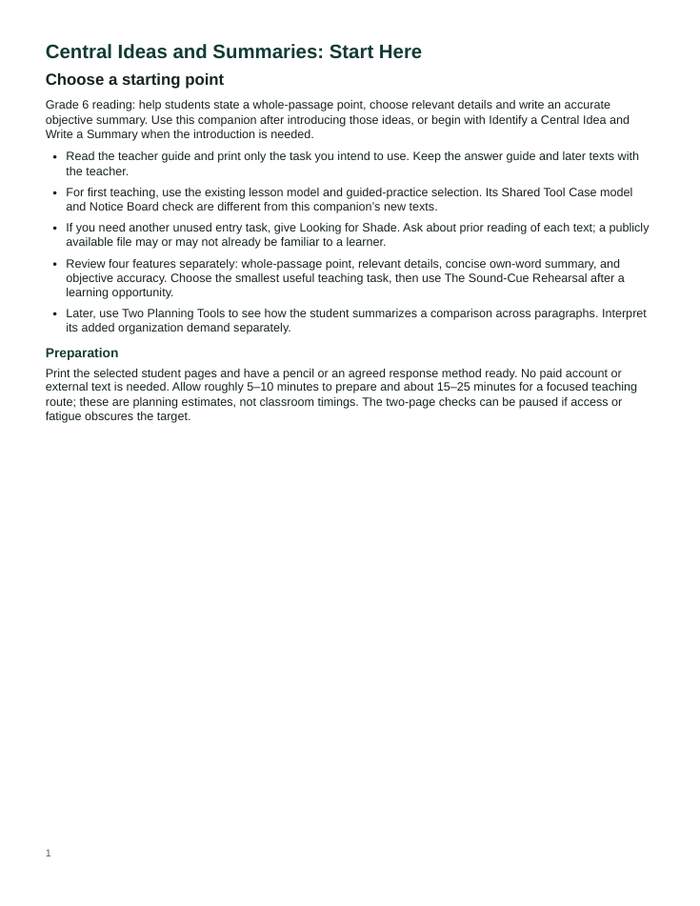
Connect the existing lesson and cover work
Emergency Grade 6 ELA Cover Kit retains its independent-use summary activity. It repeats the lesson’s Notice Board passage, so use it as familiar practice after earlier exposure; do not replace its adapted packet with a teacher-led lesson. Quick Reading Checks includes a different existing summary check with its own task-specific requirements.
Use clearer-directions planning if task access needs attention, or substitute-handoff planning to name selected familiar pages and a work-return route. Keep unused later texts back.
Classroom use
The new passages and example responses are fictional teaching material. Read-aloud, text-to-speech, enlarged text, extra processing time and an agreed response method can preserve the summary target; record the support used. Editable Word copies may reflow, so check their print preview after changes. No account, payment or student upload is needed.
Copy or adapt the original teaching text under the Terms of Use; retain attribution and identify local changes. Classroom effectiveness has not been established. Report a resource issue.
Editable Word files
Archive: ZIP files · teacher preparation only
Earlier guidance and source files are retained as historical records. For classroom teaching and printing, use the current stage files and matching guides above. Older guidance, timing and layouts are superseded; some retained browser/Word files have limited writing space or sparse extra pages. Keep historical student files with their historical keys and do not mix editions.
This archive may combine teaching, later tasks and answers. Choose the individual resource and its stage-specific pages before making student handouts.
Central ideas and summaries Word files (ZIP). Choose the editable files that match the task you will use. Use the full classroom collection for PDFs, HTML and other materials. The complete classroom collection includes these Word editions. Keep the bundles with the teacher and share only selected student tasks.
Share this resource
Report a resource issue · Open an issue email
Do not include student names or identifiable work in an issue report. Page revision: 23 October 2026; classroom files retain their own editions.