
Free teaching resource
Identify a Central Idea and Write a Summary
Is this the right resource?
- Audience / fit
- Grade 6 ELA
- Teaching or planning target
- Distinguish the topic from the central idea and write a concise summary with key details.
- Essential prerequisites
- Learners have experience reading or listening to a short teacher-provided passage; no prior lesson in the term central idea is required.
- Preparation
- About 5 minutes.
- Use time
- About 40 minutes. Planned sequence of 4 minutes opening, 5 minutes strategy, 8 minutes modeling, 9 minutes guided practice, 10 minutes independent response and 4 minutes closure; adjust to your class. Planning estimate; adjust for your class.
- Materials
- This lesson in print or editable form Pencil; a highlighter is optional. Board or display for the modeled think-aloud; optional.
- What to print
- Use the stage-specific student choices below and the matching teacher guide. Give independent, new-evidence and later-assessment pages only at their intended stage.
Start teaching
Print the two-page model and guided-practice selection first. Give the separate independent passage and response only after practice; its passage is not included in the first handout. Use the printing and task guide and the matching complete teacher key.
Choose a stage and format
Give only the stage being used. Keep later tasks and all teacher keys with the teacher until needed.
Formats and all files
Complete reference files may include teaching, independent tasks, later evidence or teacher answers. Keep them with the teacher; use the separate stage selections above for handouts.
In this 40-minute reading lesson, you will distinguish a topic from a central idea, state a central idea supported across a short passage, and write a concise, accurate 2–3 sentence summary with at least two key details and no added opinion.
All files are free. No email address, account, payment, trial or subscription is required.
- Who it is for
- Grade 6 ELA
- Preparation
- About 5 minutes.
- Teaching time
- About 40 minutes. Planned sequence of 4 minutes opening, 5 minutes strategy, 8 minutes modeling, 9 minutes guided practice, 10 minutes independent response and 4 minutes closure; adjust to your class.
- Teacher guidance
- Separate teacher files include completed examples or answer and scoring guidance.
Materials
- This lesson in print or editable form
- Pencil; a highlighter is optional.
- Board or display for the modeled think-aloud; optional.
Choose what to print or share
Use the teaching selection first. Keep the independent check and its organizer back until the independent response; keep the teacher guide and answer keys separate from learner copies.
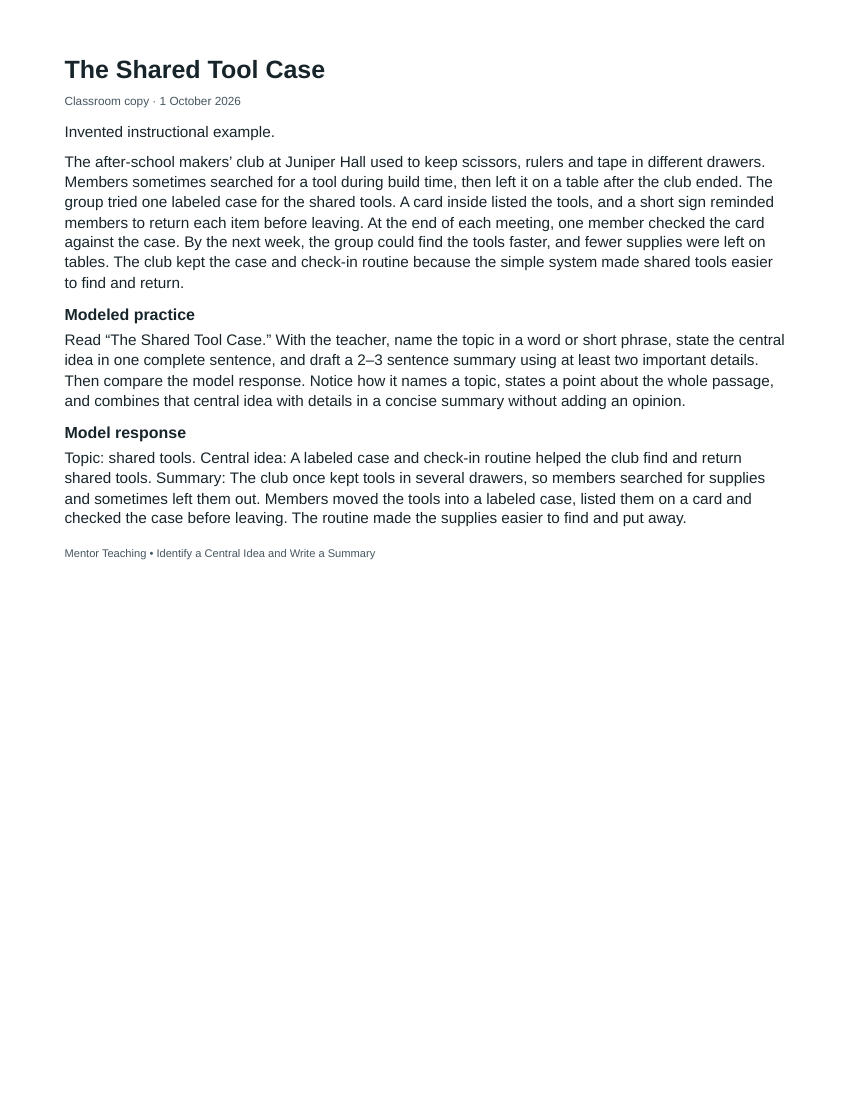
- Teaching selection — model and guided practice (2 pages): Printable PDF · Editable Word · HTML text
- Independent check and optional organizer (2 pages): Printable PDF · Editable Word · HTML text
- Teacher printing and task-selection guide (2 pages): Printable PDF · Editable Word · HTML text
The teacher print guide maps the pages, support and next steps. Use the original teacher files below for the complete lesson guidance, examples and scoring criteria.
Original complete resource and answer keys
The original learner packet includes all three passages. Its first PDF page shows the Notice Board passage, so use the separate teaching selection above when that passage needs to remain unseen.
- Original full learner packet — Editable Word file (38 KB)
- Original full learner packet — Read in browser (HTML)
- Original full learner packet — Printable PDF (52 KB)
- Teacher guide and answer key — Editable Word file (41 KB)
- Teacher guide and answer key — Read in browser (HTML)
- Teacher guide and answer key — Printable PDF (85 KB)
Keep teacher guidance and answers separate from student copies. Word files contain editable text; the PDF files are ready to print.
Support and adaptation
- Before writing, you may plan on the organizer after the independent task. It has space for the topic, whole-passage point, two details, a central-idea sentence and a short summary. Use evidence from the passage. The organizer does not give the answer or choose details; write your finished response in the lines on the task page, using a separate sheet if needed.
- A read-aloud, text-to-speech, enlarged text, chunked paragraphs or added processing time may support access. Record the support used when the result is interpreted; the objective does not assess independent decoding. Confirm individual needs locally.
Extension
- On a separate sheet, write a new title that captures the central idea and explain which two details support it. Review your summary: remove any detail that does not support the idea. If all its details fit, choose one passage detail to leave out and explain why it is less important. Use only the passage.
About the materials
Use the editable files to adapt the materials to your learners and local curriculum.
You may print, copy and adapt the resource for your planning and classroom use under our Terms of Use. Report a resource issue.
Choose supplied teaching after a summary response
The summary companion now supplies focused work for topic-only answers, small-detail lists, copied or distorted summaries and secure summaries. It includes a separate unused entry text, different follow-up and later comparison text, complete teacher models and keys. The collection route connects this original lesson and the new companion.
The Notice Board text in this lesson also appears in the cover kit. After either use, treat a repeat as familiar practice; choose an unused text when gathering new evidence.
Share this resource
Report a resource issue · Open an issue email
Do not include student names or identifiable work in an issue report. Page revision: 15 October 2026; classroom files retain their own editions.