
Thermal Energy Evidence Kits · Grade 6 · Grades 6–8 science ideas
Cool-Water Design Investigation
Current teacher guidance: 2 November 2026. Student tasks retain their stated core editions. Use the current stage choices and matching guide below.
Changes in the current files · 2 November 2026
- The teacher guide includes annotated fictional sound, partial and error responses, with concrete teaching actions and evidence to seek next.
- The complete practical guide corrects the materials allocation for the full investigation. The complete supplied-data alternative remains separate and does not demonstrate physical testing.
- Browser printing keeps task prompts with their response space; the underlying tasks retain their stated editions.
Prepare the materials
Prepare this lesson or activity
Recommended selection edition 1.0.0. Original source files retain their displayed editions.
Choose the practical or supplied-data route with the matching guide. Follow its equipment and supervision directions for practical work. Keep initial and new evidence separate and follow the stated reveal order.
Current teacher guidance: 2 November 2026. Student tasks retain their stated core edition; use the matching current guide linked here. Earlier files are kept separately in the archive.
- Audience / fit
- Intended Grade 6 science; selected Grades 6–8 standards ideas
- Teaching or planning target
- Plan a fair cool-water comparison, record baseline and prototype trials, then redesign and retest. Includes a complete supplied-data alternative.
- Essential prerequisites
- Read °C and time, subtract decimal readings, distinguish temperature from energy, and follow comparison conditions. Measuring 150 mL and safe probe placement are also required for practical work.
- Preparation
- Review the operational card and verify equipment/conditions before practical work; preparation time depends on local equipment. Supplied data needs only selected copies.
- Use time
- Practical: about 74 minutes per phase, with supervised continuation if needed (planning estimate). Supplied data: split comparison/proposal and retest/reassessment into separate stages; timing varies.
- Materials
- Supplied data: paper, pencil and Part 1, then Part 2. Practical: matching stable cups/covers, suitable non-glass probes, air thermometer, 150 mL cool water per cup, marked measure, timer, tray, probe supports, pre-cut felt and tape. Check the operational card before procurement or water use.
- What to print
- Print the chosen activity. Follow the source or reveal instructions beside it.
Evidence to notice: Look for matched conditions, labeled temperature rises, retained anomalous measurements and a claim limited to the actual comparisons. Keep a proposal before new evidence and explain any revision. Supplied-data reasoning does not demonstrate physical construction or testing.
Preview the actual student page

Start with the selected task
Matching teacher guide and answers — keep separate: Matching teacher guide and answers · 20 pages.
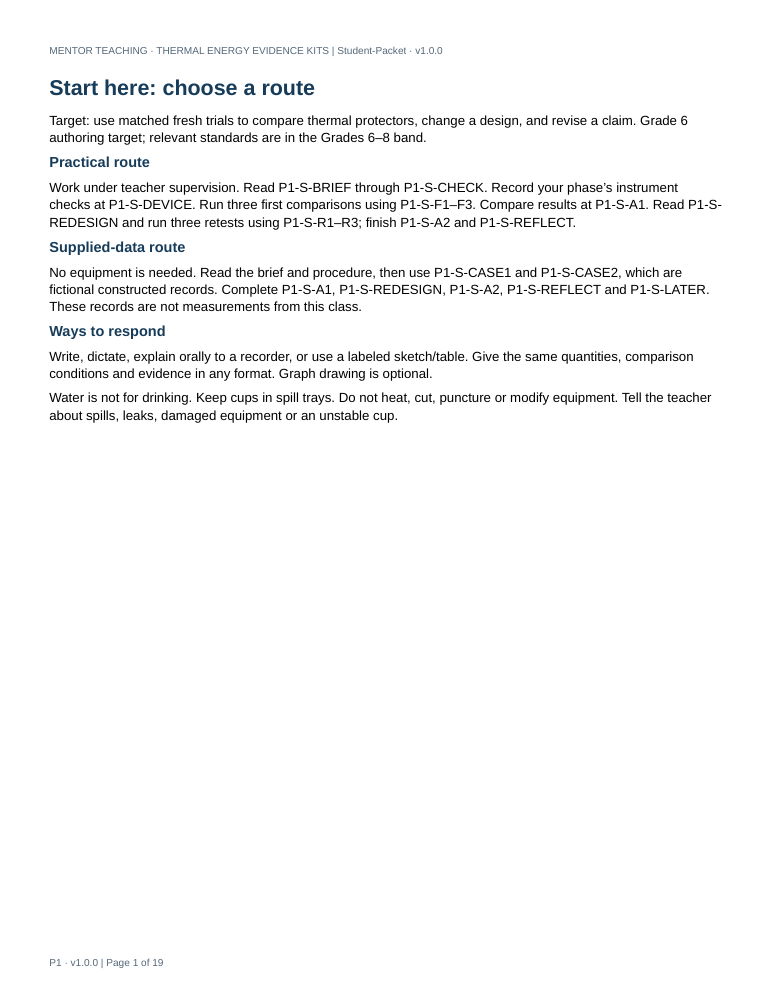
Equipment-free supplied-data route: Part 1 — compare and keep the proposal, then part 2 — reassess the new record. Keep the first proposal before revealing part 2. These files use supplied data, not classroom measurements.
Practical forms, supplied-data alternatives and later checks
Supplied-data investigation
- Supplied data, part 1 — compare and keep the proposal · 7 pages
PDF · Editable Word · Read in browser - Supplied data, part 2 — new evidence after the proposal · 3 pages
PDF · Editable Word · Read in browserComplete and keep the proposal from part 1 before opening part 2.
Later tasks — reserve for another occasion
- Later reasoning assessment · 1 page
PDF · Editable Word · Read in browser
Practical investigation materials
- Practical first comparison: directions and blank trials · 11 pages
PDF · Editable Word · Read in browser - Practical redesign: commit the plan · 6 pages
PDF · Editable Word · Read in browser - Practical retest: instrument checks and trial 1 · 2 pages
PDF · Editable Word · Read in browser - Practical retest: directions, instrument checks and trials 2–3 · 9 pages
PDF · Editable Word · Read in browser - Practical results: reassess and explain · 2 pages
PDF · Editable Word · Read in browser
Teacher files — separately
- Matching teacher guide and answers · 20 pages · Teacher PDF · Editable teacher Word · Read in browser · teacher copy
Archived page guidance and source files · Write a local teaching plan
Current print and editable package
Library package prepared 2 November 2026. Revised guides are marked with that date; other files retain their stated editions. Keep this package with the teacher. Read START-HERE, choose one stage, and retain teacher keys and checks for later use in their separate folders. Online browser versions are linked from the preparation pages.
Read the evidence
Choose and review the investigation route
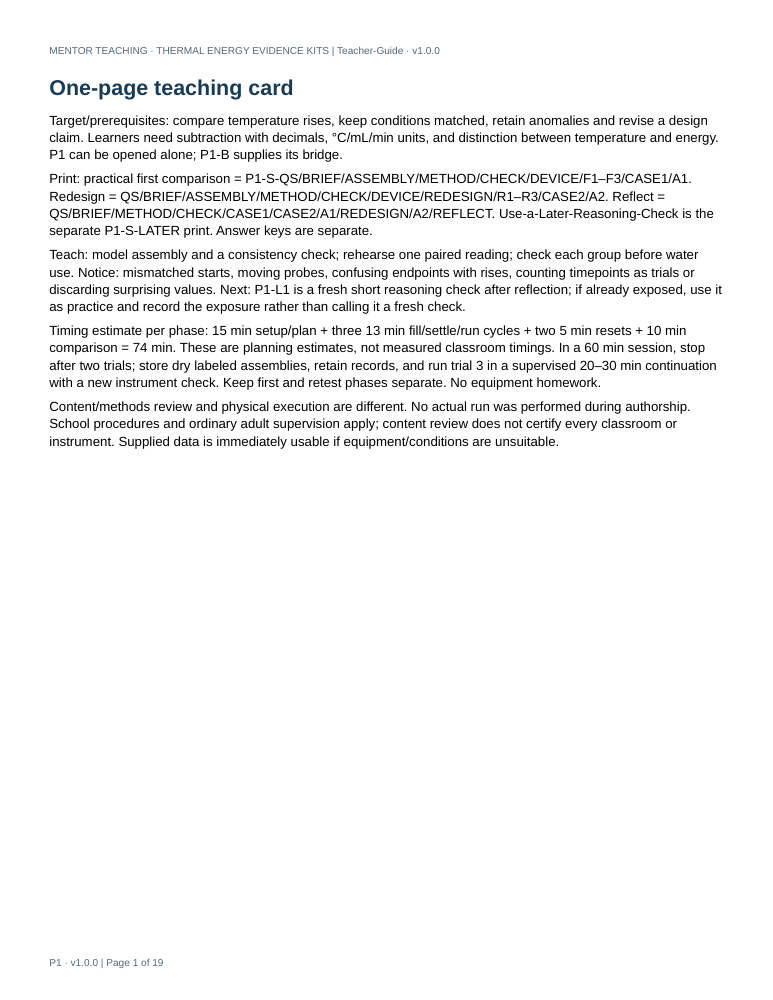
Read the operational setup and supervision directions in the teacher guide before practical work. Model assembly and a consistency check, rehearse a paired reading, and check each group before water use. Keep first comparison and redesign/retest phases separate.
Prepare and run the first comparison → retain the redesign proposal → retest trial 1 and trials 2–3 → reassess and explain.
For equipment-free reasoning, give supplied-data part 1 and retain the learner’s proposal before part 2. The new record describes a specified fictional redesign, not a test of the learner’s unbuilt proposal.
Equipment or conditions do not qualify
Use the complete supplied-data route. Do not force a fit, improvise sequential readings with one probe, or ask learners to invent measurements.
Trials are inconsistent or the observed change is small
Inspect and record starts, volume, covers, timing, placement, moisture and resets. Retain all readings and procedural concerns. Mixed usable trials can support an inconclusive claim; do not delete inconvenient values.
There is a leak, spill or wet sleeve
Stop and follow the guide’s spill procedures. Log what happened, replace with matching dry components, reset and use a new run ID.
The redesign performs worse or results are mixed
Check constraints and conditions, report the actual result and propose a relevant next modification and test. Do not force a successful outcome.
After reflection, reserve the later reasoning assessment for a fresh response. If it was already shown, use it as practice and record exposure. Supplied-data completion does not demonstrate physical building or testing.
Read the complete teacher directions and answers · Return to preparation
Archive: Additional formats, earlier editions and teaching guidance
Earlier guidance and source files are retained as historical records. For classroom teaching and printing, use the current stage files and matching guides above. Older guidance, timing and layouts are superseded; some retained browser/Word files have limited writing space or sparse extra pages. Keep historical student files with their historical keys and do not mix editions.
Is this the right resource?
- Audience / fit
- Intended Grade 6 science; selected Grades 6–8 standards ideas
- Teaching or planning target
- Plan a fair cool-water comparison, record baseline and prototype trials, then redesign and retest. Includes a complete supplied-data alternative.
- Essential prerequisites
- Read °C and time, subtract decimal readings, distinguish temperature from energy, and follow comparison conditions. Measuring 150 mL and safe probe placement are also required for practical work.
- Preparation
- Review the operational card and verify equipment/conditions before practical work; preparation time depends on local equipment. Supplied data needs only selected copies.
- Use time
- Practical: about 74 minutes per phase, with supervised continuation if needed (planning estimate). Supplied data: split comparison/proposal and retest/reassessment into separate stages; timing varies.
- Materials
- Supplied data: paper, pencil and Part 1, then Part 2. Practical: matching stable cups/covers, suitable non-glass probes, air thermometer, 150 mL cool water per cup, marked measure, timer, tray, probe supports, pre-cut felt and tape. Check the operational card before procurement or water use.
- What to print
- Use the stage-specific student choices below and the matching teacher guide. Give independent, new-evidence and later-assessment pages only at their intended stage.
Choose practical work or supplied data
Practical: assemble and compare
Adult supervision, checked equipment and qualifying conditions are required. Read the complete operational teacher guide before preparing materials.
Practical first comparison: directions and blank trials · PDF (11 pages)
Supplied data: compare, propose, then reassess
No equipment needed. The records are fictional constructed examples, not measurements from a class.
First: print Part 1, compare and record the proposal · PDF (7 pages)
Then: Part 2, reassess the specified retest record · PDF (3 pages)
Collect or retain each proposal before distributing Part 2. Keep the redesign results unseen until learners commit a proposed change. These values describe the specified fictional design, not the learner’s unbuilt proposal.
Teacher setup, procurement, complete keys and alternatives · PDF (17 pages)
For practical work, use the first-comparison directions and blank records; constructed first-trial and retest results are excluded. Read the current complete operational teacher guide before preparing equipment. Keep three fresh paired trials in each phase. Use the separate supplied-data Part 1 and Part 2 if equipment or conditions are unsuitable, and label that route as analysis of constructed records.
Teacher setup, procurement, complete keys and alternatives · PDF (17 pages)
Learning target: Compare a baseline and prototype with cool water, then redesign and retest against an identified reference.
Use written, oral or labeled representations when they show the intended reasoning. This resource addresses selected standards ideas; supplied-data analysis does not establish actual construction or testing.
Prerequisites: Read °C/time and calculate change; measure 150 mL; follow paired-condition and probe-position instructions. The brief, assembly instructions and supplied-data teaching model provide the method bridge.
Materials: Per group: three identical stable 250–300 mL plastic cups with matching loose covers and existing probe slots; two suitable non-glass immersion probes; a classroom air instrument; 150 mL cool water per cup per fresh trial; a marked measure, timer, spill tray, probe supports, clean pre-cut 26 × 6 cm felt sheets and pre-cut tape. See the operational card for quantities, conditions and equipment checks. Paper and pencil support the supplied-data fallback.
Additional files · teacher preparation
Use the separate stage choices above for student handouts. Complete selections may include later tasks or answers.
For the practical route, follow the equipment and setup guide, use adult supervision and follow your school’s procedures. Water is not for drinking; keep liquids away from electrical equipment. A complete supplied-data alternative is included.
Choose a stage and format
Give only the stage being used. Keep later tasks and all teacher keys with the teacher until needed.
- Practical first comparison: directions and blank trials · PDF (11 pages) · Practical first comparison: directions and blank trials · editable Word · Practical first comparison: directions and blank trials · browser copy
- Practical redesign: commit the plan · PDF (6 pages) · Practical redesign: commit the plan · editable Word · Practical redesign: commit the plan · browser copy
- Practical retest: instrument checks and trial 1 · PDF (2 pages) · Practical retest: instrument checks and trial 1 · editable Word · Practical retest: instrument checks and trial 1 · browser copy
- Practical retest: directions, instrument checks and trials 2–3 · PDF (9 pages) · Practical retest: directions, instrument checks and trials 2–3 · editable Word · Practical retest: directions, instrument checks and trials 2–3 · browser copy
- Practical results: reassess and explain · PDF (2 pages) · Practical results: reassess and explain · editable Word · Practical results: reassess and explain · browser copy
- Later reasoning assessment · PDF (1 page) · Later reasoning assessment · editable Word · Later reasoning assessment · browser copy
Archive: Formats and all files
Earlier guidance and source files are retained as historical records. For classroom teaching and printing, use the current stage files and matching guides above. Older guidance, timing and layouts are superseded; some retained browser/Word files have limited writing space or sparse extra pages. Keep historical student files with their historical keys and do not mix editions.
Complete reference files may include teaching, independent tasks, later evidence or teacher answers. Keep them with the teacher; use the separate stage selections above for handouts.
For supplied data, hand out Part 1 before Part 2. Full packets, combined reflection selections and mixed archives include later results: keep them with the teacher and give only the phase in use. Teacher keys and later checks stay separate.
Student
Teacher
Print Selections
- Compare the Results and Reflect (DOCX)
- Compare the Results and Reflect (HTML)
- Compare the Results and Reflect (PDF)
- Prepare and Run the First Comparison (DOCX)
- Prepare and Run the First Comparison (HTML)
- Prepare and Run the First Comparison (PDF)
- Redesign and Retest (DOCX)
- Redesign and Retest (HTML)
- Redesign and Retest (PDF)
- Use a Later Reasoning Check (DOCX)
- Use a Later Reasoning Check (HTML)
- Use a Later Reasoning Check (PDF)
Record Sheets
Data files and blank trial records
Data
- Blank comparison check record (CSV)
- Blank record: comparison trial 1 (CSV)
- Blank record: comparison trial 2 (CSV)
- Blank record: comparison trial 3 (CSV)
- Blank record: retest trial 1 (CSV)
- Blank record: retest trial 2 (CSV)
- Blank record: retest trial 3 (CSV)
- Example data: comparison trial 1 (CSV)
- Example data: comparison trial 2 (CSV)
- Example data: comparison trial 3 (CSV)
- Example data: retest trial 1 (CSV)
- Example data: retest trial 2 (CSV)
- Example data: retest trial 3 (CSV)
- Later reasoning check data (CSV)
- Teaching data (JSON)
Archive: Previous classroom editions
Earlier guidance and source files are retained as historical records. For classroom teaching and printing, use the current stage files and matching guides above. Older guidance, timing and layouts are superseded; some retained browser/Word files have limited writing space or sparse extra pages. Keep historical student files with their historical keys and do not mix editions.
Cool-Water Design Investigation — student: Read in browser (previous edition) · Editable Word (previous edition) · PDF (previous edition)
Cool-Water Design Investigation — teacher: Read in browser (previous edition) · Editable Word (previous edition) · PDF (previous edition)
Cool-Water Design Investigation — student first comparison: Read in browser (previous edition) · Editable Word (previous edition) · PDF (previous edition)
Cool-Water Supplied Data — Part 1: Compare and Propose: Printable PDF · Editable Word · Browser copy
Cool-Water Supplied Data — Part 2: Reassess the Record: Printable PDF · Editable Word · Browser copy
Archive: Previous teacher-reference editions
Earlier guidance and source files are retained as historical records. For classroom teaching and printing, use the current stage files and matching guides above. Older guidance, timing and layouts are superseded; some retained browser/Word files have limited writing space or sparse extra pages. Keep historical student files with their historical keys and do not mix editions.
Cool-Water Design Investigation — teacher guide: Browser · Editable Word · PDF
Archive: Previous complete-package editions
Earlier guidance and source files are retained as historical records. For classroom teaching and printing, use the current stage files and matching guides above. Older guidance, timing and layouts are superseded; some retained browser/Word files have limited writing space or sparse extra pages. Keep historical student files with their historical keys and do not mix editions.
About the materials
The teacher guide includes complete keys, explanations, alternatives and guidance for choosing a next task.
Complete collections · teacher reference only
These archives combine stages and may include later tasks and answers. Download them for teacher preparation; give students only the selected stage.
Useful next resources
Start Here · Session routes · Evidence portfolio.
Choose the student pages you need and keep teacher guides and answer keys with the teacher.
Share this resource
Report a resource issue · Open an issue email
Do not include student names or identifiable work in an issue report. Page revision: 2 November 2026; classroom files retain their own editions.