
Thermal Energy Evidence Kits · Grade 6 · Grades 6–8 science ideas
Thermal Energy Evidence Portfolio
Current preparation is shown below. Student tasks and matching guidance retain their stated editions. Earlier page guidance and source files are kept in the archive.
Changes in the current files · 2 November 2026
- Browser printing keeps task prompts with their response space; the underlying tasks retain their stated editions.
Prepare the materials
Prepare this lesson or activity
Recommended selection edition 1.0.0. Original source files retain their displayed editions.
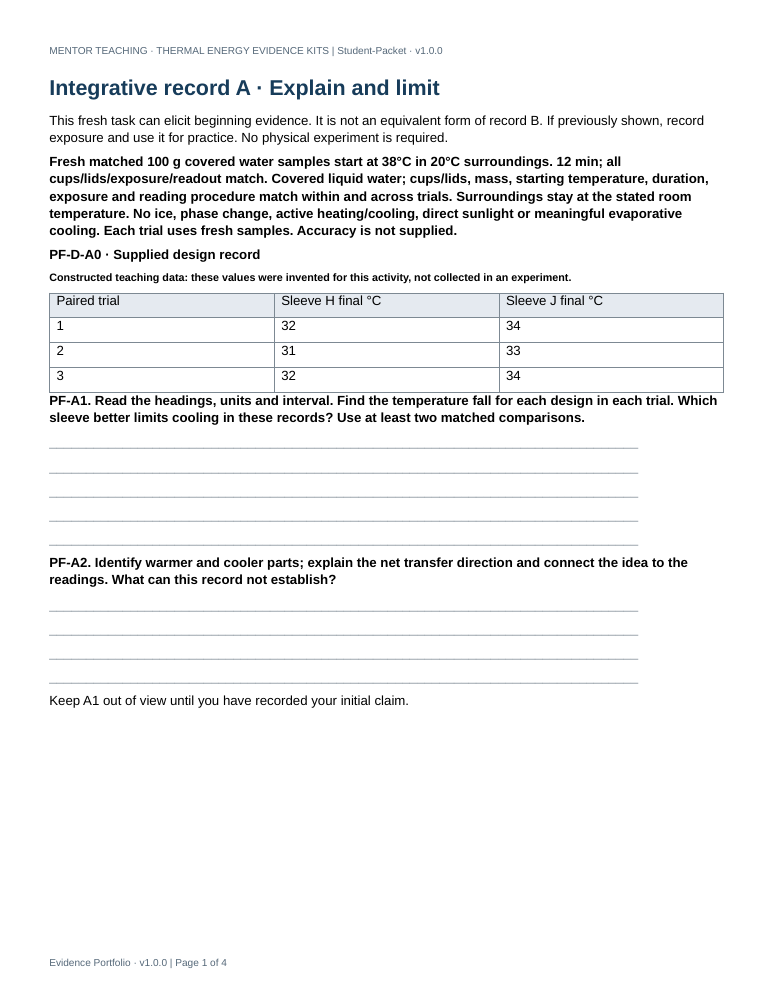
Use the portfolio after the relevant teaching. Give the initial record before the new evidence. The matching guide points to the thermal lessons needed for the next teaching decision.
- Audience / fit
- Intended Grade 6 science; selected Grades 6–8 standards ideas
- Teaching or planning target
- Use fresh integrative tasks and annotated fictional examples to describe evidence across six thermal reasoning dimensions.
- Essential prerequisites
- Use the actual named six-kit tasks or supplied integrative briefs. Clarify measurement reading, conditions and response mode; missing evidence does not establish a broad ability.
- Preparation
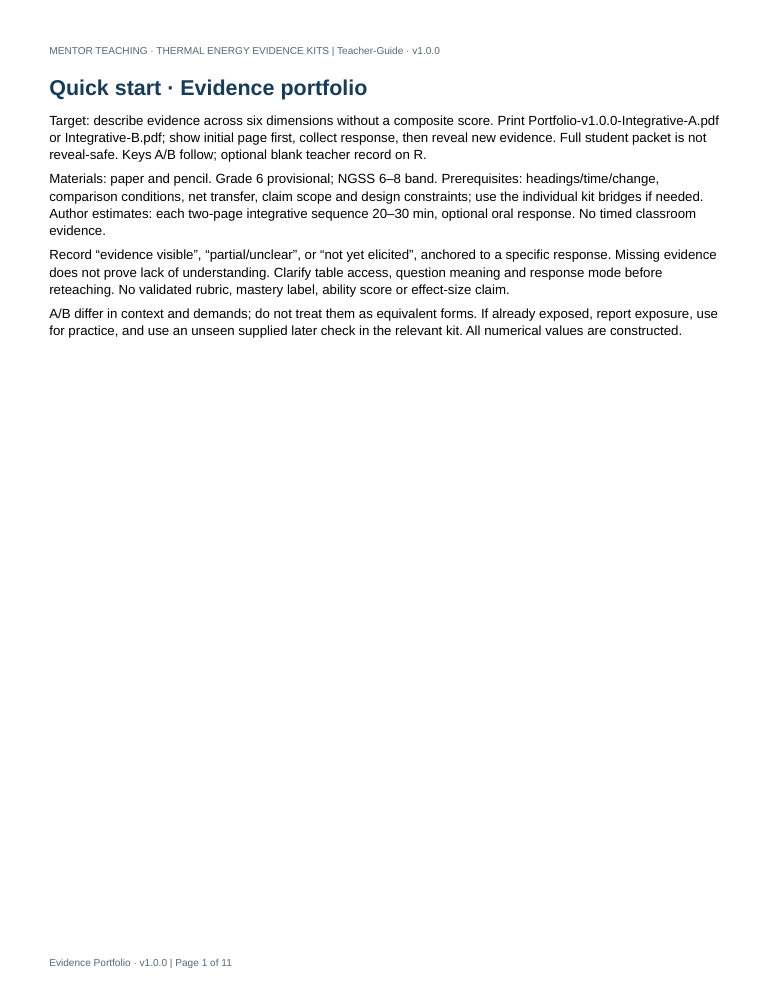
- Read the supplied teacher quick start; preparation time depends on the selected route.
- Use time
- Planning estimate: 20–30 minutes for each two-page integrative sequence; adjust for your learners. This is not measured classroom timing.
- Materials
- Paper and pencil; optional calculator, pointing, oral response or labeled representation.
- What to print
- Print the chosen activity. Follow the source or reveal instructions beside it.
Evidence to notice: Describe visible evidence separately across measurement reading, comparison conditions, representative evidence, scientific explanation, claim revision and design improvement. Record partial or unclear evidence and what was not elicited; do not combine these into a score.
Preview the actual student page

Start with the selected task
Matching teacher guide and answers — keep separate: Matching teacher guide and answers · 10 pages.
Initial portfolio records and new evidence, with teacher guidance
Starting tasks
- Portfolio A: initial record · 1 page
PDF · Editable Word · Read in browser - Portfolio B: proposal first · 1 page
PDF · Editable Word · Read in browser
New evidence — reveal at the named stage
- Portfolio A: new evidence · 1 page
PDF · Editable Word · Read in browserUse the initial page first; give the new page only when the matching teacher directions call for it.
- Portfolio B: revised design evidence · 1 page
PDF · Editable Word · Read in browserUse the initial page first; give the new page only when the matching teacher directions call for it.
Teacher files — separately
- Matching teacher guide and answers · 10 pages · Teacher PDF · Editable teacher Word · Read in browser · teacher copy
Archived page guidance and source files · Write a local teaching plan
Current print and editable package
Library package prepared 2 November 2026. Revised guides are marked with that date; other files retain their stated editions. Keep this package with the teacher. Read START-HERE, choose one stage, and retain teacher keys and checks for later use in their separate folders. Online browser versions are linked from the preparation pages.
Read the evidence
Use the portfolio to choose further teaching
Give an initial record and retain the response before revealing its new evidence. The full packet is not safe for preserving this order. Use the examples below to clarify the actual response, not to assign a diagnosis or composite score. Each quoted response is a fictional teaching example from the guide.
Measurement reading
Example: “It rose by the final number.”
Visible evidence and uncertainty: A final reading is mentioned; the change is not established. The starting row or the wording may be unclear.
Clarify: Point to the start and finish. Is the finish above or below the start?
Selected next task: Keep readings in one row — practice question 1.
After practice, use the separate Fresh check after Keep readings in one row, question 2. Keep it aside during response teaching.
Comparison conditions
Example: “Subtracting fixes the different water amounts.”
Visible evidence and uncertainty: Changes are considered, but a confound is treated as removed. This does not settle why the learner thinks the comparison is fair.
Clarify: Which conditions still differ after subtraction?
Selected next task: Repair the comparison — practice question 1.
After practice, use the separate Fresh check after Repair the comparison, question 2. Keep it aside during response teaching.
Representative evidence
Example: “D: 16 versus 18; 15 versus 17. Same start.”
Visible evidence and uncertainty: Two matched comparisons support the choice; scope and all-trial consistency still need eliciting.
Clarify: What about the third trial and conditions outside this record?
Selected next task: Later check: Reverse the direction, questions 1–3.
Scientific explanation
Example: “It went from 15 to 20.”
Visible evidence and uncertainty: The observation is correct; a scientific connection is not yet visible. The learner may need a different response form.
Clarify: Which part is warmer? Explain aloud what that means for net transfer.
Selected next task: Connect evidence to the explanation, question 2.
Claim revision
Example: “E is worse than F at 28.”
Visible evidence and uncertainty: The new ranking has only E in the new room. Generalization from F’s older-room result is a possibility to investigate.
Clarify: Where is F’s 28°C reading? Which earlier statement can remain?
Selected next task: Initial conditions and claim, then the conditions sequence.
Retain that initial response before Compare conditions before revising; then use the fresh initial check before the changed-surroundings record.
Design improvement
Example: “S-thin is guaranteed better because thinner.”
Visible evidence and uncertainty: A size benefit is offered; the warming tradeoff and scope are absent. “Better” may mean size only.
Clarify: Better by which criterion? Compare every requirement and trial.
Selected next task: A proposal needs a relevant test, questions 1–2.
Then use Fresh recheck: Whole design or one feature?, question 1.
The guide supplies additional contrasting examples and complete keys. Missing evidence does not establish lack of understanding. Record the task, exposure and support; use an unused later task from the relevant kit when an example or check has already been shown.
Read the complete teacher directions and answers · Return to preparation
Archive: Additional formats, earlier editions and teaching guidance
Earlier guidance and source files are retained as historical records. For classroom teaching and printing, use the current stage files and matching guides above. Older guidance, timing and layouts are superseded; some retained browser/Word files have limited writing space or sparse extra pages. Keep historical student files with their historical keys and do not mix editions.
Is this the right resource?
- Audience / fit
- Intended Grade 6 science; selected Grades 6–8 standards ideas
- Teaching or planning target
- Use fresh integrative tasks and annotated fictional examples to describe evidence across six thermal reasoning dimensions.
- Essential prerequisites
- Use the actual named six-kit tasks or supplied integrative briefs. Clarify measurement reading, conditions and response mode; missing evidence does not establish a broad ability.
- Preparation
- Read the supplied teacher quick start; preparation time depends on the selected route.
- Use time
- Planning estimate: 20–30 minutes for each two-page integrative sequence; adjust for your learners. This is not measured classroom timing.
- Materials
- Paper and pencil; optional calculator, pointing, oral response or labeled representation.
- What to print
- Use the stage-specific student choices below and the matching teacher guide. Give independent, new-evidence and later-assessment pages only at their intended stage.
Start teaching
Portfolio A: initial record · PDF (1 page)
Portfolio A: new evidence · PDF (1 page)
Portfolio B: proposal first · PDF (1 page)
Use Portfolio A first. Retain the initial explanation before giving A’s new evidence. Save Portfolio B for a later opportunity; retain its proposal before giving the fictional revised-design record. The records assess reasoning about supplied evidence, not actual construction or testing.
Learning target: Record visible evidence across six dimensions without computing a mastery score.
Use written, oral or labeled representations when they show the intended reasoning. This resource addresses selected standards ideas; supplied-data analysis does not establish actual construction or testing.
Prerequisites: Use the actual named six-kit tasks or supplied integrative briefs. Clarify measurement reading, conditions and response mode; missing evidence does not establish a broad ability.
Materials: Paper and pencil; optional calculator, pointing, oral response or labeled representation.
Data values are created for teaching. Use the teacher guide to plan the lesson timing.
Choose a stage and format
Give only the stage being used. Keep later tasks and all teacher keys with the teacher until needed.
- Portfolio A: initial record · PDF (1 page) · Portfolio A: initial record · editable Word · Portfolio A: initial record · browser copy
- Portfolio A: new evidence · PDF (1 page) · Portfolio A: new evidence · editable Word · Portfolio A: new evidence · browser copy
- Portfolio B: proposal first · PDF (1 page) · Portfolio B: proposal first · editable Word · Portfolio B: proposal first · browser copy
- Portfolio B: revised design evidence · PDF (1 page) · Portfolio B: revised design evidence · editable Word · Portfolio B: revised design evidence · browser copy
Archive: Formats and all files
Earlier guidance and source files are retained as historical records. For classroom teaching and printing, use the current stage files and matching guides above. Older guidance, timing and layouts are superseded; some retained browser/Word files have limited writing space or sparse extra pages. Keep historical student files with their historical keys and do not mix editions.
Complete reference files may include teaching, independent tasks, later evidence or teacher answers. Keep them with the teacher; use the separate stage selections above for handouts.
Student
Teacher
Print Selections
Data
About the materials
The teacher guide includes complete keys, explanations, alternatives and guidance for choosing a next task.
Complete collections · teacher reference only
These archives combine stages and may include later tasks and answers. Download them for teacher preparation; give students only the selected stage.
Useful next resources
Start Here · Session routes · Evidence portfolio.
Choose the student pages you need and keep teacher guides and answer keys with the teacher.
Share this resource
Report a resource issue · Open an issue email
Do not include student names or identifiable work in an issue report. Page revision: 23 October 2026; classroom files retain their own editions.