
Thermal Energy Evidence Kits · Grade 6 · Grades 6–8 science ideas
Thermal Temperature Evidence: Paper Lesson and Session Routes
Current teacher guidance: 2 November 2026. Student tasks retain their stated core editions. Use the current stage choices and matching guide below.
Changes in the current files · 2 November 2026
- The teacher guide includes annotated fictional sound, partial and error responses, with concrete teaching actions and evidence to seek next.
- Session notes are excerpts of the current route guide, paired with the complete subject and operational guides. Pacing estimates retain supervised continuation and every required trial.
Prepare the current paper lesson
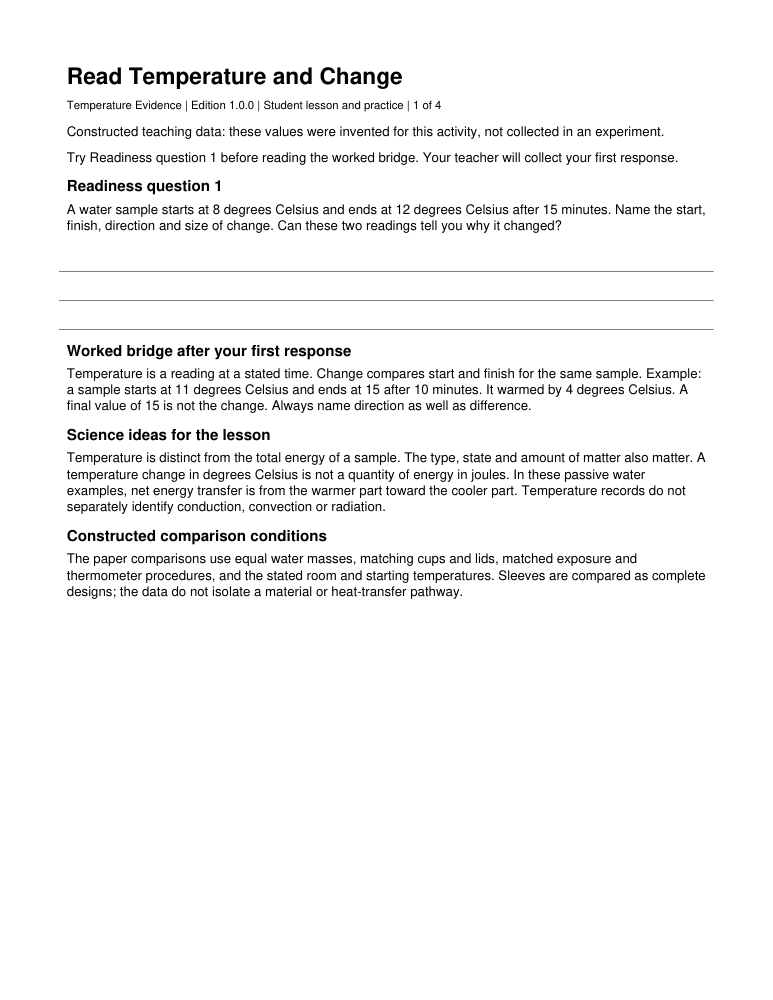
Read Temperature Records and Support a Design Choice — standalone paper lesson
Read labeled temperature changes, compare complete designs across matched constructed trials, and support a bounded choice while distinguishing observations from explanations.
Intended Grade 6 science; selected Grades 6–8 science ideas · edition 1.0.0. This paper lesson is separate from the session routes below. AI-assisted materials; classroom effectiveness has not been established. Word classroom copy: 23 October 2026; teaching content is unchanged.
Current teacher guidance: 2 November 2026. Student tasks retain their stated core edition; use the matching current guide linked here. Earlier files are kept separately in the archive.
- Before starting
- Read a small data table, locate the start and endpoint, subtract whole-number temperatures, and distinguish a measured value from its change. The readiness mini-lesson supplies these ideas when needed.
- Prepare
- Use the supplied constructed tables and ordinary paper and pencil. This paper lesson needs no practical equipment. The separate six/eight-session routes below have their own preparation and supervision requirements.
- Timing
- No time estimate is available for this paper lesson. Plan from the teacher guide and responses; do not transfer a duration from the separate multi-session routes.
- Evidence to notice
- Look for labeled changes, comparisons within matched trials, all relevant rows, and a bounded claim that separates observations from explanations.
Choose the stage to prepare
- Model and guided practice · 4 pages
Browser copy · Editable Word · Student PDF - Independent response — reserve until after teaching · 2 pages
Browser copy · Editable Word · Student PDF - Selected response — use after clarification · 2 pages
Browser copy · Editable Word · Student PDF - Later reassessment — save for another learning opportunity · 1 page
Browser copy · Editable Word · Student PDF - Extension — optional · 1 page
Browser copy · Editable Word · Student PDF
For the teacher, separately: Matching guide and answers · 11 pages. Keep answers with the teacher and give each reserved task only at its intended stage.
Matching teacher-only formats: Teacher browser copy · Editable teacher Word · Teacher PDF.
Choose a next teaching move · Find another resource · Detailed fit and existing editions below
Current print and editable package
Library package prepared 2 November 2026. Revised guides are marked with that date; other files retain their stated editions. Keep this package with the teacher. Read START-HERE, choose one stage, and retain teacher keys and checks for later use in their separate folders. Online browser versions are linked from the preparation pages.
Thermal energy: standalone lesson and complete session-route materials · current ZIP · 5.1 MB
Includes the standalone lesson, six/eight-session guide, session excerpts and all matching subject/operational materials. Select only the intended route and phase.
Choose from the evidence
A next teaching move, not a diagnosis
Use what the learner actually said, wrote or showed. First check access to the prompt and the named prerequisites; clarify the quantity, wording or calculation before interpreting the response. A single answer does not establish a persistent difficulty.
- Start with the supplied task
- Observe and clarify
- Try guided practice
- Use the separate independent check
- Revisit later
Start with the supplied task
Teaching pages, including the initial task and intentionally shown model. This is a teaching sequence, not a separate unseen diagnostic. Keep the independent and later files aside.
Observe, then clarify before choosing a response
These options come from this edition’s teacher guidance. Select an observation to inspect a possible teaching response; no option assigns a learner a diagnosis.
Endpoint is called change, a rise is called cooling, or values from different rows are combined.
Teacher move: Point to the start, then trace to the endpoint. Ask whether the number rose or fell before subtracting. Use the new X/Y data; do not prefill the answer.
Look for new evidence: New matched rows with a labeled change and correct warming direction.
Open the response pack at response 1. The PDF contains both response lessons (2 pages); the page link does not restrict printing. Choose the matching response in the teacher guide.
Matching teacher guide and answers · for the teacher only.
One favorable result is selected or the response uses always after clarification.
Teacher move: Keep all matched rows visible. Compare L and N within each trial and ask whether one design wins every row. Keep Trial 2 in view.
Look for new evidence: A claim that preserves the reversal in Trial 2 and asks for relevant further evidence.
Open the response pack at response 2. The PDF contains both response lessons (2 pages); the page link does not restrict printing. Choose the matching response in the teacher guide.
Matching teacher guide and answers · for the teacher only.
Try guided practice and check what changed
Use the model and guided-practice pages. Look for labeled changes, comparisons within matched trials, all relevant rows, and a bounded claim that separates observations from explanations. If the response is still unclear, return to access, prerequisites and the teacher’s clarification prompts rather than choosing a label.
Use the independent task separately
Independent student pages · 2 pages. Keep the matching teacher answers separate. Compare the explanation as well as the result; decide what teaching to try next from the supplied criteria.
Save the later task for another learning opportunity
Later student pages · 1 page. This is a different task or context, not a calibrated equivalent test or proof of general mastery. Use the teacher guide to interpret the evidence and its limits.
Separate multi-session route fit notes
- Audience / fit
- Intended Grade 6 science; selected Grades 6–8 standards ideas
- Teaching or planning target
- Plan a six-session paper route or an eight-session route with practical continuation points, prerequisites and selected pages to print.
- Essential prerequisites
- Choose a route using prior responses and the named prerequisites. Practical continuation requires checked equipment and adult supervision.
- Preparation
- Read the supplied teacher quick start; preparation time depends on the selected route.
- Use time
- Six supplied-data sessions or eight sessions with practical continuation; use the selected kit’s time estimates.
- Materials
- The route and print guide and selected student/teacher files; paper and pencil for supplied data. Practical equipment and checks are in the operational card.
- What to print
- Print the teacher starting or route guide, then use the direct per-session handouts and matching teacher directions below. Print stages separately; complete keys and later assessments remain with the teacher.
Archive: Session route overview, editable copies and route preparation
Earlier guidance and source files are retained as historical records. For classroom teaching and printing, use the current stage files and matching guides above. Older guidance, timing and layouts are superseded; some retained browser/Word files have limited writing space or sparse extra pages. Keep historical student files with their historical keys and do not mix editions.
Choose the science session route
Choose a route using prior student responses. Each session below has direct student handouts and matching teacher directions. Give new evidence only after retaining the initial response. Several sessions need supervised continuation; eight practical sessions do not mean eight 45-minute periods.
Standalone paper lesson: all formats and detailed teaching guidance
Compare thermal data and limit a claim
AI-assisted teaching materials.
Edition 1.0.0 · United States Grade 6; selected middle-school science ideas. A complete paper lesson connects reading a temperature table and graph to a design choice supported by repeated comparisons.
- Target
- Compare matched temperature results, use an energy-transfer explanation and limit the design claim to the supplied evidence.
- Prerequisites
- Read whole-number temperatures and subtract start and endpoint values. The supplied bridge models these moves.
- Preparation, duration and materials
- Paper and pencil; optional calculator or number line. Use the teacher quick start to select stages. All timing guidance is an estimate; no classroom timing or apparatus trial is claimed.
Preview a model task
Fresh 100 g water samples begin at 10 degrees Celsius in a 22-degree room. Use the model table and graph to find the 20-minute temperature increase of each setup. Which sleeve better limits warming in this one constructed trial? Revise the claim that it stopped all energy transfer.
All results are constructed teaching data, not measured product performance. This paper route requires no heating, handling of hot water or physical equipment.
Teacher quick start and complete keys · PDF (11 pages)
Bridge, model and guided practice · PDF (4 pages)
Independent evidence check · PDF (2 pages)
For the first response, cover the lower worked bridge on page 1 until the response is collected, then reveal it. If the whole page has already been seen, use that first response as practice. Keep teacher answers and later checks separate from ordinary student handouts. Use a response lesson and another learning opportunity before the different later check. The checks have different demands and are not calibrated forms.
Choose a stage, editable Word or browser copy
- Bridge, model and guided practice · PDF (4 pages) · Editable Word · Browser copy
- Independent evidence check · PDF (2 pages) · Editable Word · Browser copy
- Focused response lessons · PDF (2 pages) · Editable Word · Browser copy
- Different later check · PDF (1 page) · Editable Word · Browser copy
- Extension · PDF (1 page) · Editable Word · Browser copy
- Teacher quick start and complete keys · PDF (11 pages) · Editable Word · Browser copy
This lesson supports selected energy-transfer and evidence-comparison ideas; it does not fulfill the complete NGSS design/build/test or investigation-planning performance expectations. Use the full route guides below for the wider sequence.
Print and adapt under the Terms of Use. Report a resource issue without student names or identifiable work.
Six paper sessions or eight practical sessions — teacher route guide
Open the complete six/eight-session teacher route guide · PDF · 15 pages. Use the session-specific handouts and matching directions below. Session times are planning estimates; allow the stated continuation blocks. Practical work requires the separate operational setup and adult supervision.
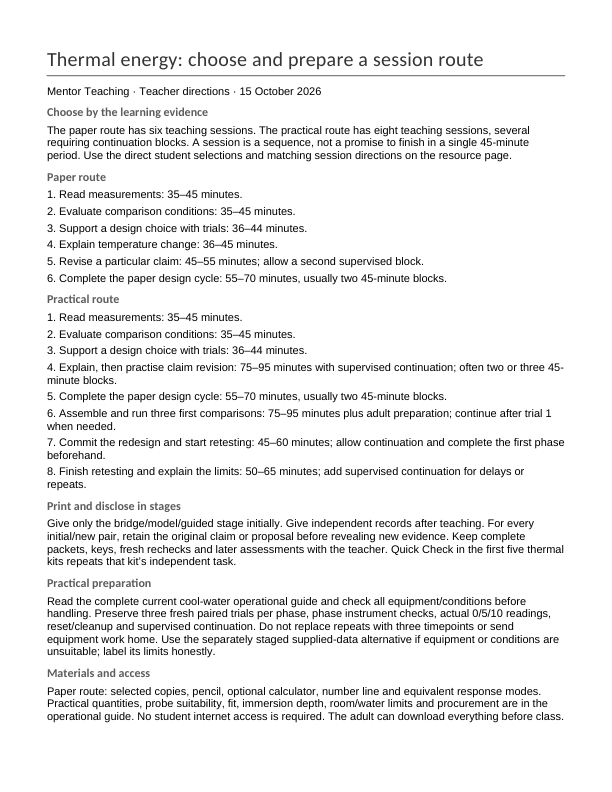
The one-page session notes are excerpts of the current 2 November 2026 route guide. Read each complete matching subject guide as well; an excerpt does not replace its task keys, access guidance or operational directions. Practical sessions 6–8 require the complete current operational guide (20 pages) before preparing equipment. If conditions or equipment are unsuitable, use the complete supplied-data alternative on the investigation preparation page; that alternative assesses record analysis, not physical construction or testing. Keep each task’s quantities, conditions and sources available. Allow extra response paper. Use the selected student procedure for the exact sensor/position order and reset protocol. PDF excerpt footers retain their source-guide page numbers; editable Word pagination recalculates for the excerpt.
Six-session paper route
Session 1: Read measurements
35–45 minutes (planning estimate).
Read a small table, identify the units and subtract whole numbers. Use the included bridge if needed.
Paper session 1 teacher excerpt · source guide section 2 · PDF · 1 page · Paper session 1 teacher excerpt · source guide section 2 · editable Word · Paper session 1 teacher excerpt · source guide section 2 · browser copy
Read the complete current subject guide and keys
Use Keep readings in one row if values are mixed; use A value is not a change if the final value is reported as the change. Keep the Later assessment unseen. The original Quick Check repeats this independent task.
Session 2: Evaluate comparison conditions
35–45 minutes (planning estimate).
Evidence of accurate start/final/change reading from session 1, or the included prerequisite bridge.
Paper session 2 teacher excerpt · source guide section 3 · PDF · 1 page · Paper session 2 teacher excerpt · source guide section 3 · editable Word · Paper session 2 teacher excerpt · source guide section 3 · browser copy
Read the complete current subject guide and keys
Choose Repair the comparison for a confound, or Specify a usable plan for a missing procedure. Do not treat a repaired paper plan as a completed physical experiment.
Session 3: Support a design choice with trials
36–44 minutes (planning estimate).
Read temperature changes and identify comparable conditions. Use the bridge if entering directly.
Paper session 3 teacher excerpt · source guide section 4 · PDF · 1 page · Paper session 3 teacher excerpt · source guide section 4 · editable Word · Paper session 3 teacher excerpt · source guide section 4 · browser copy
Read the complete current subject guide and keys
Use Compare the measurements for reading errors. Use all results and limit the claim addresses cherry-picking or always claims; give its fresh recheck only after teaching. Retain Later assessment.
Session 4: Explain temperature change
36–45 minutes (planning estimate).
Read changes and distinguish a temperature observation from an explanation. Use the included science bridge.
Paper session 4 teacher excerpt · source guide section 5 · PDF · 1 page · Paper session 4 teacher excerpt · source guide section 5 · editable Word · Paper session 4 teacher excerpt · source guide section 5 · browser copy
Read the complete current subject guide and keys
Choose Connect evidence to the explanation when only readings are reported; choose Trace energy transfer for a direction error. Each has a separate fresh recheck. Keep Later assessment unseen.
Session 5: Revise a particular claim
45–55 minutes; allow a second supervised block (planning estimate).
State a bounded claim, read comparable trials, and connect observations with science. The bridge checks these prerequisites.
- Prerequisite bridge and initial model evidence · PDF (2 pages)
- New model evidence and blank revision record · PDF (2 pages)
- Guided practice: initial evidence · PDF (1 page)
- Guided practice: new evidence · PDF (1 page)
- Independent check: initial record · PDF (1 page)
- Independent check: new record · PDF (1 page)
Paper session 5 teacher excerpt · source guide section 6 · PDF · 1 page · Paper session 5 teacher excerpt · source guide section 6 · editable Word · Paper session 5 teacher excerpt · source guide section 6 · browser copy
Read the complete current subject guide and keys
Keep original and new records together after each reveal. Choose the matching reteach pair for evidence weighting or comparison conditions. Its fresh recheck is another initial/new pair. Save the later cooling pair for a later opportunity. Continue after the model or guided pair if time runs short.
Session 6: Complete the paper design cycle
55–70 minutes, usually two 45-minute blocks (planning estimate).
Check comparable trials, bound a claim, and revise it. The bridge introduces criteria, constraints and predictions.
- Requirements, model and guided practice · PDF (3 pages)
- Independent challenge: proposal first · PDF (1 page)
- Independent challenge: new redesign evidence · PDF (1 page)
Paper session 6 teacher excerpt · source guide section 7 · PDF · 1 page · Paper session 6 teacher excerpt · source guide section 7 · editable Word · Paper session 6 teacher excerpt · source guide section 7 · browser copy
Read the complete current subject guide and keys
Break after guided practice if a second block is needed. Choose Meet every requirement or Propose a relevant test from the response evidence, then its separate fresh recheck. Keep changed-requirements and new-environment later tasks reserved. This paper cycle does not establish physical construction/testing.
Eight-session practical route
Session 1: Read measurements
35–45 minutes (planning estimate).
Read a small table, identify the units and subtract whole numbers. Use the included bridge if needed.
Practical session 1 teacher excerpt · source guide section 8 · PDF · 1 page · Practical session 1 teacher excerpt · source guide section 8 · editable Word · Practical session 1 teacher excerpt · source guide section 8 · browser copy
Read the complete current subject guide and keys
Use Keep readings in one row if values are mixed; use A value is not a change if the final value is reported as the change. Keep the Later assessment unseen. The original Quick Check repeats this independent task.
Session 2: Evaluate comparison conditions
35–45 minutes (planning estimate).
Evidence of accurate start/final/change reading from session 1, or the included prerequisite bridge.
Practical session 2 teacher excerpt · source guide section 9 · PDF · 1 page · Practical session 2 teacher excerpt · source guide section 9 · editable Word · Practical session 2 teacher excerpt · source guide section 9 · browser copy
Read the complete current subject guide and keys
Choose Repair the comparison for a confound, or Specify a usable plan for a missing procedure. Do not treat a repaired paper plan as a completed physical experiment.
Session 3: Support a design choice with trials
36–44 minutes (planning estimate).
Read temperature changes and identify comparable conditions. Use the bridge if entering directly.
Practical session 3 teacher excerpt · source guide section 10 · PDF · 1 page · Practical session 3 teacher excerpt · source guide section 10 · editable Word · Practical session 3 teacher excerpt · source guide section 10 · browser copy
Read the complete current subject guide and keys
Use Compare the measurements for reading errors. Use all results and limit the claim addresses cherry-picking or always claims; give its fresh recheck only after teaching. Retain Later assessment.
Session 4: Explain, then practise claim revision
60–75 minutes, or two supervised blocks (planning estimate). Complete the explanation task before continuing with claim-revision teaching; retain every stage.
Read changes and distinguish a temperature observation from an explanation. Use the included science bridge.
- Prerequisite bridge, model and guided practice · PDF (4 pages)
- Independent check · PDF (1 page)
- Prerequisite bridge and initial model evidence · PDF (2 pages)
- New model evidence and blank revision record · PDF (2 pages)
- Guided practice: initial evidence · PDF (1 page)
- Guided practice: new evidence · PDF (1 page)
Practical session 4 teacher excerpt · source guide section 11 · PDF · 1 page · Practical session 4 teacher excerpt · source guide section 11 · editable Word · Practical session 4 teacher excerpt · source guide section 11 · browser copy
Read the complete current subject guide and keys
Finish the explanation independent task before a continuation break. Continue with the revision model and guided pair in the next supervised block. Select either resource’s named reteach from the observed need; do not compress both into one short lesson.
Session 5: Complete the paper design cycle
55–70 minutes, usually two 45-minute blocks (planning estimate).
Check comparable trials, bound a claim, and revise it. The bridge introduces criteria, constraints and predictions.
- Requirements, model and guided practice · PDF (3 pages)
- Independent challenge: proposal first · PDF (1 page)
- Independent challenge: new redesign evidence · PDF (1 page)
Practical session 5 teacher excerpt · source guide section 12 · PDF · 1 page · Practical session 5 teacher excerpt · source guide section 12 · editable Word · Practical session 5 teacher excerpt · source guide section 12 · browser copy
Read the complete current subject guide and keys
Break after guided practice if a second block is needed. Choose Meet every requirement or Propose a relevant test from the response evidence, then its separate fresh recheck. Keep changed-requirements and new-environment later tasks reserved. This paper cycle does not establish physical construction/testing.
Session 6: Assemble and run three first comparisons
65–80 minutes plus adult preparation (planning estimate). In a 45-minute block, stop after trial 1 and complete trials 2–3 in another supervised block before redesign.
Accurate decimal °C/time reading; calculate change; measure 150 mL; follow the matched-pair and probe-position procedure. Carry forward the preceding session evidence. The adult must check the current complete operational guide, equipment and room/water conditions before handling.
Practical session 6 teacher excerpt · source guide section 13 · PDF · 1 page · Practical session 6 teacher excerpt · source guide section 13 · editable Word · Practical session 6 teacher excerpt · source guide section 13 · browser copy
Read the complete current subject guide and keys
Complete pre/post-phase instrument checks and the printed probe/position alternation; display resolution is not accuracy. Retain failed starts and inconclusive trials. A room shift over 1 °C, missing 0/10 reading or changed procedure requires a flag, not invented correction. Between trials, the teacher drains, checks dry sleeves, conditions interiors with room-temperature water for 5 minutes, drains/dries and prepares fresh water. If stopping after F1, clean/store dry labelled sleeves and finish F2/F3 in another supervised block before redesign. No equipment homework.
Session 7: Commit the redesign and start retesting
45–60 minutes; allow continuation and complete the first phase beforehand (planning estimate).
Accurate decimal °C/time reading; calculate change; measure 150 mL; follow the matched-pair and probe-position procedure. Carry forward the preceding session evidence. The adult must check the current complete operational guide, equipment and room/water conditions before handling. Three retained first-comparison records and the original construction version are required.
- Practical redesign: commit the plan · PDF (6 pages)
- Practical retest: instrument checks and trial 1 · PDF (2 pages)
Practical session 7 teacher excerpt · source guide section 14 · PDF · 1 page · Practical session 7 teacher excerpt · source guide section 14 · editable Word · Practical session 7 teacher excerpt · source guide section 14 · browser copy
Read the complete current subject guide and keys
If any F trial is unfinished, continue that phase first. Do not count a proposed redesign as physically tested. At a break, drain/clean/store dry labelled versions; retain the R1 log. The next session completes R2–R3 with fresh pairs. Never substitute the fictional retest values for missing empirical readings.
Session 8: Finish retesting and explain the limits
50–65 minutes; add supervised continuation for delays or repeats (planning estimate).
Accurate decimal °C/time reading; calculate change; measure 150 mL; follow the matched-pair and probe-position procedure. Carry forward the preceding session evidence. The adult must check the current complete operational guide, equipment and room/water conditions before handling. Bring the original/redesign versions, retained proposal, first-phase records, R1 and the pre-phase instrument check.
- Practical retest: directions, instrument checks and trials 2–3 · PDF (9 pages)
- Practical results: reassess and explain · PDF (2 pages)
Practical session 8 teacher excerpt · source guide section 15 · PDF · 1 page · Practical session 8 teacher excerpt · source guide section 15 · editable Word · Practical session 8 teacher excerpt · source guide section 15 · browser copy
Read the complete current subject guide and keys
Flag mismatch, drift, missing readings or wet/changed sleeves as the procedure requires. Clean up with the teacher. If safe equipment/conditions are unavailable, use the separate supplied-data Part 1 then Part 2 and identify the work as fictional-record analysis; it does not replace missing measured results or demonstrate construction/testing. Keep the later reasoning assessment reserved.
Learning target: Plan six supplied-data sessions or an eight-session route with practical continuation points.
Use written, oral or labeled representations when they show the intended reasoning. This resource addresses selected standards ideas; supplied-data analysis does not establish actual construction or testing.
Prerequisites: Use prior evidence named for each session. Kit bridges and the cool-water supplied-data alternative provide the referenced instruction; choose continuation points when practical repetitions need more time.
Materials: Paper and pencil; optional calculator, pointing, oral response or labeled representation.
Data values are created for teaching. Use the teacher guide to plan the lesson timing.
Archive: Formats and all files
Earlier guidance and source files are retained as historical records. For classroom teaching and printing, use the current stage files and matching guides above. Older guidance, timing and layouts are superseded; some retained browser/Word files have limited writing space or sparse extra pages. Keep historical student files with their historical keys and do not mix editions.
Teacher
Data
About the materials
The route overview and session directions identify the student stages, teaching sequence, matching lesson keys and continuation points.
Complete collections · teacher reference only
These archives combine stages and may include later tasks and answers. Download them for teacher preparation; give students only the selected stage.
Useful next resources
Start Here · Session routes · Evidence portfolio.
Choose the student pages you need and keep teacher guides and answer keys with the teacher.
Share this resource
Report a resource issue · Open an issue email
Do not include student names or identifiable work in an issue report. Page revision: 15 October 2026; classroom files retain their own editions.