
Grade 6 character-change practice and checks
Character Change: Check and Next Steps
Current teacher guidance: 2 November 2026. Student tasks retain their stated core editions. Use the current stage choices and matching guide below.
Changes in the current files · 2 November 2026
- The teacher guide includes annotated fictional sound, partial and error responses, with concrete teaching actions and evidence to seek next.
- Browser teacher-guide organizers retain their original ruled writing spaces. Use the separate student selections when distributing classroom tasks.
Prepare the materials
Prepare this lesson or activity
Recommended selection edition 1.0.0. Original source files retain their displayed editions.
Use the matching guide to choose a response to the work you observe. Clarify access and task wording first; one response is not a diagnosis. Keep independent work, later tasks and answers aside until their intended use.
Current teacher guidance: 2 November 2026. Student tasks retain their stated core edition; use the matching current guide linked here. Earlier files are kept separately in the archive.
- Audience / fit
- Grade 6 ELA
- Teaching or planning target
- Compare accurate early and later words or actions, explain a defensible change in a character’s choices, distinguish it from changed circumstances, and state what the story does not establish.
- Essential prerequisites
- For Grade 6; check the prerequisites for your class. Learners can read or listen to a short story and point to words or actions. Use Explain How a Character Changes first when comparing evidence over time needs teaching.
- Preparation
- Read Start Here; print only selected files; preparation time depends on the selected route.
- Use time
- Plan the selected route from the teacher guide
- Materials
- Only the selected student pages, pencil and separate teacher guide. Read-aloud, text-to-speech, oral rehearsal or recorded dictation can support access when decoding or writing mechanics are not the target; record actual support and response mode.
- What to print
- Print the chosen activity. Follow the source or reveal instructions beside it.
Evidence to notice: Look for passage details connected to an explanation of how the character changes; keep claims within the text.
Preview the actual student page

Start with the selected task
Matching teacher guide and answers — keep separate: Matching teacher guide and answers · 19 pages.
Compare the observed response with the guide’s criteria. Clarify access and wording, then use its conditional directions to choose an activity below. Follow-up and later tasks are not interchangeable test forms.
Teaching stages, response practice and later checks
Starting tasks
- Initial response · 2 pages
PDF · Editable Word · Read in browser
Focused teaching responses
- Continue · 2 pages
PDF · Editable Word · Read in browser - Clarify · 2 pages
PDF · Editable Word · Read in browser - Model and supported practice · 3 pages
PDF · Editable Word · Read in browser - Extend · 2 pages
PDF · Editable Word · Read in browser
Follow-up checks
- Different check after response teaching · 2 pages
PDF · Editable Word · Read in browser
Later tasks — reserve for another occasion
- Later practice · 2 pages
PDF · Editable Word · Read in browser
Teacher files — separately
- Matching teacher guide and answers · 19 pages · Teacher PDF · Editable teacher Word · Read in browser · teacher copy
Archived page guidance and source files · Write a local teaching plan
Choose from the response
Choose the next teaching move
Describe what the learner said, wrote or showed. Check access, wording, prerequisites and calculation before interpreting it. A single response is not a diagnosis. Record support and prior exposure; a helped or rehearsed task is practice.
Use after the linked Explain How a Character Changes lesson. Its guided and independent activities reuse Anika; record exposure. All four response choices reuse Leena, so repeating them is practice. Save the new follow-up story and later uneven-change story for their intended occasion.
Start with the supplied materials
Observe, clarify and select one response
Accurate early and later details support a defensible local change distinct from circumstances, with a reasonable limit.
Teaching move: Apply that full comparison to the Leena practice story and test it with a second later detail.
Read the matching teacher directions; keep answers with the teacher.
Wording or response conditions obscure what the learner means.
Teaching move: Clarify the actual early/later evidence without selecting it or supplying a motive.
Read the matching teacher directions; keep answers with the teacher.
The response treats changed circumstances as character change, uses only one moment, or makes an unsupported trait or motive claim.
Teaching move: Model the Cora contrast between the person and circumstances, then let the learner supply the Leena evidence.
Read the matching teacher directions; keep answers with the teacher.
The evidence and limited explanation are supported here.
Teaching move: Use the Leena practice to weigh two claims and explain how contrary evidence narrows an interpretation.
Read the matching teacher directions; keep answers with the teacher.
Look again after teaching
After selected response teaching and another learning opportunity, use the unused follow-up task.
Return on a later occasion
Reserve these tasks until their intended use. They have different demands; do not treat them as equivalent tests or proof of broad mastery.
Return to preparation and all formats · Complete teacher guide and answers
Archive: Additional formats, earlier editions and teaching guidance
Earlier guidance and source files are retained as historical records. For classroom teaching and printing, use the current stage files and matching guides above. Older guidance, timing and layouts are superseded; some retained browser/Word files have limited writing space or sparse extra pages. Keep historical student files with their historical keys and do not mix editions.
Is this the right resource?
- Audience / fit
- Grade 6 ELA
- Teaching or planning target
- Compare accurate early and later words or actions, explain a defensible change in a character’s choices, distinguish it from changed circumstances, and state what the story does not establish.
- Essential prerequisites
- For Grade 6; check the prerequisites for your class. Learners can read or listen to a short story and point to words or actions. Use Explain How a Character Changes first when comparing evidence over time needs teaching.
- Preparation
- Read Start Here; print only selected files; preparation time depends on the selected route.
- Use time
- Plan the selected route from the teacher guide
- Materials
- Only the selected student pages, pencil and separate teacher guide. Read-aloud, text-to-speech, oral rehearsal or recorded dictation can support access when decoding or writing mechanics are not the target; record actual support and response mode.
- What to print
- Use the primary PDF choice below and its matching adult guide. Print only the phase/task being used; keep complete keys and later checks with the teacher.
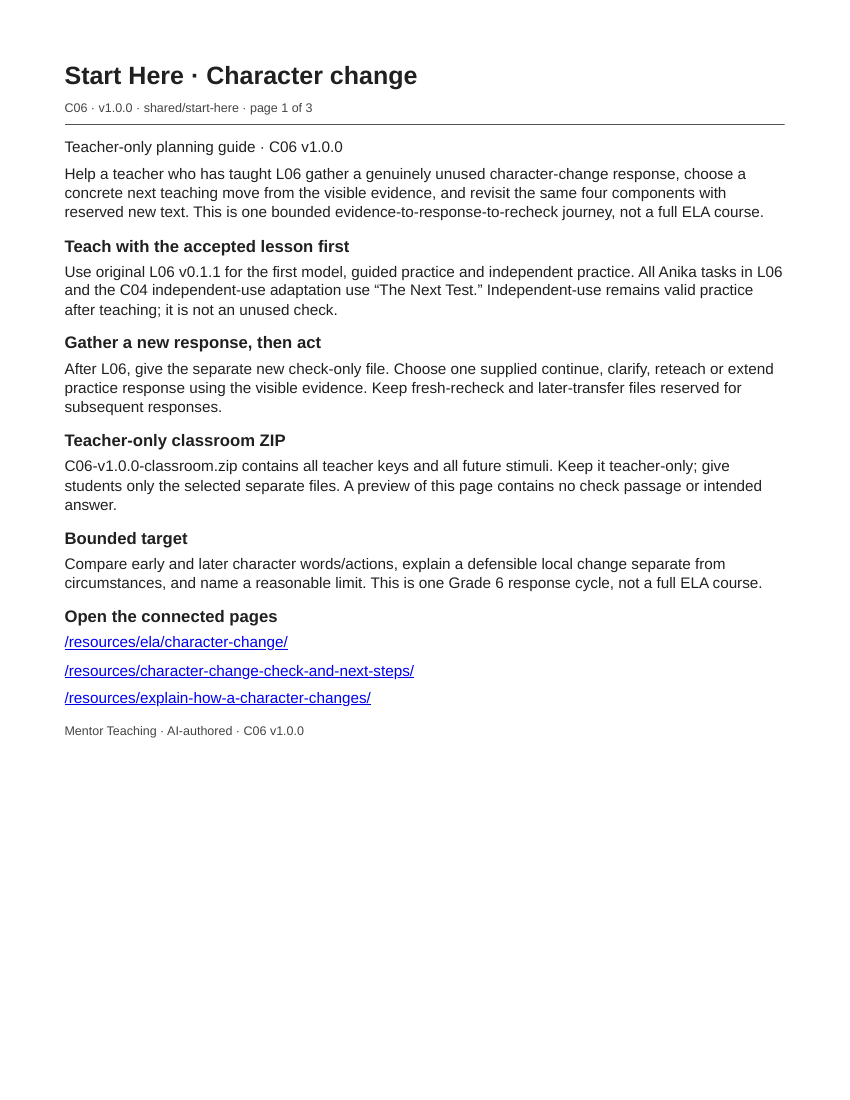
Start teaching
Print only the student pages you plan to use. Keep teacher answers and later checks with the teacher until their intended use.
Archive: Formats and all files
Earlier guidance and source files are retained as historical records. For classroom teaching and printing, use the current stage files and matching guides above. Older guidance, timing and layouts are superseded; some retained browser/Word files have limited writing space or sparse extra pages. Keep historical student files with their historical keys and do not mix editions.
Browse free resources · Character-change collection and starting route
Help Grade 6 students explain how a character changes using early and later story details. After teaching, use a short check, choose focused practice and try a follow-up story. Includes printable and editable student materials with separate teacher guidance.
All files are free, with no account, email address, payment or learning platform required.
- Teaching target
- Compare accurate early and later words or actions, explain a defensible change in a character’s choices, distinguish it from changed circumstances, and state what the story does not establish.
- Fit and prerequisites
- For Grade 6; check the prerequisites for your class. Learners can read or listen to a short story and point to words or actions. Use Explain How a Character Changes first when comparing evidence over time needs teaching.
- Materials
- Only the selected student pages, pencil and separate teacher guide. Read-aloud, text-to-speech, oral rehearsal or recorded dictation can support access when decoding or writing mechanics are not the target; record actual support and response mode.
- What’s included
- Printable student materials and editable files are supplied with separate teacher guidance.
Teach, respond and look again
- Teach and practice with Explain How a Character Changes. Its guided and individual responses use the same Anika story; they are practice after seeing the text.
- After teaching, give students just the short check, making sure they have not already read its story. Keep answer keys with the teacher and save later tasks for another opportunity.
- Review the four criteria separately. Clarify uncertain wording or access conditions before selecting one continue, clarify, reteach or extend task from the teacher guide.
- Use the chosen task for practice. Save the follow-up check until after that practice, and the later task for another learning opportunity. Before using either as a check, make sure students have not seen its story. Record the support students used and compare their reasoning on each story.
Student files — share only the selected task
- Character-change check — keep back until after teaching: Printable PDF · Editable Word · HTML text
- Explain Leena’s change with supporting details: Printable PDF · Editable Word · HTML text
- Compare Leena’s early and later actions: Printable PDF · Editable Word · HTML text
- Model character change and changed circumstances: Printable PDF · Editable Word · HTML text
- Compare two interpretations of Leena’s change: Printable PDF · Editable Word · HTML text
- Follow-up check — use after practice: Printable PDF · Editable Word · HTML text
- Later task — try another context: Printable PDF · Editable Word · HTML text
Teacher guidance and complete keys
- Teacher guide, keys and next teaching steps: Printable PDF · Editable Word · HTML text
- Teacher Start Here and printing guide: Printable PDF · Editable Word · HTML text
The teacher guide includes answers for every task and modeled example, criteria-based response routes and a local decision record. Keep it separate from learner copies.
Choose a next move
- Explain How a Character Changes lesson and practice — Return here when early/later comparison or character-versus-circumstance needs introduction.
- Distinguish an Inference from a Guess — Use its model and practice when an interpretation is not linked to textual clues.
- The cover-work character activity uses the same Anika story as the character-change lesson. Use it for practice once students have read the story. Emergency Grade 6 ELA Cover Kit independent-use character activity
- Collection starting route and classroom package — Select the first teaching, independent-use or response-cycle entry point.
- Substitute Handoff and Independent-Work Pack — Prepare independent practice and a return route for a substitute; save later check stories.
- Clear Directions and Language-Support Pack — Prepare clear directions while preserving students’ choice of early and later evidence.
- Practical Family-Communication Templates — Offer familiar reading practice and keep later check stories for classroom use.
Sources and classroom use
New stories and instructional wording are original fictional examples. Teachers may print and adapt these materials for classroom use under the site’s Terms of Use; retain attribution and identify local changes. The site does not collect student responses. Terms of Use.
Editable Word files
Choose the editable files for this resource and keep teacher guidance separate.
Share this resource
Report a resource issue · Open an issue email
Do not include student names or identifiable work in an issue report. Page revision: 2 November 2026; classroom files retain their own editions.