
Free teaching resource
Explain How a Character Changes
Current teacher guidance: 2 November 2026. Student tasks retain their stated core editions. Use the current stage choices and matching guide below.
Changes in the current files · 2 November 2026
- The teacher guide includes annotated fictional sound, partial and error responses, with concrete teaching actions and evidence to seek next.
- Browser printing keeps task prompts with their response space; the underlying tasks retain their stated editions.
- Browser teacher-guide organizers retain their original ruled writing spaces. Use the separate student selections when distributing classroom tasks.
Prepare the materials
Prepare this lesson or activity
Recommended selection edition 0.1.1. Original source files retain their displayed editions.
These are selected activities. Use the matching guide to decide how they fit your teaching; do not assume that these files alone provide a complete teaching and follow-up sequence.
Current teacher guidance: 2 November 2026. Student tasks retain their stated core edition; use the matching current guide linked here. Earlier files are kept separately in the archive.
- Audience / fit
- Grade 6 ELA
- Teaching or planning target
- Use early and later story details to explain a change in a character’s choices.
- Essential prerequisites
- Learners can read or listen to a short fictional story and point to a sentence or action. No prior lesson on character traits is required.
- Preparation
- About 5 minutes.
- Use time
- About 40 minutes. Planning estimate: opening 3 minutes, strategy 5, model 7, guided practice 10, independent response 13, closure 2.
- Materials
- Learner pages in print or editable format. Pencil; a highlighter or two colored pencils are optional for marking early and later evidence. Board or display for the modeled evidence tracker; optional. No physical bridge or counters are needed.
- What to print
- Print the chosen activity. Follow the source or reveal instructions beside it.
Evidence to notice: Look for accurate early and later actions and an explained, bounded character change; changing circumstances alone do not establish a changed trait.
Preview the actual student page

Start with the selected task
Matching teacher guide and answers — keep separate: Matching teacher guide and answers · 13 pages.
Teaching pages, independent activities and editable copies
Teaching and guided practice
- Model and guided practice · 4 pages
PDF · Editable Word · Read in browser
Independent responses
- Independent response · 2 pages
PDF · Editable Word · Read in browser
Teacher files — separately
- Matching teacher guide and answers · 13 pages · Teacher PDF · Editable teacher Word · Read in browser · teacher copy
Archived page guidance and source files · Write a local teaching plan
Archive: Additional formats, earlier editions and teaching guidance
Earlier guidance and source files are retained as historical records. For classroom teaching and printing, use the current stage files and matching guides above. Older guidance, timing and layouts are superseded; some retained browser/Word files have limited writing space or sparse extra pages. Keep historical student files with their historical keys and do not mix editions.
Is this the right resource?
- Audience / fit
- Grade 6 ELA
- Teaching or planning target
- Use early and later story details to explain a change in a character’s choices.
- Essential prerequisites
- Learners can read or listen to a short fictional story and point to a sentence or action. No prior lesson on character traits is required.
- Preparation
- About 5 minutes.
- Use time
- About 40 minutes. Planning estimate: opening 3 minutes, strategy 5, model 7, guided practice 10, independent response 13, closure 2.
- Materials
- Learner pages in print or editable format. Pencil; a highlighter or two colored pencils are optional for marking early and later evidence. Board or display for the modeled evidence tracker; optional. No physical bridge or counters are needed.
- What to print
- Use the stage-specific student choices below and the matching teacher guide. Give independent, new-evidence and later-assessment pages only at their intended stage.
Start teaching
Print model and guided practice first. Keep the independent response with the teacher until guided practice is complete. Use the complete teacher guide for the named task’s criteria and answers. The independent paragraph uses the story already discussed; it shows independent writing on a familiar text, not transfer to an unseen story.
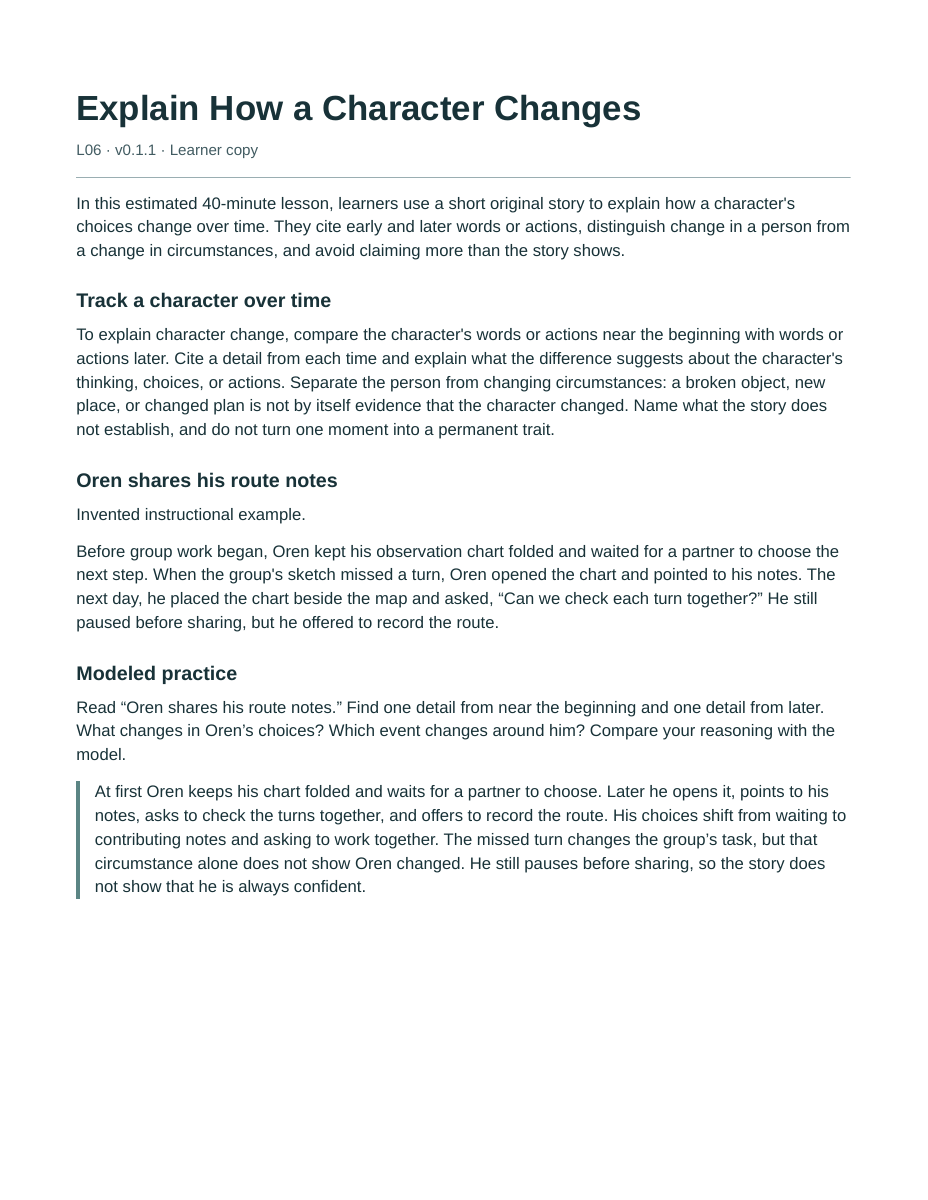
In this estimated 40-minute lesson, learners use a short original story to explain how a character's choices change over time. They cite early and later words or actions, distinguish change in a person from a change in circumstances, and avoid claiming more than the story shows.
All files are free. No email address, account, payment, trial or subscription is required.
- Who it is for
- Grade 6 ELA
- Preparation
- About 5 minutes.
- Teaching time
- About 40 minutes. Planning estimate: opening 3 minutes, strategy 5, model 7, guided practice 10, independent response 13, closure 2.
- Teacher guidance
- Separate teacher files include completed examples or answer and scoring guidance.
Materials
- Learner pages in print or editable format.
- Pencil; a highlighter or two colored pencils are optional for marking early and later evidence.
- Board or display for the modeled evidence tracker; optional. No physical bridge or counters are needed.
Choose a stage and format
Give only the stage being used. Keep later tasks and all teacher keys with the teacher until needed.
Archive: Formats and all files
Earlier guidance and source files are retained as historical records. For classroom teaching and printing, use the current stage files and matching guides above. Older guidance, timing and layouts are superseded; some retained browser/Word files have limited writing space or sparse extra pages. Keep historical student files with their historical keys and do not mix editions.
Complete reference files may include teaching, independent tasks, later evidence or teacher answers. Keep them with the teacher; use the separate stage selections above for handouts.
Read or download the complete resource
- Learner copy — Editable Word file (38 KB)
- Learner copy — Read in browser (HTML)
- Learner copy — Printable PDF (50 KB)
- Teacher guide and answer key — Editable Word file (42 KB)
- Teacher guide and answer key — Read in browser (HTML)
- Teacher guide and answer key — Printable PDF (88 KB)
Keep teacher guidance and answers separate from student copies. Word files contain editable text; the PDF files are ready to print.
Support and adaptation
- If tracking chronology is a barrier, read the story aloud or use text-to-speech, chunk it by paragraph, and mark early and later evidence with two symbols. Offer the tracker sentence starters orally and allow rehearsal or dictation when mechanics are not the target; record response mode. Keep the character-versus-circumstance comparison. Confirm individual access needs locally; general suggestions do not replace an access plan.
Extension
- Invite learners to write a short follow-up scene in a new activity where Anika receives feedback on another design. Include two observable words or actions that let a reader judge whether her approach transfers. Annotate what the scene supports and what one scene still cannot prove about her behavior in every setting.
About the materials
Use the editable files to adapt the materials to your learners and local curriculum.
You may print, copy and adapt the resource for your planning and classroom use under our Terms of Use. Report a resource issue.
Share this resource
Report a resource issue · Open an issue email
Do not include student names or identifiable work in an issue report. Page revision: 2 November 2026; classroom files retain their own editions.