
Middle-school physical science · Grade 6
Which Design Is Better Supported?
Current teacher guidance: 2 November 2026. Student tasks retain their stated core editions. Use the current stage choices and matching guide below.
Changes in the current files · 2 November 2026
- The teacher guide includes annotated fictional sound, partial and error responses, with concrete teaching actions and evidence to seek next.
- Previously combined response practice and fresh-check questions have separate files. Use the practice first and reserve its matching check.
- Browser printing keeps task prompts with their response space; the underlying tasks retain their stated editions.
Compare matched results across trials, choose a sleeve design using relevant evidence, and keep the conclusion within the tested conditions.
Prepare the materials
Prepare this lesson or activity
Recommended selection edition 1.0.0. Original source files retain their displayed editions.
Use the matching guide to choose a response to the work you observe. Clarify access and task wording first; one response is not a diagnosis. Keep independent work, later tasks and answers aside until their intended use.
Current teacher guidance: 2 November 2026. Student tasks retain their stated core edition; use the matching current guide linked here. Earlier files are kept separately in the archive.
- Audience / fit
- Intended Grade 6 science; selected Grades 6–8 standards ideas
- Teaching or planning target
- Compare temperature results across trials, support a sleeve choice, and limit the claim. Includes its prerequisite mini-lesson.
- Essential prerequisites
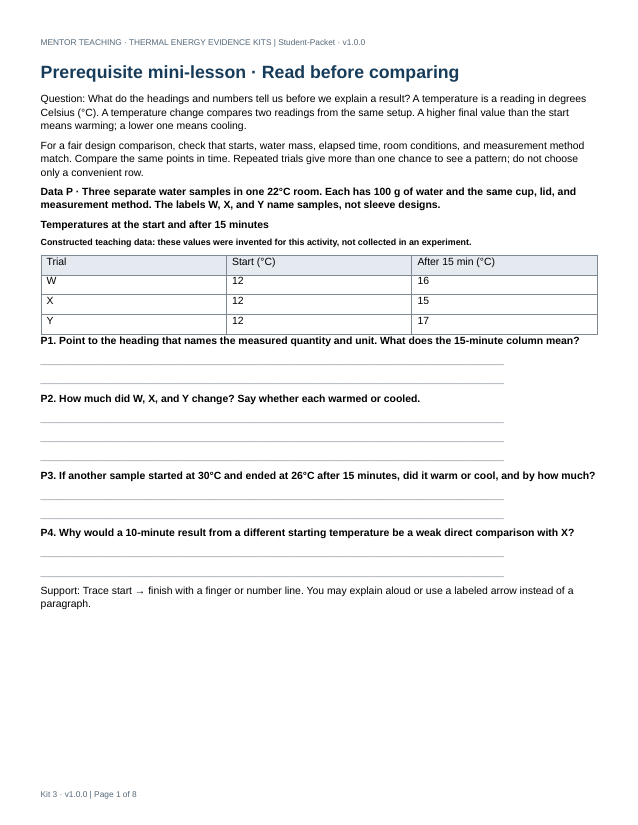
- Read a small table, subtract whole-number temperatures, recognize °C, and distinguish starting and final readings. The included mini-lesson teaches these moves before the main task.
- Preparation
- Read the quick start and choose the student pages; preparation time depends on the selected route.
- Use time
- Allow about 36–44 minutes for the full route, 10–15 minutes for a reteach, or 5–8 minutes for the later check. Planning estimate; adjust for your class.
- Materials
- Paper and pencil. Optional: calculator, number line, projection, pointing, or an oral explanation. No lab equipment is required.
- What to print
- Print the chosen activity. Follow the source or reveal instructions beside it.
Evidence to notice: Look for comparisons across the relevant results and a design claim limited to what those results support.
Preview the actual student page

Start with the selected task
Matching teacher guide and answers — keep separate: Matching teacher guide and answers · 12 pages.
Compare the observed response with the guide’s criteria. Clarify access and wording, then use its conditional directions to choose an activity below. Follow-up and later tasks are not interchangeable test forms.
Teaching stages, response practice and later checks
Teaching and guided practice
- Prerequisite bridge, model and guided practice · 3 pages
PDF · Editable Word · Read in browser
Independent responses
- Independent check · 1 page
PDF · Editable Word · Read in browser
Focused teaching responses
- Compare the measurements — response practice · 1 page
PDF · Editable Word · Read in browserPractice only. Keep the matching separate fresh-check file aside until this response teaching is complete.
- Use all results and limit the claim · 1 page
PDF · Editable Word · Read in browser
Follow-up checks
- Fresh recheck after reteaching · 1 page
PDF · Editable Word · Read in browser - Fresh check after Compare the measurements · 1 page
PDF · Editable Word · Read in browserReserve until the named response practice is complete; do not distribute with the practice file.
Later tasks — reserve for another occasion
- Later assessment · 1 page
PDF · Editable Word · Read in browser
Teacher files — separately
- Matching teacher guide and answers · 12 pages · Teacher PDF · Editable teacher Word · Read in browser · teacher copy
Archived page guidance and source files · Write a local teaching plan
Current print and editable package
Library package prepared 2 November 2026. Revised guides are marked with that date; other files retain their stated editions. Keep this package with the teacher. Read START-HERE, choose one stage, and retain teacher keys and checks for later use in their separate folders. Online browser versions are linked from the preparation pages.
Choose from the response
Choose the next teaching move
Describe what the learner said, wrote or showed. Check access, wording, prerequisites and calculation before interpreting it. A single response is not a diagnosis. Record support and prior exposure; a helped or rehearsed task is practice.
Use the practice-only response file. Its matching fresh check is a separate reserved file; give it only after the selected practice is complete. Keep the later task for another occasion. A different task is not a validated equivalent test.
Start with the supplied materials
Observe, clarify and select one response
Reading, change or direction errors remain after clarification.
Teaching move: Compare the Measurements before making a design claim.
- Compare the measurements — response practice · PDF · 1 page
Practice only. Keep the matching separate fresh-check file aside until this response teaching is complete.
After this practice, give the matching check below only if it has not been seen. Keep it aside during teaching.
- Fresh check after Compare the measurements · PDF · 1 page
Reserve until the named response practice is complete; do not distribute with the practice file.
Read the matching teacher directions; keep answers with the teacher.
Only one favorable row is used, or the claim goes beyond the supplied evidence.
Teaching move: Use All Results and Limit the Claim; inspect the other matched trials and the conditions.
Read the matching teacher directions; keep answers with the teacher.
Look again after teaching
After the supplied teaching and guided practice, give the selected independent task without its answers. Use its explanation to choose a response above.
Return on a later occasion
Reserve these tasks until their intended use. They have different demands; do not treat them as equivalent tests or proof of broad mastery.
Return to preparation and all formats · Complete teacher guide and answers
Archive: Additional formats, earlier editions and teaching guidance
Earlier guidance and source files are retained as historical records. For classroom teaching and printing, use the current stage files and matching guides above. Older guidance, timing and layouts are superseded; some retained browser/Word files have limited writing space or sparse extra pages. Keep historical student files with their historical keys and do not mix editions.
Is this the right resource?
- Audience / fit
- Intended Grade 6 science; selected Grades 6–8 standards ideas
- Teaching or planning target
- Compare temperature results across trials, support a sleeve choice, and limit the claim. Includes its prerequisite mini-lesson.
- Essential prerequisites
- Read a small table, subtract whole-number temperatures, recognize °C, and distinguish starting and final readings. The included mini-lesson teaches these moves before the main task.
- Preparation
- Read the quick start and choose the student pages; preparation time depends on the selected route.
- Use time
- Allow about 36–44 minutes for the full route, 10–15 minutes for a reteach, or 5–8 minutes for the later check. Planning estimate; adjust for your class.
- Materials
- Paper and pencil. Optional: calculator, number line, projection, pointing, or an oral explanation. No lab equipment is required.
- What to print
- Use the stage-specific student choices below and the matching teacher guide. Give independent, new-evidence and later-assessment pages only at their intended stage.
Start teaching
Print the bridge, model and guided practice first, then give the separate independent check. Quick Check in the original files repeats that independent task; it is not fresh evidence. Choose a reteach page from the teacher guide and retain the later assessment until its intended use. Use only the selected stage, not the complete student packet.
Choose a stage and format
Give only the stage being used. Keep later tasks and all teacher keys with the teacher until needed.
- Prerequisite bridge, model and guided practice · PDF (3 pages) · Prerequisite bridge, model and guided practice · editable Word · Prerequisite bridge, model and guided practice · browser copy
- Independent check · PDF (1 page) · Independent check · editable Word · Independent check · browser copy
- Compare the measurements · PDF (1 page) · Compare the measurements · editable Word · Compare the measurements · browser copy
- Use all results and limit the claim · PDF (1 page) · Use all results and limit the claim · editable Word · Use all results and limit the claim · browser copy
- Fresh recheck after reteaching · PDF (1 page) · Fresh recheck after reteaching · editable Word · Fresh recheck after reteaching · browser copy
- Later assessment · PDF (1 page) · Later assessment · editable Word · Later assessment · browser copy
Archive: Formats and all files
Earlier guidance and source files are retained as historical records. For classroom teaching and printing, use the current stage files and matching guides above. Older guidance, timing and layouts are superseded; some retained browser/Word files have limited writing space or sparse extra pages. Keep historical student files with their historical keys and do not mix editions.
Complete reference files may include teaching, independent tasks, later evidence or teacher answers. Keep them with the teacher; use the separate stage selections above for handouts.
Thermal Energy Evidence Kits · Browse all free resources
Kit 3 is a self-contained teaching kit. It includes a prerequisite mini-lesson, a worked sleeve comparison, guided practice, a fresh independent task, two focused reteaches with new checks, and a later task about cooling. You can use Kit 3 independently or after Kits 1 and 2 in the foundation collection.
- Prerequisites
- Read a small table, subtract whole-number temperatures, recognize °C, and distinguish starting and final readings. The included mini-lesson teaches these moves before the main task.
- Audience
- For Grade 6. Related NGSS expectations span Grades 6–8; check your local course placement.
- Materials
- Paper and pencil. Optional: calculator, number line, projection, pointing, or an oral explanation. No lab equipment is required.
- Teaching time
- Allow about 36–44 minutes for the full route, 10–15 minutes for a reteach, or 5–8 minutes for the later check.
Constructed teaching data: these values were invented for this activity, not collected in an experiment. These records do not establish the actual performance of real sleeves or products.
Choose what to print
- Teach the Lesson — 4 pages
- Use a Quick Check — 1 page; the lesson’s independent task
- Reteach: Compare the Measurements — 1 page, including a cooling check
- Reteach: Use All Results and Limit the Claim — 2 pages, including a follow-up check
- Use a Later Check — 1 page, a new cooling task
Each selection includes its needed setup, table, disclosure and prompts. Match the task headings to the teacher guide. Quick Check repeats the lesson’s independent task; save Later Check for a new response after teaching.
Student mini-lesson
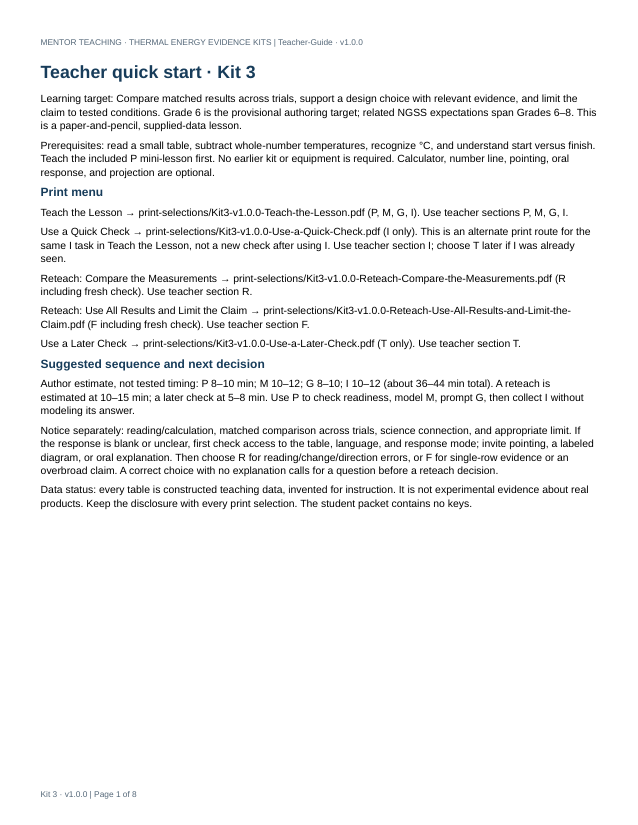
Teacher quick start
Complete student packet
- Full student packet — PDF, 8 pages
- Full student packet — editable Word file
- Read the student packet as HTML
Teacher explanations and keys
- Teacher guide and complete key — PDF, 8 pages
- Teacher guide and complete key — editable Word file
- Read the teacher guide as HTML
Accept an accurate labeled diagram, pointed-to data with an oral explanation, or connected prose. Clarify an unclear response and its access needs before assigning a reteach. The teacher guide supplies the explanation, accepted alternatives and a next-task decision.
About the materials
Supplied-data analysis supports selected components of the energy and design expectations. It does not show that a learner designed, constructed and tested a physical device. Read the source and standards notes.
Editable data and package
Download the classroom package ZIP with student and teacher files, print selections and constructed data. Teaching data (JSON). The CSV tables are also included in the ZIP.
You may print, copy and adapt the resources for your planning and classroom use under our Terms of Use. Report a resource issue.
. The Start Here guide links the complete foundation sequence.
Share this resource
Report a resource issue · Open an issue email
Do not include student names or identifiable work in an issue report. Page revision: 2 November 2026; classroom files retain their own editions.