
Free teaching resource
Use Context to Clarify Vocabulary
Is this the right resource?
- Audience / fit
- Grade 6 ELA
- Teaching or planning target
- Use nearby clues to justify a word meaning and test a plausible alternative.
- Essential prerequisites
- Learners can read or listen to a short fictional excerpt and point to a word or sentence. No prior lesson on a particular vocabulary strategy is required.
- Preparation
- About 5 minutes.
- Use time
- About 40 minutes. Planning estimate: opening 3 minutes, strategy 5, model 8, guided practice 10, independent response 12, closure 2.
- Materials
- Learner pages in print or editable format. Pencil; a highlighter is optional. Board or display for the model; optional. A dictionary may be used after an initial context-based response to compare possible senses, not to replace the text evidence.
- What to print
- Use the stage-specific student choices below and the matching teacher guide. Give independent, new-evidence and later-assessment pages only at their intended stage.
Start teaching
Print model and guided practice first. Keep the independent response with the teacher until guided practice is complete. Use the complete teacher guide for the named task’s criteria and answers.
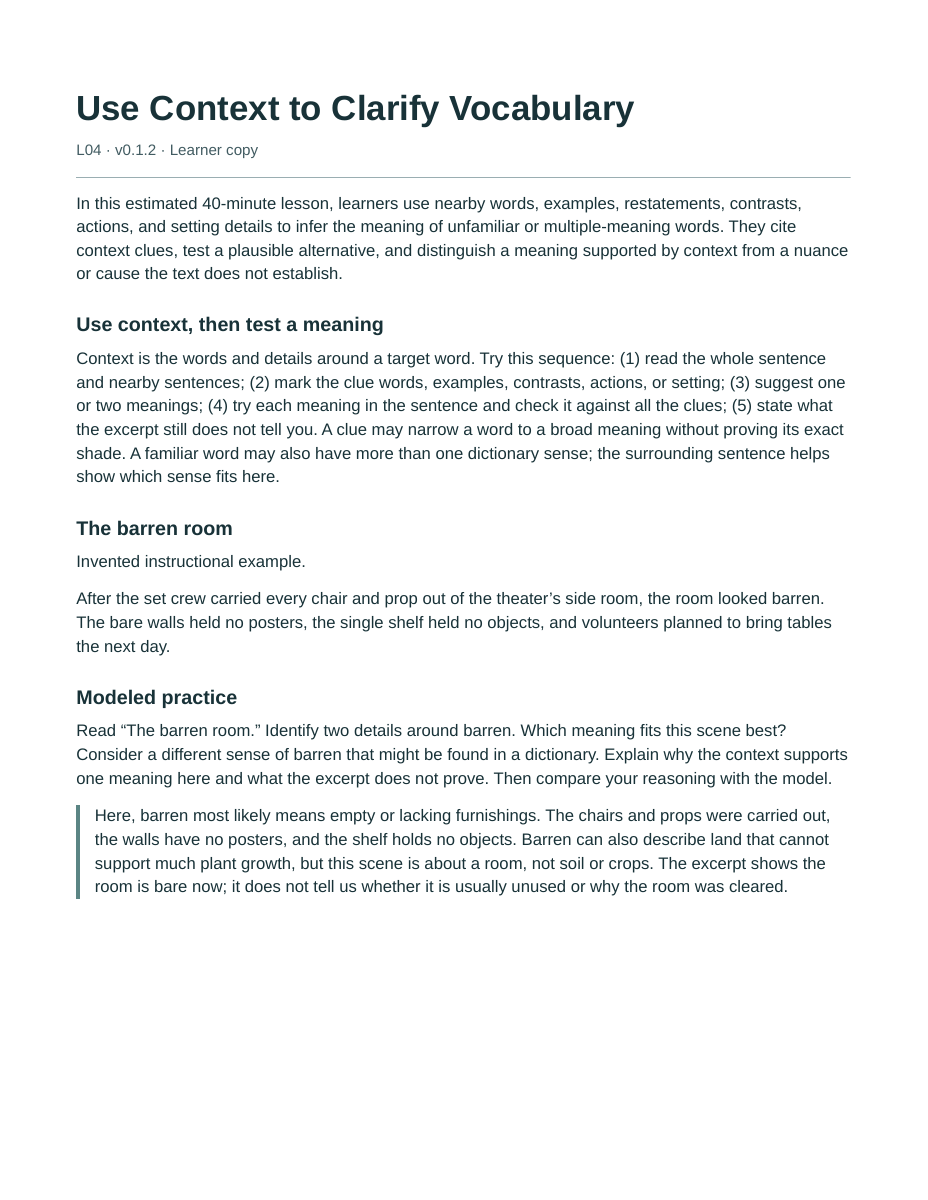
In this estimated 40-minute lesson, learners use nearby words, examples, restatements, contrasts, actions, and setting details to infer the meaning of unfamiliar or multiple-meaning words. They cite context clues, test a plausible alternative, and distinguish a meaning supported by context from a nuance or cause the text does not establish.
All files are free. No email address, account, payment, trial or subscription is required.
- Who it is for
- Grade 6 ELA
- Preparation
- About 5 minutes.
- Teaching time
- About 40 minutes. Planning estimate: opening 3 minutes, strategy 5, model 8, guided practice 10, independent response 12, closure 2.
- Teacher guidance
- Separate teacher files include completed examples or answer and scoring guidance.
Materials
- Learner pages in print or editable format.
- Pencil; a highlighter is optional.
- Board or display for the model; optional.
- A dictionary may be used after an initial context-based response to compare possible senses, not to replace the text evidence.
Choose a stage and format
Give only the stage being used. Keep later tasks and all teacher keys with the teacher until needed.
Formats and all files
Complete reference files may include teaching, independent tasks, later evidence or teacher answers. Keep them with the teacher; use the separate stage selections above for handouts.
Read or download the complete resource
- Learner copy — Editable Word file (38 KB)
- Learner copy — Read in browser (HTML)
- Learner copy — Printable PDF (48 KB)
- Teacher guide and answer key — Editable Word file (42 KB)
- Teacher guide and answer key — Read in browser (HTML)
- Teacher guide and answer key — Printable PDF (84 KB)
Keep teacher guidance and answers separate from student copies. Word files contain editable text; the PDF files are ready to print.
Support and adaptation
- If reading or holding several clues in mind is a barrier, read the excerpt aloud or use text-to-speech, chunk it by sentence, and let learners mark one clue at a time. The target remains choosing and justifying a meaning from context. If writing is not the target, an oral or pointing-plus-explanation response may show the same vocabulary reasoning; record the response mode. Confirm individual access needs locally; generic suggestions do not replace an access plan.
Extension
- For an extension, invite learners to choose a familiar multiple-meaning word such as “draft” and write two short fictional contexts that make different senses fit. Each context should include at least two clues and a tempting alternative sense that does not fit. A partner underlines the clues and explains which sense the context supports and what remains uncertain. Do not use a real person’s private information.
About the materials
Use the editable files to adapt the materials to your learners and local curriculum.
You may print, copy and adapt the resource for your planning and classroom use under our Terms of Use. Report a resource issue.
Share this resource
Report a resource issue · Open an issue email
Do not include student names or identifiable work in an issue report. Page revision: 15 October 2026; classroom files retain their own editions.