
Subject-Specific Teaching
Spatial Reasoning Across the Curriculum: Representations, Language, and Transfer
Also in: Instructional Strategies
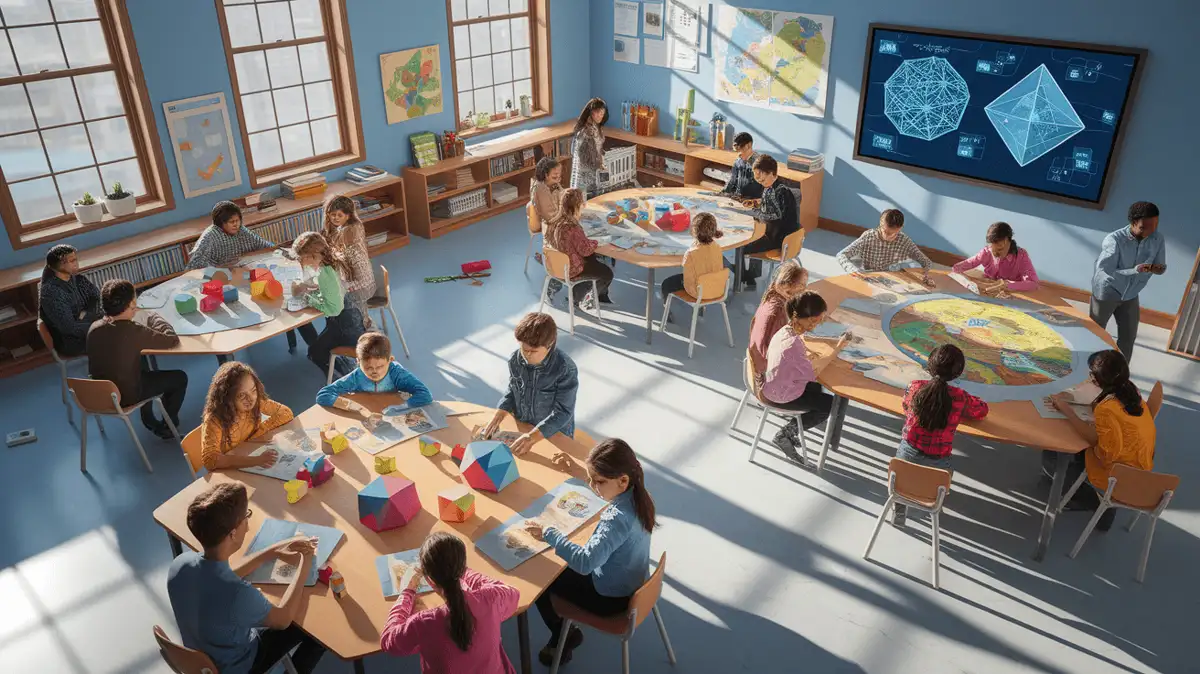
Define the spatial action
Spatial reasoning includes distinct actions such as mentally rotating an object, visualizing a change, locating an object relative to a reference, interpreting a representation, or navigating a route. Name and assess the action required by the current task. Do not treat spatial reasoning as one hidden ability or assume it transfers across STEM, art, and everyday problems.
Storyboarding to Sculpture: Language Arts and Spatial Thinking
A storyboard can ask students to map a scene, sequence events, and position characters relative to one another. A sculpture or diorama can make selected spatial relationships visible. State whether the objective is narrative reasoning, representation, object manipulation, or another action and assess that action directly.
Describing a room’s layout uses spatial vocabulary and reasoning about position and direction. The linked spatial-reasoning review can inform task design without assigning a fixed “intelligence” to a learner or assuming a cross-subject gain.
Visualizing Scientific Concepts
Science uses visual-spatial skills to examine phenomena ranging from the spiral of a galaxy to the mechanics of the human heart. In science education, models of molecules, diagrams of ecosystems, and 3D renderings of geological layers can clarify how systems interact. Ask students to explain what a rotated or changed model represents and check the explanation against the science concept.
Tasks involving physical models, simulations, or coordinate systems can elicit spatial reasoning when students must explain relationships, transformations, or position. Review their explanations and representations rather than assuming that activity format improves understanding or retention.
Navigating History and Geography
In history, a timeline can represent temporal order and intervals; in geography, a map can represent location, distance, direction, scale, and relationships between places. For a migration route, military decision, or landscape comparison, specify the representation students must interpret and the evidence they must cite rather than inferring a general spatial ability.
Interactive map work, GIS platforms, and scale models of historical sites can connect spatial awareness with subject understanding. Collect a map-based explanation using scale, direction, location, or context as required by the objective.
Creative Movement and Design
Spatial reasoning can involve visual and physical tasks. Dance choreography, sports plays, and engineering design may require students to interpret, create, or revise spatial relationships. Define the target process—such as mental rotation or visual-motor coordination—and collect evidence of that process rather than assuming a hands-on format produces it.
A building task, theater staging problem, or architectural sketch can require students to represent dimensions, positions, movement, constraints, or viewpoints. Define those criteria and collect individual evidence; the activity format does not establish creativity, coordination, relevance, or general problem-solving ability.
Assessing Spatial Growth
Assess spatial reasoning with tasks matched to the specific process being taught, such as mental rotation or spatial visualization. Use more than one task and review the reasoning students show; the linked spatial-reasoning guidance provides examples.
- Observation during hands-on activities
- Performance in spatial puzzles or manipulatives
- Progress in using spatial vocabulary correctly
- Accuracy in translating between 2D and 3D representations
Assess the specified spatial task and the evidence students produce. Do not infer a general growth mindset or stronger spatial intelligence from participation or outcome scores alone.
Charting the Spatial Road Ahead
Curriculum-integrated spatial tasks can provide practice with mental rotation, scale, position, and representations used in several subjects. Assess the specific spatial relationship being taught rather than predicting achievement, career, or life outcomes.
Use a spatial task when the subject objective requires a relationship, scale, position, or change of viewpoint. Check that specific action before planning another context.
Worked example: connect contour lines to slope
Hypothetical planning example; the observations and results below are constructed, not reported classroom evidence.
Inputs: Grade 5 students have a simple contour map, modeling clay, dental floss for slicing, and the objective, “Explain how contour spacing represents a steep or gentle slope.”
Steps: Students build the mapped hill in clay, slice it at equal heights, trace the layers, and compare the resulting rings with two marked routes on the map before writing an explanation.
Decision: Fourteen of 22 explanations connect close lines with a steeper change, while eight describe close lines as a lower elevation without addressing rate of change.
Response: Keep the objective and use one exaggerated model to contrast elevation with slope, then ask the eight students to annotate and explain a new route; offer a tactile or enlarged-map route where required.
Classroom resources for this teaching goal
- Read Maps and Explain Change with Evidence — For selected Grades 6–8, compare supplied Boston maps and a report, distinguish observation from inference and support a limited historical claim.