
Free teaching resource
Evaluate a Web Source’s Credibility
Current teacher guidance: 2 November 2026. Student tasks retain their stated core editions. Use the current stage choices and matching guide below.
Changes in the current files · 2 November 2026
- A supplied response lesson now connects the full learning target to separate different fresh and later checks. Keep those checks out of the teaching packet.
- Browser printing keeps task prompts with their response space; the underlying tasks retain their stated editions.
- Browser teacher-guide organizers retain their original ruled writing spaces. Use the separate student selections when distributing classroom tasks.
Prepare the materials
Prepare this lesson or activity
Recommended selection edition 0.1.3. Original source files retain their displayed editions.
Use the matching guide to choose a response to the work you observe. Clarify access and task wording first; one response is not a diagnosis. Keep independent work, later tasks and answers aside until their intended use.
Current teacher guidance: 2 November 2026. Student tasks retain their stated core edition; use the matching current guide linked here. Earlier files are kept separately in the archive.
- Audience / fit
- Grade 6 ELA
- Teaching or planning target
- Use fictional offline source cards to examine evidence, purpose, creator, date, and limits.
- Essential prerequisites
- Learners can read or listen to a short source card and explain a choice. No prior website-evaluation vocabulary is required.
- Preparation
- Read the current matching guide; prepare the original teaching/independent stages or the selected response-teaching file. Keep fresh/later files and answers separate.
- Use time
- About 40 minutes. Planning estimate: opening 3, strategy 7, model 8, guided comparison 10, independent evaluation 10, closure 2. Selected response route: Planning estimates: preparation 5 minutes; model 4, guided pair 8–10, fresh evaluation 8. Split the check from instruction if needed; retain both cards and all source checks.
- Materials
- Learner pages in print or editable DOCX. Pencil or another way to mark and draft an evaluation. Optional highlighter for marking source details.
- What to print
- Print the chosen activity. Follow the source or reveal instructions beside it.
Evidence to notice: Look for a question-specific evaluation of creator and access, purpose, evidence or method, date and source trail, with uncertainty and a useful next check.
Preview the actual student page

Start with the selected task
Matching teacher guide and answers — keep separate: Matching teacher guide and answers · 16 pages.
Compare the observed response with the guide’s criteria. Clarify access and wording, then use its conditional directions to choose an activity below. Follow-up and later tasks are not interchangeable test forms.
Teaching stages, response practice and later checks
Teaching and guided practice
- Model and guided practice · 4 pages
PDF · Editable Word · Read in browser
Independent responses
- Independent response · 4 pages
PDF · Editable Word · Read in browser
Focused teaching responses
- Question, evidence and source limits — model and practice · 1 page
PDF · Editable Word · Read in browser
Follow-up checks
- Different source pair — reserve until after response teaching · 1 page
PDF · Editable Word · Read in browserReserve this different task until its named occasion. Keep models and answers with the teacher.
Later tasks — reserve for another occasion
- Later source pair — reserve for another occasion · 1 page
PDF · Editable Word · Read in browserReserve this different task until its named occasion. Keep models and answers with the teacher.
Teacher files — separately
- Matching teacher guide and answers · 16 pages · Teacher PDF · Editable teacher Word · Read in browser · teacher copy
Archived page guidance and source files · Write a local teaching plan
Choose from the response
Choose the next teaching move
Describe what the learner said, wrote or showed. Check access, wording, prerequisites and calculation before interpreting it. A single response is not a diagnosis. Record support and prior exposure; a helped or rehearsed task is practice.
Use the original model and guided practice before the independent task. Select the supplied response lesson from the work you observe; reserve the different fresh/later files. These are not equivalent tests.
Start with the supplied materials
Observe, clarify and select one response
One source cue replaces evidence/method checking, or a conclusion exceeds what the cards support.
Teaching move: After the original C/D evaluation, use this route when a learner ranks sources by appearance or authority alone, confuses replies with attendance, or omits limits/checks. First clarify the question and access. Model the difference between the repair-log question and brand reliability. Guide B/C by making one line per source: question fit, creator/access, purpose, evidence/method, date, missing record. Ask how both sources can matter rather than announcing a winner. Put practice away before D/E; reserve F/G for later. All records are constructed, so proposed source checks are plans, not actual verifications of real records.
After this practice, give the matching check below only if it has not been seen. Keep it aside during teaching.
- Different source pair — reserve until after response teaching · PDF · 1 page
Reserve this different task until its named occasion. Keep models and answers with the teacher.
Read the matching teacher directions; keep answers with the teacher.
Look again after teaching
After the supplied teaching and guided practice, give the selected independent task without its answers. Use its explanation to choose a response above.
After selected response teaching and another learning opportunity, use the unused follow-up task.
- Different source pair — reserve until after response teaching · PDF · 1 page
Reserve this different task until its named occasion. Keep models and answers with the teacher.
Return on a later occasion
Reserve these tasks until their intended use. They have different demands; do not treat them as equivalent tests or proof of broad mastery.
- Later source pair — reserve for another occasion · PDF · 1 page
Reserve this different task until its named occasion. Keep models and answers with the teacher.
Return to preparation and all formats · Complete teacher guide and answers
Archive: Additional formats, earlier editions and teaching guidance
Earlier guidance and source files are retained as historical records. For classroom teaching and printing, use the current stage files and matching guides above. Older guidance, timing and layouts are superseded; some retained browser/Word files have limited writing space or sparse extra pages. Keep historical student files with their historical keys and do not mix editions.
Is this the right resource?
- Audience / fit
- Grade 6 ELA
- Teaching or planning target
- Use fictional offline source cards to examine evidence, purpose, creator, date, and limits.
- Essential prerequisites
- Learners can read or listen to a short source card and explain a choice. No prior website-evaluation vocabulary is required.
- Preparation
- About 5 minutes.
- Use time
- About 40 minutes. Planning estimate: opening 3, strategy 7, model 8, guided comparison 10, independent evaluation 10, closure 2.
- Materials
- Learner pages in print or editable DOCX. Pencil or another way to mark and draft an evaluation. Optional highlighter for marking source details.
- What to print
- Use the stage-specific student choices below and the matching teacher guide. Give independent, new-evidence and later-assessment pages only at their intended stage.
Start teaching
Print model and guided practice first. Keep the independent response with the teacher until guided practice is complete. Use the complete teacher guide for the named task’s criteria and answers.
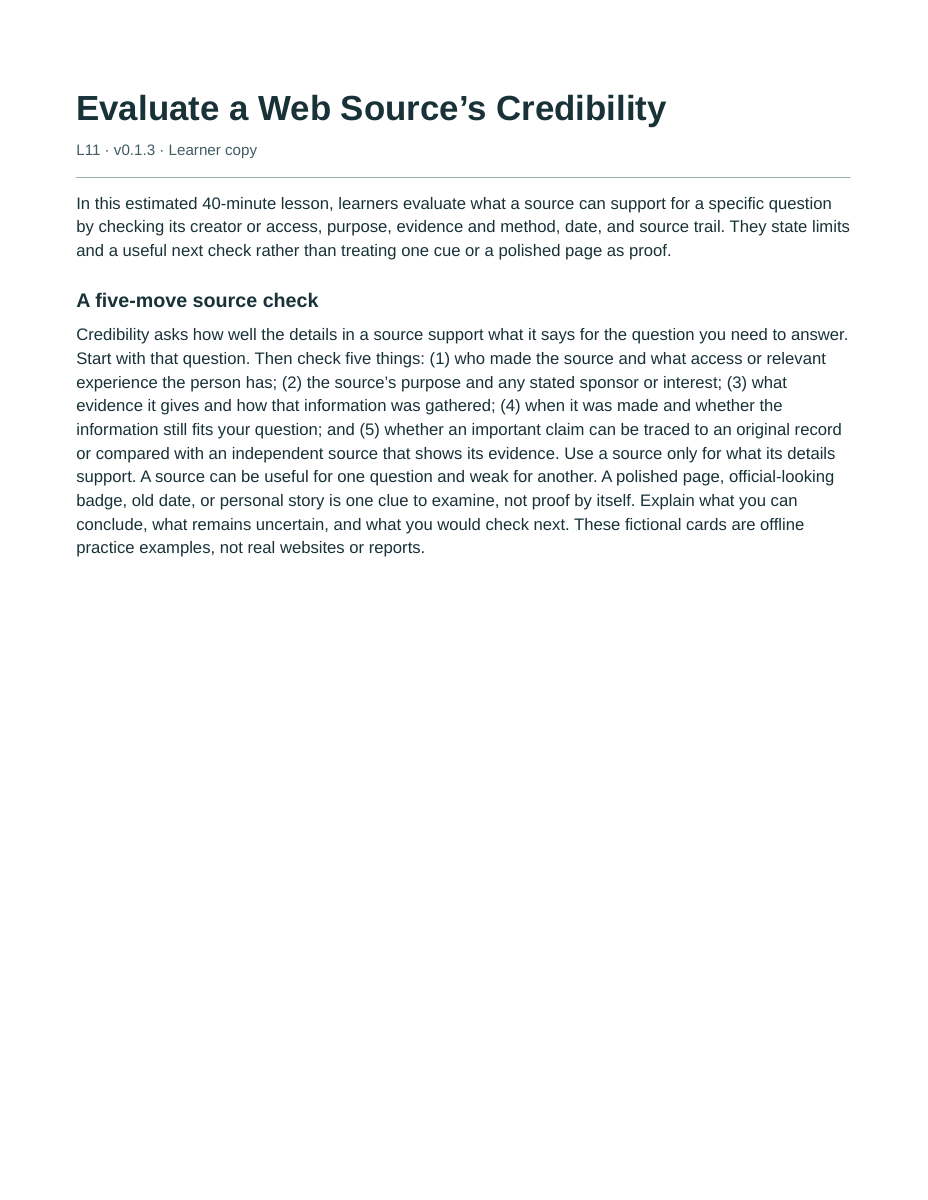
In this estimated 40-minute lesson, learners evaluate what a source can support for a specific question by checking its creator or access, purpose, evidence and method, date, and source trail. They state limits and a useful next check rather than treating one cue or a polished page as proof.
All files are free. No email address, account, payment, trial or subscription is required.
- Who it is for
- Grade 6 ELA
- Preparation
- About 5 minutes.
- Teaching time
- About 40 minutes. Planning estimate: opening 3, strategy 7, model 8, guided comparison 10, independent evaluation 10, closure 2.
- Teacher guidance
- Separate teacher files include completed examples or answer and scoring guidance.
Materials
- Learner pages in print or editable DOCX.
- Pencil or another way to mark and draft an evaluation.
- Optional highlighter for marking source details.
Choose a stage and format
Give only the stage being used. Keep later tasks and all teacher keys with the teacher until needed.
Archive: Formats and all files
Earlier guidance and source files are retained as historical records. For classroom teaching and printing, use the current stage files and matching guides above. Older guidance, timing and layouts are superseded; some retained browser/Word files have limited writing space or sparse extra pages. Keep historical student files with their historical keys and do not mix editions.
Complete reference files may include teaching, independent tasks, later evidence or teacher answers. Keep them with the teacher; use the separate stage selections above for handouts.
Read or download the complete resource
- Learner copy — Editable Word file (39 KB)
- Learner copy — Read in browser (HTML)
- Learner copy — Printable PDF (61 KB)
- Teacher guide and answer key — Editable Word file (43 KB)
- Teacher guide and answer key — Read in browser (HTML)
- Teacher guide and answer key — Printable PDF (98 KB)
Keep teacher guidance and answers separate from student copies. Word files contain editable text; the PDF files are ready to print.
Support and adaptation
- Read one card at a time, use the independent organizer, mark the question/creator/evidence/limit, and allow oral rehearsal, dictation, or typing without revealing a preferred schedule.
Extension
- Apply one source to a different question, identify evidence that could independently corroborate a claim, and explain how a new result would change the conclusion.
About the materials
Use the editable files to adapt the materials to your learners and local curriculum.
You may print, copy and adapt the resource for your planning and classroom use under our Terms of Use. Report a resource issue.
Share this resource
Report a resource issue · Open an issue email
Do not include student names or identifiable work in an issue report. Page revision: 2 November 2026; classroom files retain their own editions.