
Student Engagement
Designing for Collaboration: Crafting Lesson Plans That Foster Successful Group Work
Also in: Instructional Strategies
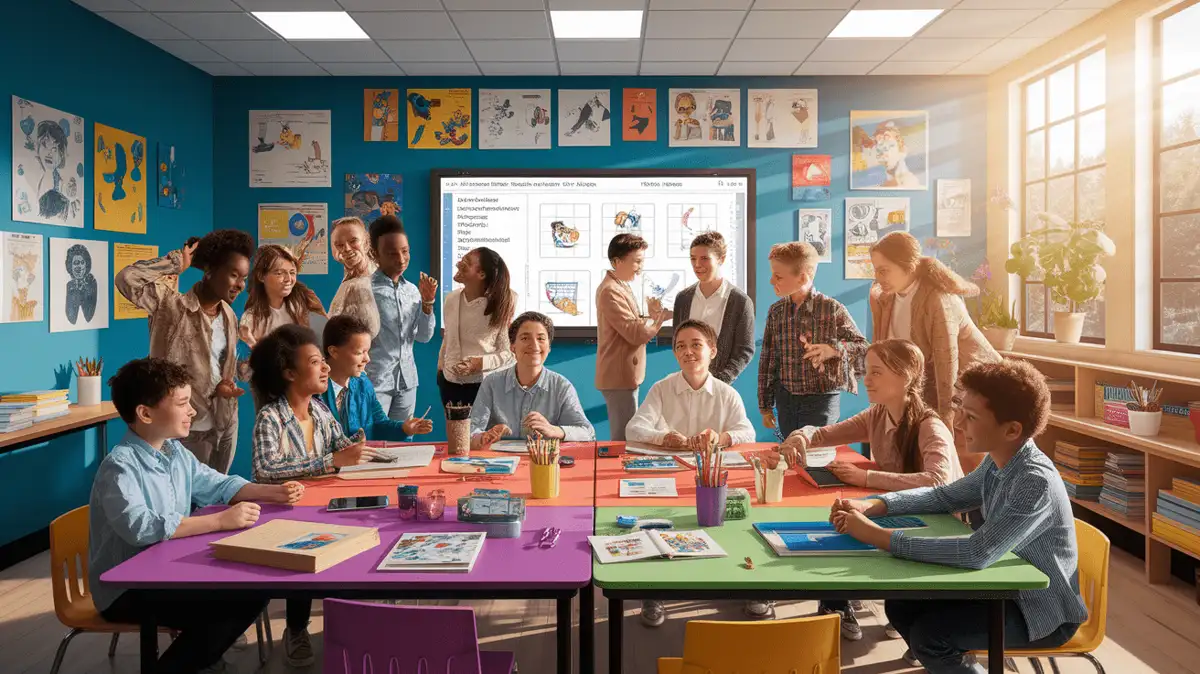
Collaborative-task action sequence
- Define the shared product and the individual evidence required from every student.
- Choose group size, roles, materials, access routes, and a help procedure that fit the task.
- Model one observable collaboration move, such as asking for evidence or checking agreement.
- Collect a brief individual response and inspect the group product at a planned midpoint.
- Reteach, reassign a role, change the task structure, or pause the group when evidence or safety requires it.
Worked example: compare two source accounts
Hypothetical example: In a history lesson, groups of three create a two-column comparison of two short source accounts. One student locates claims, one locates supporting details, and one checks source information; roles rotate after the first account. Each student independently writes which difference matters most and cites one detail before the group drafts its summary.
At the midpoint, the teacher checks each individual note and whether the group table distinguishes a claim from supporting detail. A missing individual response triggers support and another check rather than being hidden by the group product. The teacher also reviews role access, interruptions, uncredited work, and whether the final summary reflects the sources before using the structure again.
Copyable collaboration checkpoint
Learning objective:
Shared product:
Individual evidence:
Group size and roles:
Access and help routes:
Collaboration move to model:
Midpoint evidence:
Participation or task problem:
Continue, reteach, restructure, or pause:
Purposeful collaborative lessons require more than placing students in groups. Plan a shared task, clear responsibilities, ways for students to explain their reasoning, and checks on participation.
Conditions for Collaborative Planning
The main planning task here is designing student collaboration with a shared objective, explicit roles, and individual evidence. Colleagues or specialists can help prepare that task when coordination is needed. When writing effective lesson plans together, define shared goals, communication procedures, responsibilities, and how each contributor can participate.
A collaborative lesson plan must specify the academic objective, reason collaboration is necessary, roles or coordination process, individual evidence, access and participation options, teacher monitoring, and assessment criteria. Group work does not ensure the learning target, interpersonal skill development, or academic achievement.
When a shared task serves the objective
Choose collaboration when students need to compare evidence, combine distinct contributions, or explain and challenge reasoning. A group arrangement alone does not show what each student understands. Require a shared product and a brief individual response, then review both against the stated criteria.
For the two-source history example above, the shared comparison organizes the accounts; each student’s separate supported claim shows whether that learner can use the comparison. If one student produces the whole group response, change roles or provide an individual route before drawing conclusions about the others.
Plan the Shared Task and Evidence
Design collaborative lessons around the learning objective, group task, participation structure, and evidence of individual and shared work. Select resources only after those elements are defined.
Creating "Group-Worthy" Tasks
A group task can require collective problem-solving, critical thinking, and differentiated roles. Use these criteria to decide whether the task requires collaboration:
- STEM Projects: Students use shared data and collective expertise to design solutions
- Cross-Curricular Units: Interdisciplinary teams combine science, math, and language arts in project-based learning (PBL) tasks
- Real-World Problem Solving: Students address challenges that mirror workplace collaboration
Require collaboration only when the objective or product needs coordinated contributions. Define what each student must contribute, explain, or demonstrate; physical proximity is not evidence of collaboration.
Understanding Group Work vs. Team Work
Select the shared task, role structure, and individual evidence explicitly; the labels “group” and “team” do not establish these features.
Choose the structure that fits the learning objective.
The 4-Step Framework for Collaborative Success
The following four-step framework pairs collaborative procedures with evidence of the academic objective:
- Draft Tasks: Design assignments that genuinely require teamwork
- Model Collaboration: Demonstrate roles and expected practices
- Guide During Work: Support peer evaluation and feedback
- Reflect Post-Tasks: Debrief the learning and identify process improvements
Putting Plans into Practice
Successful implementation depends on structure and support. Effective instructional strategies should serve the collaborative learning objective.
Establishing Clear Group Roles
Defined, rotating roles can clarify responsibilities during group work, but they do not ensure equitable participation. Monitor whose ideas, speaking time, and labor are represented. Possible roles include:
- Leader: Facilitates discussion and keeps the group on task
- Recorder: Documents ideas and maintains group notes
- Timekeeper: Manages pacing and deadlines
- Resource Manager: Organizes materials and technology tools
Rotate a role only after its actions have been modeled, the student has an accessible route to perform it, and the rotation serves the objective. Record the task-specific contribution rather than inferring a well-rounded teamwork skill.
Integrating Technology for Enhanced Collaboration
Learning management systems such as Canvas, Google Classroom, and Moodle can distribute group tasks and collect contributions in online settings. Edpuzzle can support shared video tasks, while shared documents can record real-time contributions. Choose each tool according to the task and access requirements.
Keep the learning objectives, not the technology, at the center of student collaboration.
Assessment-Driven Planning
Check learning throughout a collaborative lesson. Use evidence gathered during the work to adjust instruction and evaluate collaboration outcomes. Possible checks include:
- Quick check-ins during group work
- Peer evaluation forms
- Individual reflection journals
- Rubrics for group work assessment that measure both process and product
Troubleshooting Team Dynamics
When group dynamics interfere with the task, identify the specific participation or coordination problem and select a response that can be observed during practice.
Common Challenges and Solutions
Surface-Level Collaboration: When students divide tasks without shared planning, require the group to explain how the contributions fit together and collect both group and individual evidence.
Unequal Participation: Some students contribute more often or complete more of the work than others. Use protocols such as round-robin sharing or role rotation to define contribution opportunities and available response routes, then inspect individual evidence rather than assuming the protocol produces equal participation.
Social Emotional Learning (SEL) Considerations: Working effectively in a team requires explicit instruction in communication skills and conflict resolution. Do not assume students already know how to collaborate. Model and practice these skills.
Supporting Struggling Collaborators
Support students who struggle with collaboration through differentiated approaches:
- Provide sentence starters for discussions
- Create visual aids showing collaboration expectations
- Offer alternative ways to contribute (writing, drawing, organizing)
- Use smaller groups initially when they make individual participation easier to observe, then review each student’s contribution before changing the group size
Introduce one collaborative routine at a time, model the expected behavior, and give feedback on the specific practice. Review evidence over time before increasing complexity.
Sample Lesson in Action
The following elementary lesson-plan example applies these collaboration principles.
Grade 4 Science: Weather Detectives
Objective: Students will collaborate to analyze weather patterns and create a community weather forecast.
The example organizes collaboration within the four phases of a lesson plan:
Phase 1 - Introduction (10 minutes): Students watch a collaborative weather forecasting video and discuss how meteorologists work together.
Phase 2 - Development (25 minutes): Teams of four students receive different weather data sets. Each student has a specific role:
- Data Analyst: Interprets temperature readings
- Pattern Analyst: Identifies weather trends
- Technology Specialist: Uses online weather tools
- Communication Leader: Prepares team presentations
Phase 3 - Practice (15 minutes): Teams discuss the evidence and synthesize their data into a collaborative weather prediction.
Phase 4 - Assessment (10 minutes): Teams present their forecasts while others provide peer evaluation using a simple rubric focusing on collaboration process and scientific accuracy.
What Makes This Lesson Collaborative?
This project requires coordinated contributions because students hold different data and responsibilities. Assess each student’s analysis and explanation as well as the shared product; completing the project does not by itself establish general critical-thinking or communication growth.
Review Individual and Group Evidence
Review the shared product, each student’s defined contribution, and the access or coordination problems observed during the task. Use that evidence to retain, revise, or stop the collaboration structure; do not infer general teamwork growth from participation alone.
Strategies for Assessing Individual Contributions in Group Projects
Use these assessment strategies to balance individual accountability with group success:
- Individual Reflections: Students write about their personal contributions and learning
- Peer Evaluation: Structured feedback forms help students assess each other's collaboration
- Process records: Save selected plans, decisions, drafts, feedback, revisions, and individual contributions needed to support the stated assessment decision.
- Exit Tickets: Quick formative assessment checks after each collaborative session
Building a Culture of Collaboration
Begin with a low-stakes collaborative activity that lets students practice a defined teamwork routine before assigning a more complex project-based task.
Create classroom norms that define individual and group responsibilities. Display collaborative work only with required permission and an accessible private alternative, and discuss observed examples against explicit collaboration criteria.
Long-Term Impact
Differentiated group work can give students practice in interpersonal communication, critical thinking, and teamwork when teachers explicitly teach and observe those skills. Assess the stated content objective and collaboration criteria separately rather than assuming that group work provides lasting academic or professional benefits.
Review the shared reasoning, each learner's evidence, role distribution, access, feedback, and resulting work. Revise the task when the group structure hides understanding or creates avoidable barriers.
Start with one collaborative task that requires shared reasoning while preserving individual evidence and valid alternatives. Review role distribution, access, contributions, and the resulting work before deciding whether to expand the format.
Classroom resources for this teaching goal
- Compare Two Accounts of the Same Event — For Grade 6 reading, compare two supplied fictional accounts, distinguish omission from contradiction and connect each speaker's position to the account's focus.
- Participate in an Evidence-Based Discussion — For Grade 6 discussion, use the supplied paired texts and participation options to assess evidence, reasoning and a fair response, rather than speaking frequency.
Tools in this guide: Plan group work with a sequence, a focused shared-product example, and a copyable midpoint review.