
Student Engagement
Student Agency in the Classroom: Bounded Choice and Teacher Responsibility
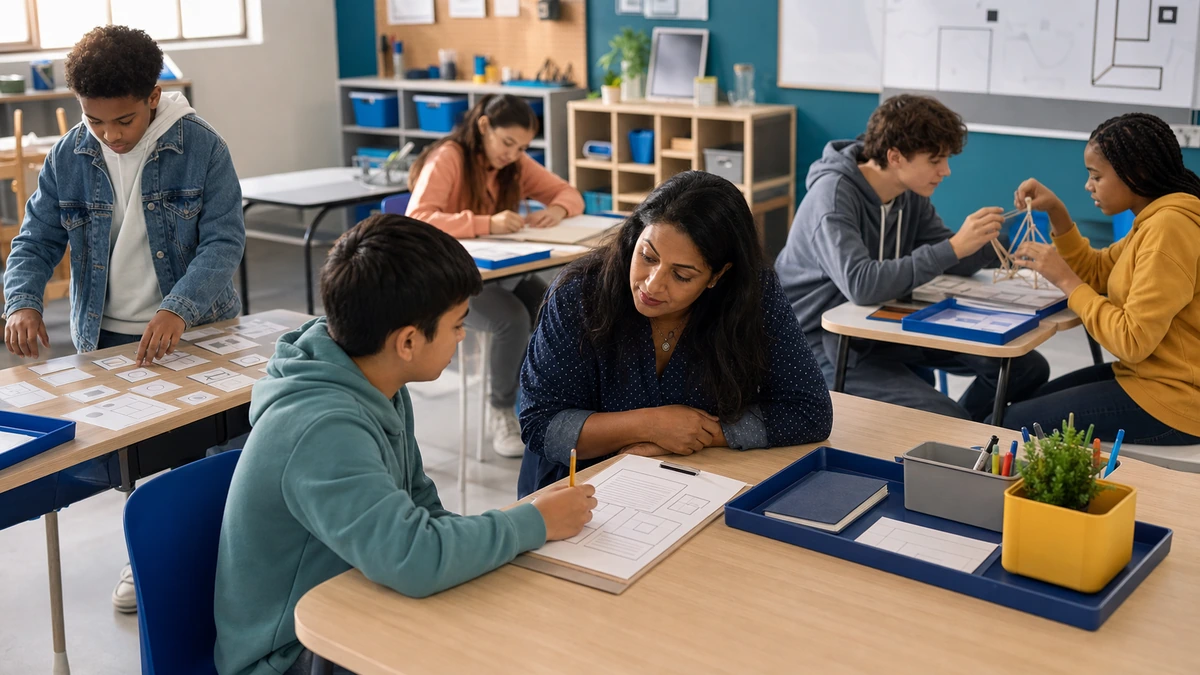
Student agency means students make consequential, understandable decisions about their learning within defined objectives and responsibilities. It may involve choosing a process, setting a short goal, explaining a decision, requesting support, using feedback, or revising work. Agency is visible in what a student is permitted and able to decide; participation style or enthusiasm is not a sufficient measure.
Agency needs neither technology, public leadership, personal disclosure, project-based learning, nor unrestricted choice. A quiet private revision decision can be as genuine as leading a group. A direct lesson can include agency when students have a meaningful decision that does not replace required teaching.
Separate teacher decisions from student decisions
| Teacher decides and protects | Students may decide | Evidence to review |
|---|---|---|
| Required objective and success criteria | Which approved example, topic, or question to use | Whether the chosen route produces evidence for the same objective |
| Essential instruction, safety rules, and policy requirements | Order of approved steps after prerequisites are complete | A plan and completed checkpoints |
| Accessible materials and required accommodations | Which equivalent support or response route to use | Access to the task and quality of resulting work |
| Assessment decision, deadlines, and minimum evidence | When to request feedback and which criterion to revise first | Student explanation, feedback request, and revision |
| Privacy and safeguarding boundaries | Whether to use a non-personal example and whether to share beyond the teacher when sharing is optional | Work that meets the objective without unnecessary disclosure |
Design a bounded choice
A useful choice changes something that matters to the learner while keeping the learning target, workload, access, and evidence comparable. Start with two or three valid routes. State why each route is valid and what would make a proposed alternative invalid.
| Choice area | Valid bounded options | Teacher keeps fixed | Invalid choice |
|---|---|---|---|
| Topic | Choose one of four teacher-checked organisms for the same adaptation explanation. | Science objective, source set, evidence requirements, and length range. | A topic with no usable evidence or one that requires unsafe or private information. |
| Process | Annotate first and then outline, or use an evidence table before drafting. | Required text analysis and final response. | Skipping analysis because a preferred process feels faster. |
| Product | Written explanation, captioned audio, or structured conference when each shows the same reasoning. | Criteria, individual evidence, and accessibility requirements. | A decorative product that does not reveal the assessed reasoning. |
| Collaboration | Work independently or with a partner during practice; submit an individual explanation. | Individual assessment evidence and assigned supports. | A group product when individual evidence is required but cannot be identified. |
| Pacing | Choose the order of two practice items and an approved feedback point. | Prerequisites, checkpoints, available class time, and due date. | Deferring all work until there is no time for feedback or support. |
When a student proposes another option, test it against four questions: Does it address the same objective? Can the student access it? Can the teacher review comparable evidence in the available time? Does it meet safety, privacy, and policy requirements? If any answer is no, explain the constraint and offer a valid alternative rather than treating refusal as a lack of agency.
Completed elementary example
| Plan element | Grade 3 reading example |
|---|---|
| Objective | Explain a character’s response to one event using two details from the assigned story. |
| Teacher decisions | Story, mini-lesson, two-detail requirement, evidence sentence frames, conference schedule, and Friday due date. |
| Student decisions | Choose one of three events; use a written paragraph, teacher-scribed conference, or captioned audio; choose whether to use the evidence table. |
| Invalid choices | Retelling the whole story without explaining a response; choosing another book before its evidence has been checked; replacing text evidence with a personal story. |
| Checkpoints | Tuesday: event selected and first detail marked. Wednesday: explanation rehearsed. Thursday: student names one criterion for feedback. |
| Access and work review | Confirm the story and prompts work with required reading and communication supports. Compare whether each response route shows the character response and two details; review routes separately if one adds avoidable difficulty. |
Completed secondary example
| Plan element | Grade 10 environmental science example |
|---|---|
| Objective | Evaluate a local water-use proposal using the supplied data, identify one limitation, and justify a recommendation. |
| Teacher decisions | Approved data packet, source lesson, reasoning criteria, individual recommendation, privacy rules, checkpoints, and final deadline. |
| Student decisions | Choose one of three proposals; begin with the cost, consumption, or ecological data table; request feedback on evidence, limitations, or reasoning; submit a memo or recorded briefing with transcript. |
| Invalid choices | Using unverified social-media figures, contacting members of the public, omitting the required limitation, or submitting only a group product. |
| Checkpoints | Day 2: proposal and relevant data identified. Day 4: claim-evidence outline. Day 6: feedback conference. Day 8: revision note and final response. |
| Access and work review | Provide readable data tables, definitions, and equivalent response routes. Check whether route choice changes time burden or makes a criterion harder to demonstrate; adjust materials without changing the reasoning target. |
Use checkpoints without taking the decision back
At each checkpoint, ask the student to name the decision made, show current evidence, and identify the next step. Intervene when the route is invalid, a prerequisite is missing, the student cannot access the option, or the timeline no longer allows completion. When possible, preserve the student’s decision by narrowing the next step or adding a support instead of replacing the plan.
| Checkpoint question | If the plan is workable | If the plan is not workable |
|---|---|---|
| What did you choose, and why? | Ask the student to connect the choice to the objective. | Restate the boundaries and invite a valid choice. |
| What evidence do you have? | Confirm the next evidence-producing step. | Model the missing prerequisite or reduce the step size. |
| What support would help? | Provide an available support selected by the student. | Offer two specific supports and make sure required accommodations are in place. |
| What will you revise by the next check? | Record the student’s chosen criterion and time. | Set a near checkpoint and define the minimum viable revision. |
Copyable goal and reflection form
Learning objective and non-negotiable evidence:

My valid choices are:
My choice:
Why this route fits the objective:

My short goal before the next checkpoint:
The evidence I will bring:
Support or resource I will use:
Checkpoint date or lesson:

After the checkpoint
What I completed:
Evidence that meets a criterion:
Feedback I received:
What I will revise or do next:
One decision I would keep or change, and why:
Teacher follow-up or support:Student self-assessment
Use self-assessment to elicit evidence, not a personality rating. Students can mark not yet, with support, or independently in this task, then cite a feature of their work.
| Statement | Evidence I can point to | Next decision or support |
|---|---|---|
| I selected a valid route and can explain how it addresses the objective. | Choice record or explanation | Keep, narrow, or change the route |
| I used a checkpoint before the deadline. | Draft, note, conference record, or question | Choose the next checkpoint |
| I requested or used a relevant support. | Named support and where it helped | Continue, change, or remove the support |
| I revised a specific feature using criteria or feedback. | Before-and-after feature | Name the next criterion |
| I can identify one decision the teacher still needed to make. | Objective, access, safety, assessment, or timeline example | Ask for clarification if the boundary is unclear |
Review access and work before expanding choice
After the task, compare option use, completion at checkpoints, help requests, and work against the same criteria. Look for students who could not use an option, routes that added reading, language, motor, technology, public-speaking, or time demands unrelated to the objective, and required accommodations that were not available in practice. Student comments can identify barriers, but inspect the materials and work as well.
Retain a choice when students could understand and use it and when the resulting evidence addressed the objective. Revise or remove an option that repeatedly produces inaccessible conditions, hidden workload, or evidence that cannot be scored against the criteria. Findings apply to the particular task and conditions; they do not establish a fixed agency level for a student.
Classroom resources for this teaching goal
- Objective-to-Assessment Alignment Pack — Use the blank planner and fictional worked alignments to check whether a task elicits the objective and produces evidence recognized by its criterion.
- Choose, Test & Improve a Thermal Protector — For Grade 6 design reasoning, evaluate every criterion, propose an improvement and reconsider it against supplied fictional results. Data analysis does not establish physical construction or testing.
Sources
- OECD, Learning Compass 2030: student agency and co-agency as educational concepts.
- CAST, Universal Design for Learning Guidelines: choices, access, action, expression, and support.
- National Research Council, Education for Life and Work: evidence and limits concerning transferable competencies.
Tools in this guide: Plan student choices with focused examples, decision rules, checkpoints, and copyable goal, reflection, and self-assessment tools.