
Subject-Specific Teaching
Tone Anchor Chart: Quick Reference and Creation Guide
Also in: Ready-to-Use Lesson Ideas
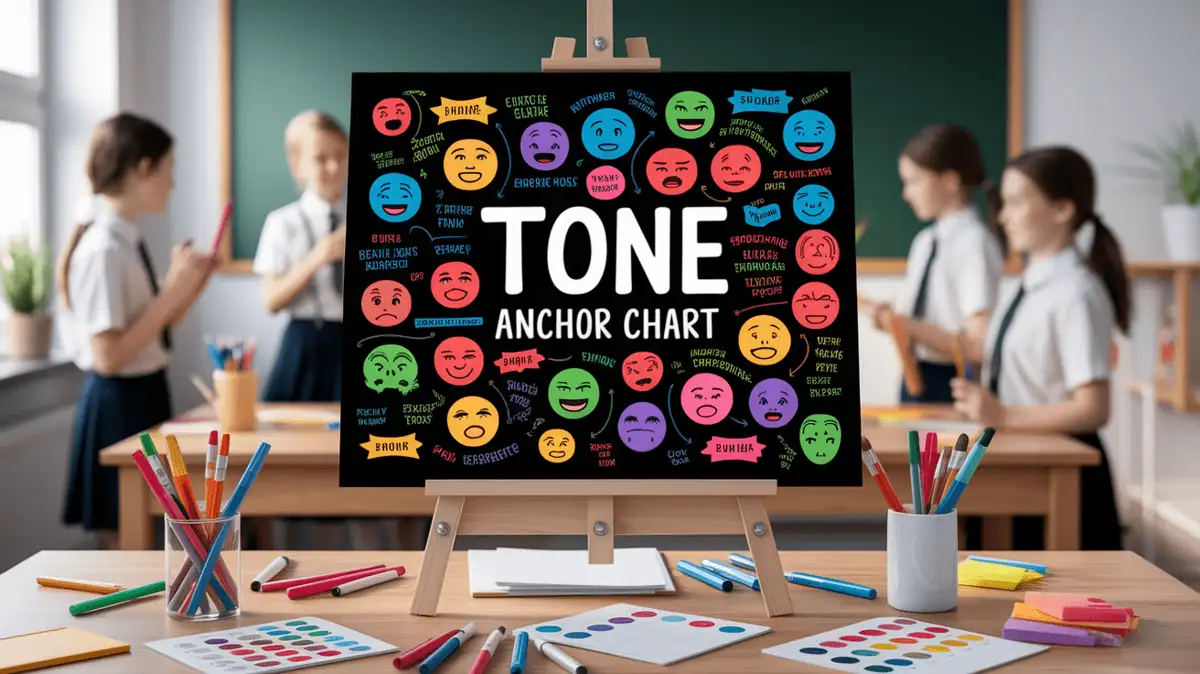
Setting the Scene with a Tone Anchor Chart
A tone anchor chart is a visible reference for definitions, possible tone words, and text-evidence prompts during text analysis. Its usefulness depends on how students apply the prompts to a particular passage.
A tone anchor chart defines tone, supplies selected examples, distinguishes tone from mood, and lists textual clues students can test against a passage. Assess literary analysis from the student’s cited evidence and explanation rather than from the chart’s presence.
Components of a Tone Anchor Chart
Include only the chart elements needed for the current tone-identification task. Model how a reader cites words, syntax, imagery, or context to support a tone interpretation; the chart itself does not improve comprehension or tone identification.
- Clear definition of tone – A short, student-friendly explanation of the author’s attitude in writing.
- Tone words list – Group words into categories such as positive, negative, and neutral to make them easier to find and compare.
- Examples from literature – Short excerpts with identified tones to help students see tone in action.
- Mood comparison section – A quick reference to remind students how mood affects the reader, while tone reflects the author.
- Clues for identification – Tips on spotting tone through diction, syntax, and imagery.
- Visual aids – Use icons or color coding only when they clarify tone categories; provide text labels and sufficient contrast, and avoid decorative fonts that reduce readability.
Together, these elements provide a reference for reading instruction. Use a separate student response to assess the intended literary analysis; the chart itself does not establish broader skill growth.
Step-by-Step Creation Process
Build a printable tone anchor chart for the classroom through the following steps:
- Introduce tone: Begin with a class discussion about what tone is and how it differs from mood. Use a tone-versus-mood chart as a starter visual.
- Brainstorm tone words: Create a collaborative tone words list with your students. Categorize them into positive, negative, and neutral tones.
- Give examples: Provide short passages and model how to analyze diction, sentence structure, and imagery to determine tone.
- Design your chart: Use headings, sections, and color coding. Include a tone graphic organizer or symbols that make terms easy to locate.
- Display it: Place the chart where students can refer to it easily during literature study.
Implementing Your Tone Anchor Chart in the Classroom
Use the chart during reading tasks by connecting tone labels to reading strategies and evidence in the text. Ask students to:
- Glance at the chart for possible tone words they might use.
- Compare their guess at the author’s tone with the tone word categories on the display.
- Discuss with peers how they identified tone, citing text evidence.
- Use the tone anchor chart alongside related tools like a point of view chart or mood chart for more nuanced analysis.
In whole-class teaching, small groups, or individual work, use a classroom poster as a prompt, then assess whether students use it to explain literary elements with evidence.
Maintaining and Adapting Your Chart
Review and update a tone anchor chart when new texts, terms, or student responses show that a revision is needed. Possible maintenance steps include:
- Adding new tone words students encounter in reading.
- Highlighting class “tone words of the week.”
- Swapping in fresh examples from current texts being studied.
- Encouraging students to contribute their own literary finds.
- Adapting examples to the current season or theme.
Revise the chart when new examples or distinctions arise, and refer to it during tone practice and related reading tasks. Review whether students use the chart accurately rather than assuming continued display makes it useful.
Review the tone evidence
A tone anchor chart can prompt students to consult definitions, examples, and vocabulary while analyzing a passage. Adapt it to the text and learners, then use students’ tone identification explanations to determine whether the chart is helping.
Worked example: add “restrained” to the chart
Inputs: Students analyze the teacher-created sentence, “Mara folded the rejection letter, placed it beneath the ledger, and returned to the next customer.” Candidate tone words are angry, restrained, cheerful, and panicked.
Steps: Students underline the controlled verbs, compare each word’s definition, and contrast the absence of an outburst with evidence that would support angry or panicked.
Decision: Treat restrained as one plausible description of the narration: it reports a sequence of actions without an explicit emotional judgment. Mara’s behavior is character evidence, not direct proof of the narrator’s tone. The rejection context does not rule out a positive or ironic reading; accept a different label when the student supports it from the wording and available context.
Response: The chart entry reads “restrained—controlled rather than openly expressed,” cites the three verbs, and lists uncontrolled as a contrast. On the next passage, students must cite new evidence instead of reusing the label automatically.
Build a tone chart from evidence
Use four columns: tone word, words or details from the passage, what those details suggest, and the author’s attitude. For example, students can record a tone word, quote a phrase, and explain how its wording supports their interpretation.
Check the interpretation
Have students compare their explanation with the passage’s syntax, imagery, and context. If those details point to a different attitude, revise the tone word and explain why.