
Subject-Specific Teaching
Phonological Awareness Activities: Sound Games for Early Learners
Also in: Ready-to-Use Lesson Ideas
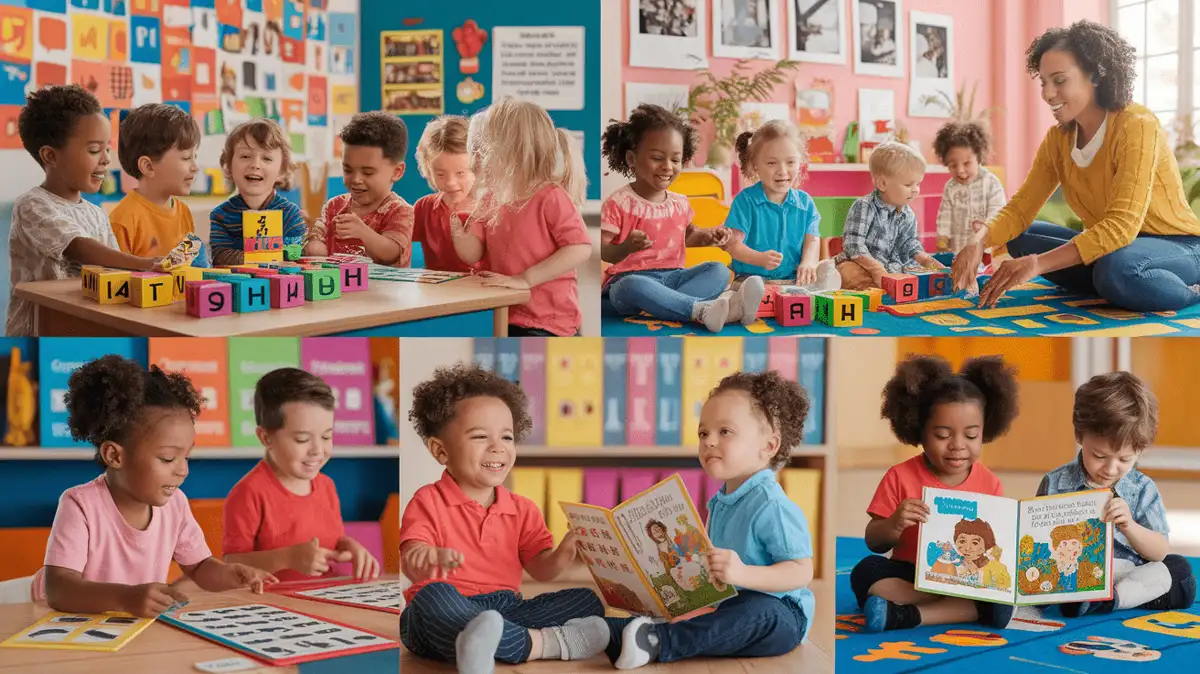
Keep phonological awareness distinct from phonics
Phonological awareness concerns the sound structure of spoken language, from words and syllables to onset–rime and individual phonemes. Phonics connects sounds with written symbols. An oral activity can prepare students to attend to sounds, but completion of that activity does not establish a later reading outcome.
The Institute of Education Sciences foundational-skills practice guide recommends teaching students to recognize and manipulate sound segments and connect that work with letter knowledge. Use screening results, classroom responses, curriculum requirements, and specialist guidance to select the next task. Do not assume every learner needs the same sequence or duration.
Select the sound action and response
On a small screen, scroll this table horizontally to see all columns.
| Sound level | Teacher prompt | Observable response | Adjustment |
|---|---|---|---|
| Words in a sentence | “Say: Birds can fly. Move one counter for each word.” | Three counters, one per spoken word. | Repeat more slowly without changing the sentence. |
| Rhyme | “Do map and cap end with the same sound pattern?” | Yes/no plus the shared ending. | Contrast with a non-rhyming pair. |
| Syllable | “Say sunset. Move a counter for each spoken part.” | Two counters for sun-set. | Model the first word and try a parallel word. |
| Onset–rime | “Blend /m/ and /ap/.” | Map. | Shorten the pause between parts. |
| Phoneme | “Say mat without /m/.” | At. | Return to phoneme identification or blending. |
Use a short model–practice–check routine
- Name the action: “We will blend two spoken parts into one word.”
- Model one example: Say /s/ and /un/, shorten the pause, and say sun.
- Practice together: Use two examples with the same response demand.
- Check individually: Ask for one spoken, pointed, selected, or assistive-communication response from each learner.
- Record narrowly: Note the word, action, prompt level, and response.
- Decide: Repeat with a clearer contrast, change the sound level, connect to letters when appropriate, or seek additional guidance.
Worked example: phoneme blending
Objective: Blend three isolated phonemes into a spoken word. Model /m/ /a/ /p/ and map. Practice /s/ /a/ /t/ together. Then check /f/ /i/ /sh/ individually. Record whether the learner blended independently, after the sounds were repeated with shorter pauses, or not yet.
That record describes performance on the selected words under stated conditions. It should not be converted into a diagnosis or a general conclusion about reading ability.
Plan for language, speech, and access differences
- Use words the learner knows and pronounce them accurately in the language variety being used.
- Do not treat a home-language or dialect difference as an error merely because it differs from the teacher’s pronunciation.
- When necessary, separate hearing and sound-manipulation goals from speech-production demands. A learner may point, select, or use assistive communication.
- Provide required accommodations and consult the student’s plan and appropriate specialists.
- If responses raise a sustained concern about hearing, speech, language, or literacy, document the instructional evidence and follow the school’s screening or referral process rather than diagnosing.
Planning checklist
- Is one sound action named?
- Are examples familiar, pronounceable, and controlled for difficulty?
- Can every learner make an accessible response?
- Will prompt level and response be recorded?
- Is the next instructional decision defined?
- Are language difference, speech production, and diagnosis kept separate?