
Educational Technology and AI
Hybrid Lesson Planning: Access, Interaction, and Backup Routes
Also in: Lesson Planning Fundamentals
Hybrid-lesson action sequence
- Write the learning objective and the evidence every student must produce.
- Assign each lesson segment to a mode only when that mode serves a stated instructional or access purpose.
- Map directions, materials, interaction, timing, teacher support, and an equivalent route across locations.
- Test links, permissions, accessibility, devices, and the no-network backup before the lesson.
- Review evidence and participation by route, along with technology failures and workload, before repeating the design.
Worked example: compare geometric reasoning across modes
Hypothetical example: Students must justify whether two figures are similar. In-person students annotate printed figures with a partner; remote students annotate the same figures in an approved shared file or on paper submitted through the established route. All students then complete the same individual explanation. If the shared file fails, the teacher displays numbered figures and accepts the paper response.
The teacher reviews the individual justifications against the same criterion, then notes missing evidence, delayed access, partner participation, audio or file problems, and added setup time by route. If remote students could view but not annotate, the task is revised before interpreting participation. Attendance or login data is not treated as evidence of geometric reasoning.
Copyable hybrid-lesson review
Learning objective:
Required individual evidence:
In-person segments and purpose:
Online segments and purpose:
Equivalent participation routes:
Directions and teacher support:
No-network backup:
Evidence and access by route:
Keep, revise, or simplify:
Define the hybrid-learning purpose
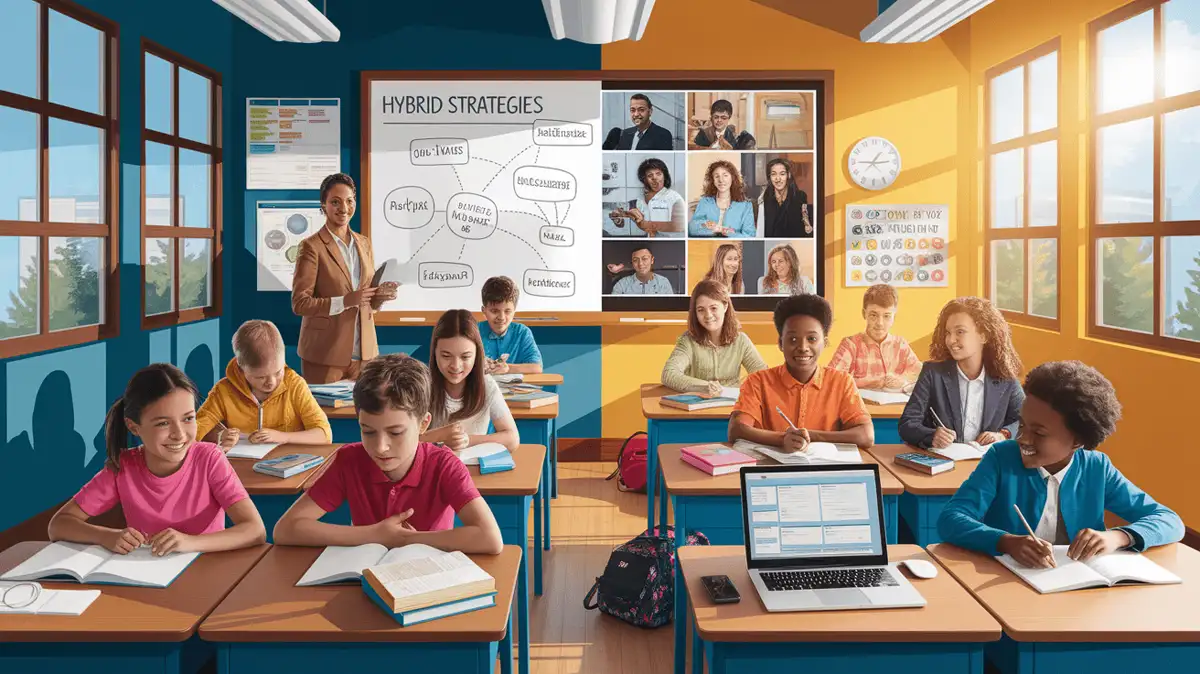
Hybrid learning combines in-person and online components. Define which objective, activity, or access need each mode serves instead of promising that the experience will be smooth or engaging.
Hybrid delivery may offer useful timing, participation, or resource options, but it can also add technology, privacy, accessibility, and coordination burdens. Compare it with a fully in-person or fully remote route for the stated objective and class context.
Balancing Online and In-Person Elements
Decide where each activity is most feasible and instructionally useful. The Ohio State hybrid-learning guidance offers examples, but readings, videos, and checks are not automatically suited to online delivery. Asynchronous work also does not guarantee self-paced understanding.
Use real-time, in-person work when the objective requires supervised equipment, immediate modeling, or interaction that cannot be provided equivalently online. Before staggering attendance, confirm schedule authority, access, staffing, and how absent students will receive equivalent instruction and evidence routes.
- Use online modules for theory and background readings when they fit the objective and access requirements.
- Choose either mode for active or collaborative work when it meets the objective, participation, access, and evidence requirements; physical co-location is not the criterion.
- For each digital resource, name the objective, transition, access requirements, privacy approval, and non-digital fallback.
Designing Cohesive Hybrid Lessons
Map one objective and evidence route across both modes, and state how work completed in one mode prepares for the next. Do not rely on a commercial vendor guide as evidence that a particular design preserves learning flow.
For example, students might review approved material, complete a short check, and then apply the concept in a supervised lab. Use school-approved collaboration or discussion tools only after checking privacy, accessibility, account, and non-digital-alternative requirements.
- Set a clear, measurable goal for each lesson.
- Map each objective to online or in-person work based on instructional fit and access.
- Use technology only when it supports an instructional objective, an access need, or a transition between learning spaces.
Assessing Student Participation and Progress
Assessments should measure the same objective through routes that are comparably accessible and valid. When an in-person experiment cannot be reproduced remotely, define what evidence the alternative must produce and check local curriculum, safety, and accommodation requirements.
Use formative and summative evidence that matches the objective. Do not treat login, poll, or discussion-log counts as learning or collect participation data without a stated purpose, approved system, access review, retention rule, and alternative route.
- Online: Auto-graded quizzes, discussion board contributions, formative polls.
- In-person: Group presentations, hands-on demonstrations, collaborative problem-solving tasks.
- Hybrid: Portfolio projects combining work from both environments.
Bridging the Divide: Your Next Steps
Start with one course segment and compare access, work quality, pacing, and burden across modes. Use student feedback as one source of evidence, and follow local approval requirements before changing technology or delivery.
Adjust the balance of online and in-person work for each group based on the objective, access, evidence, and burden. No single rhythm or technology choice is best for every hybrid classroom.
Classroom resources for this teaching goal
- Clear Directions and Language-Support Pack — For the direction-and-response part of a hybrid lesson, use the planner with the actual task, materials and locally tested delivery routes.
Tools in this guide: Plan across learning modes with a sequence, a focused hybrid lesson example, and a copyable access review.