
Classroom Management and Routines
Collaborative Classroom Culture: Norms, Roles, Accountability, and Reflection
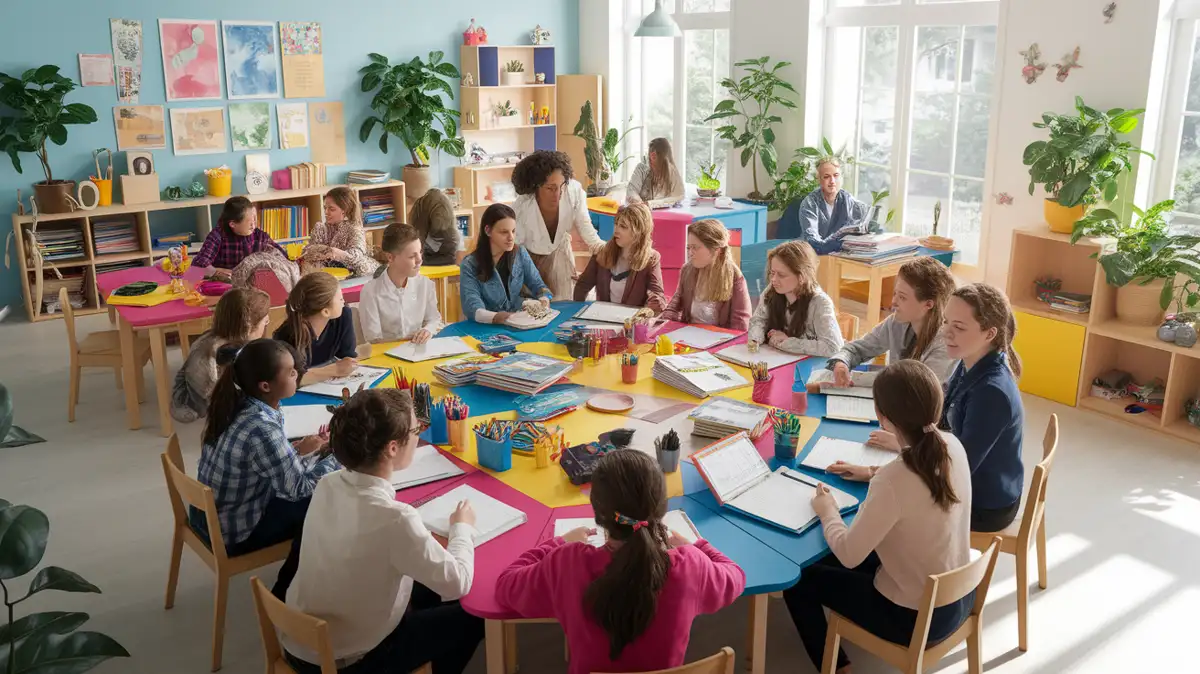
What Structured Collaboration Can Support
Structured group work can give students practice in explaining ideas, sharing responsibility, and responding to peers. The National Education Association overview describes potential benefits, but results depend on the task, roles, individual accountability, access, and feedback.
Collaborative structures also change teacher planning, observation, and feedback responsibilities. They may create opportunities for colleagues to exchange ideas, but they do not by themselves reduce isolation, improve job satisfaction, or create community.
Key Elements of a Collaborative Classroom
Do not form groups without a defined task, roles, access plan, and way to check individual understanding. Plan each structure deliberately:
Clear Structures and Expectations
Group work benefits from clear protocols, shared dependencies that fit the task, and individual accountability. Describe participation expectations without labeling students as hitchhikers.
Safe and Supportive Environment
Teach how students can disagree with an idea, request a pause, report a problem privately, and re-enter the task. Intervene when comments, exclusion, or pressure make participation unsafe; a norm poster is not evidence that students can use these routes.
Reimagined Teacher Role
The teacher’s role varies by task and may include direct instruction, modeling, observation, feedback, or intervention. The Digital Promise resource offers one approach to designing tasks and facilitating discussions; it does not require replacing instruction with a single guide-on-the-side role.
Thoughtful Assessment Practices
Separate the quality of the group product from each student’s evidence of the learning target. Use a brief individual response, observation note, or conference, and tell students in advance how collaboration and subject knowledge will be evaluated.
Inclusivity by Design
Plan collaborative work for access from the start, then review participation rather than assuming the structure serves every student. The Inclusive Schools Network overview describes possible approaches. Provide required accommodations, multiple contribution modes, and individual checks; collaboration alone does not amplify every voice or build cross-cultural competence.
Strategies for Building Collaboration
Choose the smallest structure that genuinely helps students meet the objective. Teach one routine at a time, observe it in use, and expand the task only after students can use the routine with reasonable independence.
Start Small and Scale Up
Begin with a two-minute pair exchange in which one student explains and the other asks a specified question, then switch roles. Collect one response from each student before moving to longer group work.
Jigsaw Routines
Use a jigsaw only when dividing information serves the objective. Give expert groups a verification checkpoint and ensure each student can access the full content afterward; do not make one student solely responsible for essential instruction.
Rotating Group Roles
Define roles as observable actions, such as summarizing a claim, locating evidence, checking criteria, or recording a question. Rotate roles within or across tasks, and provide another valid contribution route when speaking, writing, movement, or tool use creates a barrier.
Project-Based Learning
Projects can create a reason to coordinate when the task genuinely requires distinct contributions. Define roles, dependencies, individual evidence, and checkpoints rather than assuming that an authentic or real-world context creates collaboration.
Digital Collaboration Tools
Shared documents, virtual whiteboards, and discussion platforms can support some group tasks. Use only school-approved tools that protect student data, meet accessibility requirements, and provide an equivalent non-digital route. Do not assume students described as quiet will find a digital channel easier.
Evaluate Process and Product
Review the product against the learning criteria and the process against a small set of observable behaviors. A polished group product can conceal weak individual understanding, while a difficult discussion can still produce useful individual reasoning.
Overcoming Challenges
Common challenges and possible responses include:
The Participation Imbalance
Pause and name the task action that is missing rather than assigning a motive. Shorten turns, rotate a defined role, ask each student to record an idea before discussion, and use an individual check to see whether the structure—not the student—needs to change.
Preference for Individual Work
Some students may prefer individual work or be concerned about control, pace, grading, access, or peer dynamics. Explain the purpose of the group task, make contributions observable, provide required accommodations, and check individual learning. Do not label students by achievement level or assume multiple perspectives always improve the result.
Fair-Grading Concerns
Some students and families may question how collaborative work is graded. Publish criteria that distinguish individual evidence from any group outcome, explain how missing or inaccessible participation will be handled, and provide a route to raise concerns.
Social Dynamics and Conflicts
Do not group students by inferred ability, friendship, identity, or social status on the assumption that mixing such categories produces better results. Use criteria tied to the task, monitor interactions, and regroup when access, safety, or learning requires it. The linked school leadership resource discusses conflict-resolution instruction, but brief lessons do not guarantee year-long effects.
Access and Participation Barriers
The Inclusive Schools Network resource describes possible supports, but teachers should not infer needs from disability, language background, or a broad learning-differences label. Implement required accommodations and consider role cards, visual cues, sentence starters, vocabulary support, or another contribution mode when appropriate; then check whether the student can access the task and show individual understanding.
Reviewing Collaborative Practice
Collaborative work can provide practice with communication, problem-solving, and comparing perspectives, but future workplaces vary and classroom group work does not guarantee career readiness. Judge the routine by the stated learning goal and the evidence collected.
Treat collaboration as a routine to test and revise, not as a force that transforms academic outcomes or classroom community. Keep a structure only when group participation and individual evidence support its use.
Teach one collaboration routine, assign observable roles, and check both group participation and individual understanding before deciding whether to keep or revise it.
Worked example: structure a source-comparison task
Hypothetical example: Students must compare the claims and evidence in three short sources, and every student must produce an individual comparison. The teacher considers three structures before choosing one.
| Structure | Useful when | Risk to check | Individual evidence |
|---|---|---|---|
| Pair comparison | Each student can access all sources and benefits from rehearsing a claim with one peer. | One partner may do the recording or explanation. | Each student completes a comparison row and exit response. |
| Jigsaw | Distinct source expertise is necessary and there is time to verify what each group teaches. | An absence, access barrier, or misunderstanding can leave peers without essential content. | Each student checks all three sources after the expert exchange. |
| Team synthesis | The task requires several ideas to be tested against shared criteria. | Roles can become status labels or hide uneven participation. | Roles rotate, and every student submits a claim with cited evidence. |
Because the objective requires every student to compare all three sources, the teacher chooses pair comparison, gives both students the full source set, switches the explainer and evidence-checker roles after each source, and collects an individual exit response. If the exit responses show that students repeated a partner’s claim without checking evidence, the next lesson returns to individual source annotation before another paired comparison.
Copyable collaboration decision record
Learning objective:
Why collaboration is needed:
Structure selected:
Role or turn-taking routine:
Access and non-speaking participation route:
Group evidence:
Individual evidence:
What the teacher will observe:
Retain, revise, regroup, or stop when:
Classroom resources for this teaching goal
- Participate in an Evidence-Based Discussion — For Grade 6 discussion, use the supplied paired texts and participation options to assess evidence, reasoning and a fair response, rather than speaking frequency.
- Teach and Reteach Classroom Routines — Plan one routine with a clear cue, observable steps, modeling, rehearsal and a reteach check. Adapt the card to established local procedures.
Tools in this guide: Choose a collaboration structure with practical guidance, a worked choice, and a copyable collaboration plan.