Compare Rate and Output

Read the graph and keep two questions separate

These supplied continuous linear models give total water for 0 to 6 minutes. The graph points are also listed so you can read the quantities without relying on color.
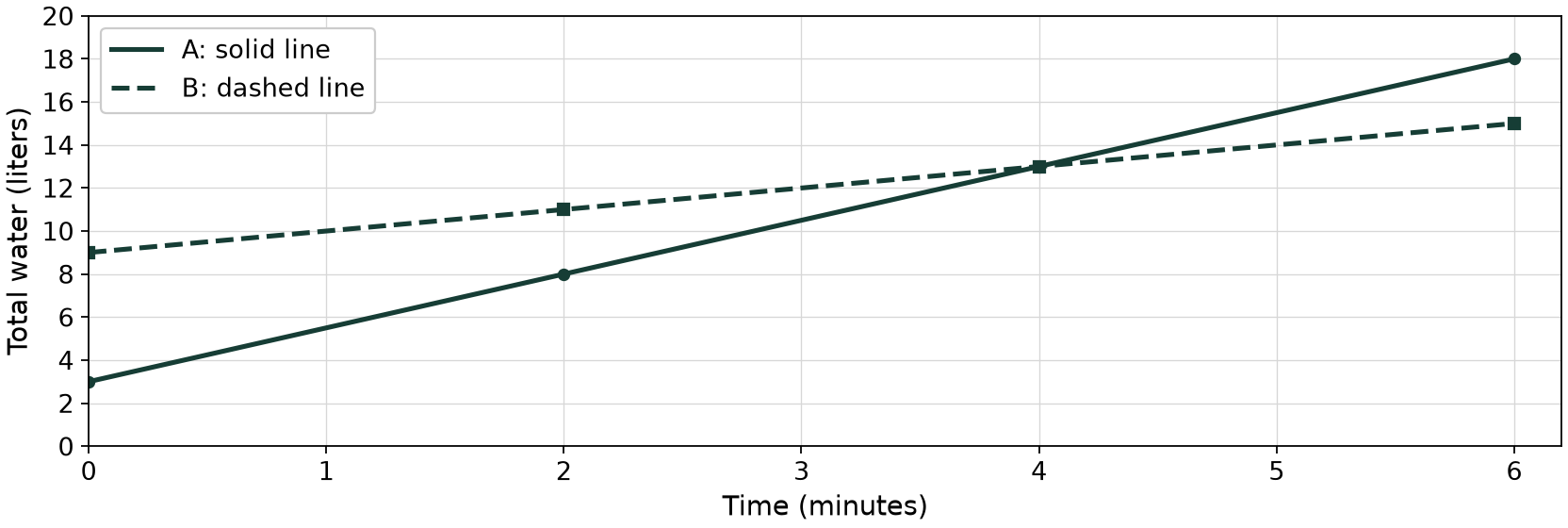
Two line segments over 0 to 6 minutes. A is solid through (0,3), (2,8), (4,13), (6,18). B is dashed through (0,9), (2,11), (4,13), (6,15). Both use total liters versus minutes.
Time (minutes)A total (liters)B total (liters)
039
2811
41313
61815

1 Guided comparison

Use A’s points at 2 and 6 minutes to calculate its rate and recover its initial value. B begins with 9 liters and gains 1 liter per minute. Write both rules. Which has the greater rate? Which has greater total at 0, 2 and 6 minutes?

Your calculations and comparisons

1

Compare Rate and Output

Find when the comparison changes

The rules for the graph are A = 2.5t + 3 and B = t + 9. Equality requires 2.5t + 3 = t + 9. Remove t from each side, then 3 from each side: 1.5t = 6. Thus t = 4 minutes, and each total is 13 liters. Before 4 minutes B has more; after 4 A has more, within the stated 0-to-6-minute domain.

A larger change rate describes how output changes as input changes. Greater output is a comparison at a particular common input. Initial values also affect that output. Outside the supplied domain, an extended expression is a conditional prediction, not a guaranteed reading.

2 Your comparison

For 0 to 8 minutes, supplied linear model C begins with 2 liters and gains 2 liters per minute. Model D is given by a table below. Find D’s rate and initial value, write both rules, and find when totals are equal. State which has more before and after that time, within the domain.

Time (minutes)D total (liters)
18
310
613

Rules, equality and qualified comparison

2

Compare Rate and Output

What two recorded points can establish

3 Two observations and a proposed rule

A record gives (1, 6) and (3, 12), in minutes and liters, but supplies no full model. One possible process is 3t + 3 liters throughout 0 to 6 minutes. Another is 3t + 3 through minute 3, then t + 9 after minute 3 through minute 6.

Check that both possibilities fit both observations. What does each give at five minutes? If a full linear model over 0 to 6 were explicitly assumed, which expression would those two points determine? Does the record alone establish that assumption?

What follows, what is conditional, and why

Two distinct points determine a line under a linear assumption. They do not by themselves establish that every later physical reading belongs to that line.

4 Equal rates, different starts

On 0 to 6 minutes, E = 2t + 5 and F = 2t + 1 give total liters. Do they ever have equal totals? Explain how equal rates affect the difference between their outputs.

Your equal-rate comparison

3