Equal Groups, Comparisons and Shares

Lesson 1: Which Group Role Is Unknown?

There are 12 counters. They are arranged in 3 equal groups of 4 counters.
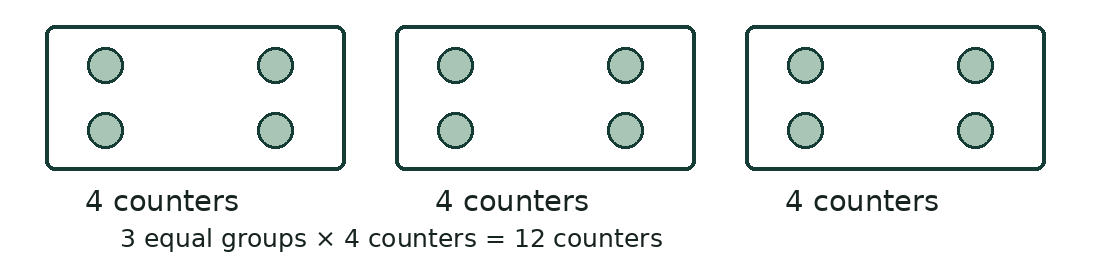
Three outlined groups, each containing four counters: 3 groups times 4 counters in each group equals 12 counters.

Name the roles

Number of groups × size of each group = total. Here: 3 groups × 4 counters in each group = 12 counters.

Two different division questions

If 3 equal groups are given, 12 ÷ 3 = 4 finds counters in each group. If groups of 4 counters are given, 12 ÷ 4 = 3 finds the number of groups. Both use the same total, but the unknown role differs.

Label the total and the given role first. Draw equal groups, find the missing role, and check by multiplication. Equal groups have the same size.
1

Equal Groups, Comparisons and Shares

Try It: Groups of Counters and Beads

Show group roles with a drawing, words or labeled equations.

1. There are 20 counters in 4 equal groups. Draw or explain the groups. Find the size of each group and label a multiplication equation.

2. Another set of 20 counters is put in groups of 5 counters. How many groups are there? Explain what the answer counts, and compare it with question 1.

3. Five bags each contain 4 beads. Someone writes 5 + 4 = 9 beads in all. Explain the error and show the total.

2

Equal Groups, Comparisons and Shares

Lesson 2: Times as Long or Longer By?

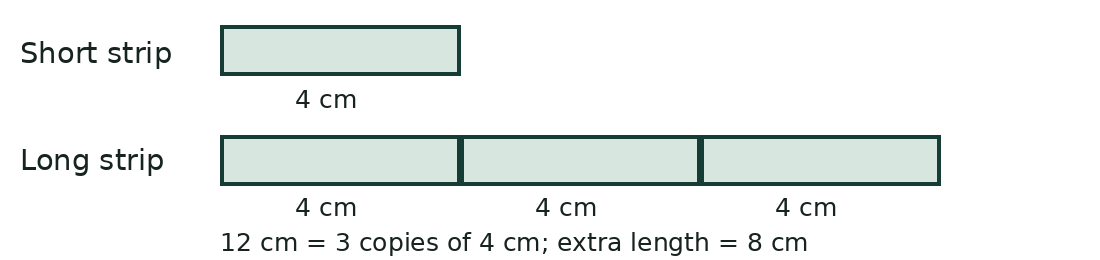
A short strip is 4 cm long. A long strip is 12 cm long. Both lengths use the same unit.

A 4 cm strip above a 12 cm strip split into three 4 cm copies. The 12 cm strip is 3 times as long and 8 cm longer than the 4 cm strip.

Count copies of the shorter length

Three copies of 4 cm make 12 cm: 3 × 4 cm = 12 cm. The long strip is 3 times as long as the short strip. The 4 cm strip is the comparison baseline.

Find the extra length

The extra length is 12 cm − 4 cm = 8 cm. The long strip is 8 cm longer. “Times as long” counts copies; “longer by” describes a difference in centimeters.

Name the baseline and use the same unit. An equation can be read with either factor first, but explain what each number represents.

3

Equal Groups, Comparisons and Shares

Try It: Two Ways to Compare

Use copies for “times as long” and a difference for “centimeters longer.”

1. One strip is 5 cm long; another is 15 cm long. How many times as long is the longer strip? How many centimeters longer is it? Show the difference between the two comparisons.

2. A strip is 4 times as long as a 3 cm strip. Find its length and explain what the 4 means.

3. A 6 cm strip is compared with an 18 cm strip. Jo says “18 is 12 more, so the long strip is 12 times as long.” Explain which part is correct and repair the other part.

4

Equal Groups, Comparisons and Shares

Lesson 3: Equal Shares Can Be Fractions

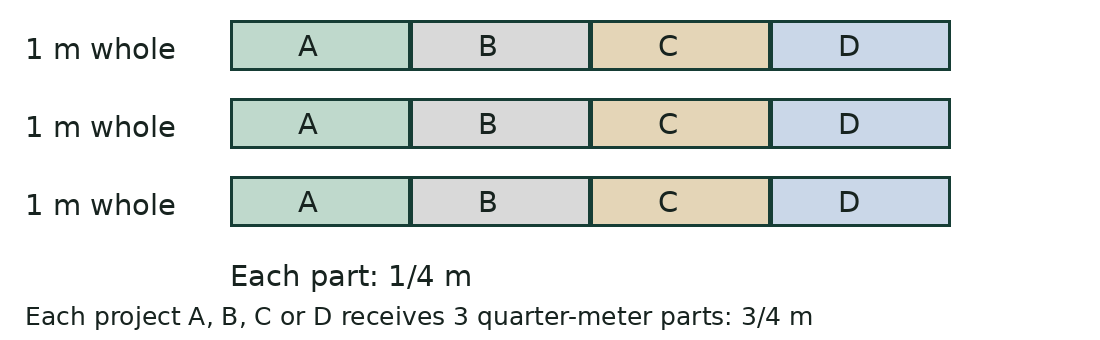
A 3 m ribbon is shared equally among 4 projects. Ribbon may be cut; no length is lost in this mathematical model.

Three separate 1 m bars, each split into four equal quarter-meter parts. Each project receives one quarter-meter from every bar: three quarters of a meter in all.

Keep the whole unit fixed

Each bar is 1 m. Split each meter into 4 equal parts: each part is 1/4 m. Give each project one part from each of the 3 meters. Each project receives 3 parts of 1/4 m, or 3/4 m.

Connect the model to division

3 m shared equally among 4 projects gives 3 ÷ 4 = 3/4, so each share is 3/4 m. Four such shares use all 3 m. The denominator counts equal parts of ONE meter; the numerator counts how many of those parts are in a share.

For a whole-number amount a of a fixed unit shared equally among b groups, with b greater than zero, each share is a/b of that unit. The context must allow dividing the amount. Keep the unit and equal parts visible.

5

Equal Groups, Comparisons and Shares

Try It: Measured Shares

Lengths and water volumes can be partitioned in these supplied mathematical situations. Use the stated unit, and show equal shares.

1. A 2 m ribbon is shared equally among 3 projects and may be cut. Draw the equal shares and find the length for each project. Label what counts as 1 whole meter.

2. A container holds 5 L of water. Four equal portions are poured. Find the volume of each portion. Explain how four portions use all 5 L.

3. A 1 m strip is marked into two parts, 1/4 m and 3/4 m. Can the parts both be called one half of a meter? Explain.

6